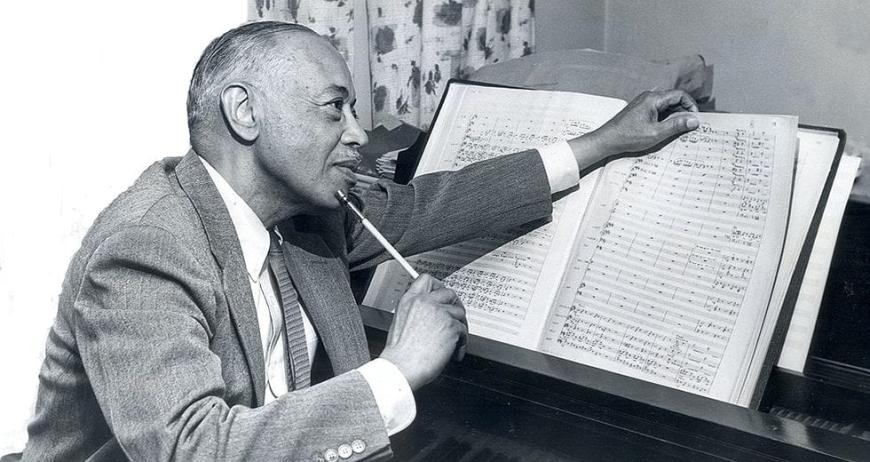
Portrait of Florence Price / photo by Geroge Nelidoff, unknown date. Wikimedia Commons
The Rodman Wanamaker Foundation sponsored at least five contests in “musical competition for members of the Negro race.” Florence Price submitted two orchestral works and two piano pieces to the fifth of these (1932). Her Piano Sonata in E-minor and Symphony in E minor won the top prizes. The other works both received honorable mention: Fantasie nègre No. 4 in B minor in the piano competition and Ethiopia’s Shadow in America in the orchestral competition.
News of her triumph spread nationwide. Frederick Stock, music director of the Chicago Symphony Orchestra, took notice of it and decided to perform the symphony at the 1933 Chicago World’s Fair on June 15, 1933. She therefore became the first Negro woman to have a composition performed by a major American orchestra.
[Why do I write Negro instead of black or African American? The term “black” became current only in the 1960s, after Price’s death. Many of her contemporaries, including William Grant Still, objected to being called black. “African American” came even later. Both terms are therefore anachronistic in describing Price’s life and times.]
Childhood
Florence Beatrice Smith Price, born April 9, 1887, in Little Rock, Arkansas, was the youngest of the three children of James H. and Florence Irene Smith. Her father was one of the few Negro dentists in the entire country. Her mother taught elementary school and had some private piano students, including Florence Beatrice. The young girl gave her first public performance at age four.
Both of her parents were of mixed ethnicity. Dr. Smith had Negro, Indian, and English ancestry while Mrs. Smith had a French, Indian, and Spanish background. Legally, none of that mattered. Dr. Smith and his family were considered Negro.
The Smith family belonged to what W.E.B. Du Bois called the Talented Tenth, a minority of the Negro population who by education and employment had privileges and prospects not shared by most of the race. He called on that class “to be leaders of thought among their people.” As an adult, Price stepped into that role without hesitation.
Among the Smith family’s friends were Thomas Shepperson, whose stepson was the future composer William Grant Still. Both Smith and Still, eight years younger, began composing in Little Rock. Smith had one of her pieces published when she was eleven and received payment for another five years later.
She graduated from Capitol High School as valedictorian in 1903 when she was fourteen. While Still’s mother tried to prevent him from pursuing a career in music, Smith’s mother encouraged her to enroll in the New England Conservatory of Music in Boston. In fact, to ensure acceptance there, she gave young Florence’s birth place as Pueblo, Mexico, even though the conservatory did in fact admit Negro students.
Education and teaching career

Smith graduated from the New England Conservatory in 1906 with degrees in organ performance and piano pedagogy. Besides her keyboard studies, she took courses in composition and counterpoint from George Whitefield Chadwick (the conservatory’s director), Frederick Converse, and Benjamin Cutter. Chadwick, one of the leading American composers of his generation, used Negro elements in some of his own works. Although enrolled as a Mexican student, Price began to use her Negro heritage in her lessons with Chadwick.
Smith and all Negro composers felt the influence of Harry T. Burleigh, a Negro student of Antonin Dvořák. Unlike Chadwick and Dvořák, he approached the Negro musical heritage as an insider rather than a visitor.
Burleigh’s maternal grandfather, Hamilton Waters, had paid for his freedom from slavery in 1832, so none of his descendants lived as slaves, but he loved to sing plantation songs and passed them on to his grandchildren. Burleigh composed a considerable number of art songs but specialized in arranging Negro spirituals for voice and piano.
Upon her graduation, Smith returned to Arkansas and embarked on a teaching career, often composing music suitable to her students’ needs. Upon being denied membership in the Arkansas State Teachers Association for being Negro, she founded the Little Rock Club of Musicians, which gave her opportunity to perform her own compositions.
In 1910, she left Arkansas to become head of the music department at Atlanta’s Clark University and met Thomas Jewell Price, a promising young attorney. The two returned to Little Rock in 1912 and married. The couple had three children, a son who died in infancy and two daughters: Florence Louise and Edith.
Florence Price continued to compose, winning second place in the Holstein Prize, offered by the magazine Opportunity, in both 1925 and 1927. Her husband submitted one of her piano pieces, At the Cotton Gin, to a contest sponsored by the important publisher G. Schirmer. It won a prize and publication.
Race relations in the South deteriorated. A lynching occurred in a middle-class Negro neighborhood in Little Rock in 1927. Apparently for that reason, the Price family moved to Chicago.
Chicago

In Chicago, Florence Price made a steady income playing organ for silent movies and became a prolific composer of songs, arrangements of spirituals, and piano pieces for children, and having some of them published. Her husband, on the other hand, struggled to establish himself as an attorney. His anger at frequent unemployment led him to become abusive. She divorced him in 1931.
Price continued her education, taking classes at the Chicago Musical College, the American Conservatory of Music, Chicago Teachers Central YMCA College, the Lewis Institute, and the University of Chicago. She did not limit her studies to music. In fact, her eldest daughter, Florence Louise, later recalled that she wanted to be a doctor and decided that she could not overcome the obstacles for a Negro woman in the medical profession. In aspiring to be a composer, she could support herself from teaching and performing, just as white male composers did.
Success?
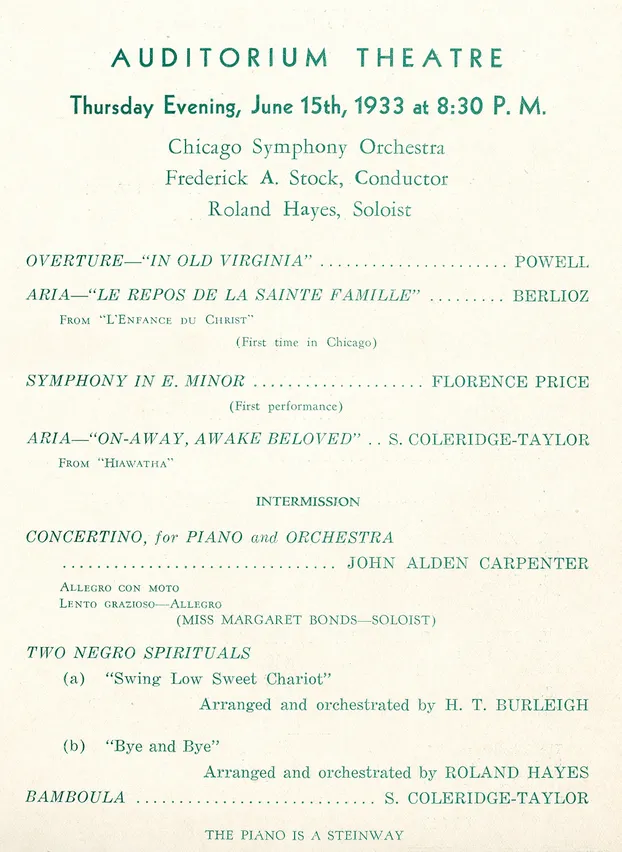
Program for the premiere of Price’s First Symphony / CSO Archives
Inclusion of Price’s symphony at the Chicago World’s Fair marks a milestone, but on closer examination, it also highlights the racial attitudes of the time. On June 14, 1933, Stock and the Chicago Symphony Orchestra presented “American Night,” featuring works by Henry Hadley, Deems Taylor, and George Gershwin.
The premiere of Price’s symphony took place the next day. Most of the concert highlighted the achievements of Negro musicians. The program also featured two works by Samuel Coleridge-Taylor and two Negro spirituals arranged for orchestra by Henry T. Burleigh and Roland Hayes. The first piece after the intermission was Concertino for Piano and Orchestra by John Alden Carpenter, a white composer from New England, but the soloist, Margaret Bonds, was Negro. The first two pieces on the program, however, were by John Powell, a politically active white supremacist, and Hector Berlioz. Performance of a French piece meant the program could not be termed “American music.”
Over the next decade, several orchestras both in the US and Europe performed Price’s music, sometimes with Price herself as piano soloist. None of the best known and most prestigious American orchestras, however, programed it. Besides instrumental music, Price composed numerous songs, some especially for the great Negro contralto Marian Anderson. Anderson, denied a venue in Washington, DC, sang Price’s “My Soul’s Been Anchored in the Lord” at her 1939 concert on the steps of the Lincoln Memorial.
Subsequent career
Price did not cease to seek performances by major American orchestras. In 1943, she sent some music to Serge Koussevitzky, conductor of the Boston symphony orchestra. Her cover letter began
My Dear Dr. Koussevitzky,
To begin with I have two handicaps—those of sex and race. I am a woman; and I have some Negro blood in my veins. Knowing the worst then, would you be good enough to hold in check the possible inclination to regard a woman’s composition as long on emotionalism but short on virility and thought content–until you shall have examined some of my work? As to the handicap of race, may I relieve you by saying that I neither expect nor ask any concession on that score. I should like to be judged on merit alone.
I have not found how or if Koussevitzky responded, but as of 2014, the Boston Symphony Orchestra had not play any of her music.
At least one European orchestra still admired Price’s music. In 1951, Sir John Barbirolli, music director of the Hallé Orchestra in Manchester, England, commissioned a new orchestral work based on Negro spirituals. By the time she completed it, she was too sick to attend the premiere. She was also unable to travel to Paris in 1953 to receive an award.
She died in Chicago on June 3, 1953, with the bulk of her output unpublished and unremembered. Only Negroes continued to perform the published pieces.
Posthumous fame
In 2009, Vicki and Darrell Gatwood purchased an abandoned house in St. Anne, Illinois. There, they found a trove of compositions by Florence Price, along with books and other documents. Ethiopia’s Shadow in America, one of her honorable mention pieces in the 1932 Wanamaker contest, was among them. Searching online, they learned that the house had once been her summer cottage and that the archives of University of Arkansas at Fayetteville already had some of her papers. Therefore, they sold all the material to the university.
Since the rediscovery of Price’s manuscripts, G. Schirmer has obtained the rights to publish them. Recordings of this newly available music soon appeared.
The first annual International Florence Price Festival took place (virtually because of the pandemic) in August 2020 at the University of Maryland at College Park. Subsequent festivals have been held in different cities.
The social dimension of Florence Price’s career
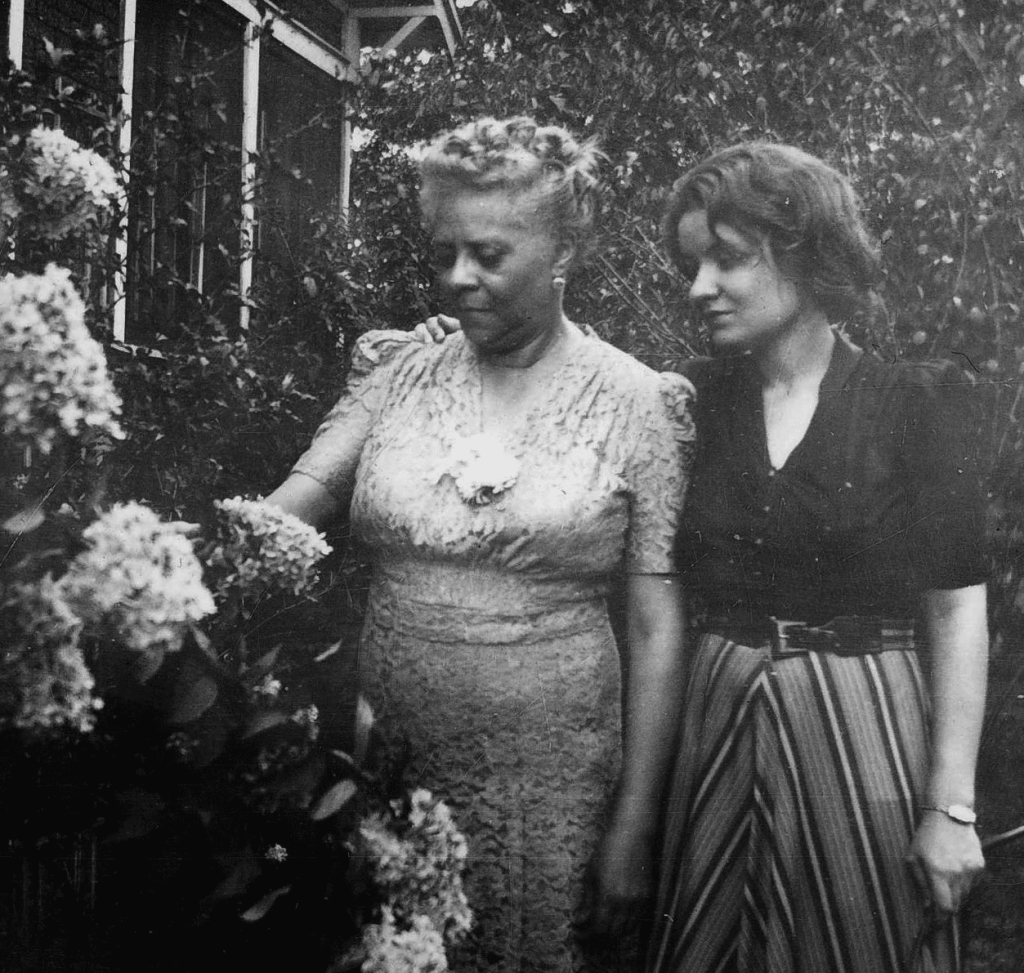
Florence Price with her daughter Florence Louise Robinson / source unknown
In the 1930s and into the 1940s, at least partly under the influence of the Harlem Renaissance, many American orchestras, but not the most important ones, presented premieres of new works by composers such as Price, William Dawson, and William Grant Still. Critical reviews and audience responses were both generally positive and dismissive of the explicit use of Negro musical material. Still received an invitation to collaborate on Twentieth Century Fox’s all-Negro film Stormy Weather (1942). He quit in disgust when the music director insisted that authentic Negro music had to be crude and sexy.
By the end of the Second World War, American conductors seem to have tired of the novelty of programming music of Negro composers. It is often simply observed that Price’s music was neglected for more than half a century until the discovery of so much of her music in that abandoned house. Neglected by whom? Every conductor, chamber ensemble, or soloist who neglected to continue to program it and by every writer about American classical music who neglected to investigate it.
Dawson, Still, and Price are not the only black composers (to return to our contemporary usage) who composed music worth listening to, nor is Price the only black woman.
Orchestras, chamber ensembles, choruses, and soloists certainly ought to continue to program the masterpieces of the classical canon. When they seek works beyond the canon, they ought to consider those by black (and Hispanic) composers as seriously as they explore lesser-known white composers. And writers about classical music ought to cover works of all ethnicities together and not separate them into racial categories.
Sources:
Florence Price (1887-1953) / Dan Dykema, Encyclopedia of Arkansas, April 7, 2025
Florence Price and the politics of her existence / Samantha Ege, The Kapralova Society Journal 16 (Spring 2018): 1-10
Florence Price, Composer / Barbara Garvey Jackson, Black Perspective in Music 5 (Spring 1977): 30–43
Florence Price in 2020, I / Doug Shadle, The Classical Alternative, March 12, 2020
A Florence Price prizewinning piece finally living in the light: Ethiopia’s Shadow in America / Todd E. Sullivan, Ravinia Backstage Blog, July 25, 2023
What I wish everyone knew about Florence Price / Doug Shadle, The Classical Alternative, March 19, 2020