Symphony no. 3, Rhenish, by Robert Schumann
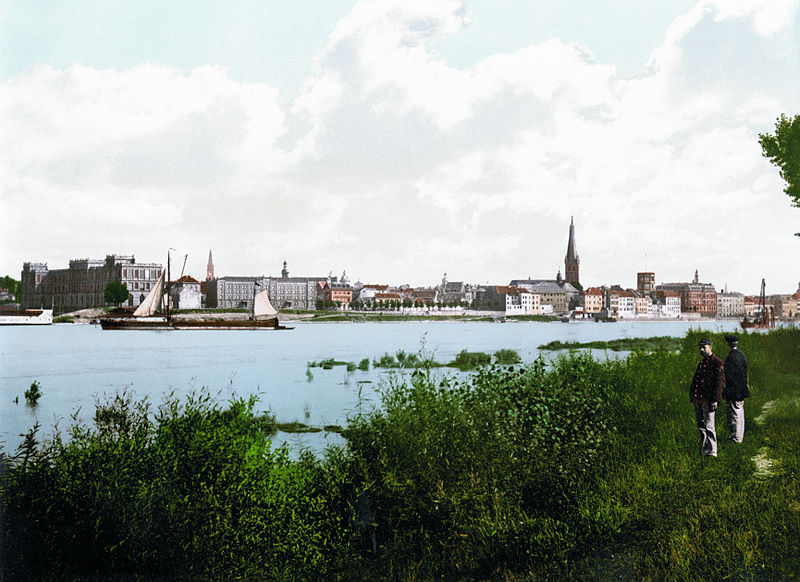
Düsseldorf and the Rhine / between 1890 and 1905, via Wikimedia Commons
In all, Robert Schumann composed and published four symphonies. The last of them in order of composition is what is known as the Third Symphony, or Rhenish Symphony. His publisher had declined to accept the second of his symphonies. Schumann revised it in 1851 and so it was published as his Fourth Symphony.
The Rhenish Symphony acquired its nickname from letters to his publisher and some friends. In them, Schumann spoke of the Rhine River as his inspiration.
A new job for Schumann
Schumann moved to Düsseldorf in September 1850 to become the conductor of its orchestra and chorus. He had sought positions in Leipzig, Dresden, and Berlin, so Düsseldorf had been far from his first choice. Still, he recalled an earlier boat trip on the Rhine River, which runs through Düsseldorf, and the memory made the city very attractive to him.
Düsseldorf welcomed Schumann and his wife Clara extravagantly, with concerts, serenades, and proclamations. Although Schumann had long shown emotional pathologies, the change of scenery seemed good for him at first.
Late in the month, the couple visited Cologne, another city on the Rhine, and especially enjoyed its majestic cathedral. Many program notes assert that the enthronement of the cardinal there inspired the slow movement of the Rhenish Symphony, but that event actually occurred the following day, after they returned home. No documentary evidence exists that the cathedral itself inspired the movement, but it seems a reasonable inference.
Unfortunately, their enjoyment of Düsseldorf quickly dissipated. The reserved and introverted Schumann found townspeople too talkative and not serious enough. Street noises even intruded on his privacy at home.
The musicians of Düsseldorf soon learned that Schumann was not a good conductor. By the end of 1852, the chorus requested his resignation and he had started to show signs of a debilitating mental illness. In February 1853, he threw himself into the Rhine, but fishermen interrupted his suicide and took him home. He spent the last three years of his life in an asylum.
The genesis of the Rhenish Symphony

Daguerrotype of Robert Schumann, 1850 / via Wikimedia Commons
Schumann began his tenure in Düsseldorf with a burst of optimism and creativity. He quickly composed his cello concerto in October. On November 2, he started work on a symphony in E-flat major and finished it on December 9. If just over a month seems a short time to compose a symphony, it was a leisurely pace for Schumann. He completed his First Symphony in four days.
When he sent the symphony to his publisher, he wrote that it “perhaps mirrors here and there something of Rhenish life.”. On another occasion, he said that he wanted to describe the simplicity and naturalness of the folk life along its banks. Therefore, the symphony soon became known as the Rhenish, even though the nickname did not originate with Schumann himself. The manuscript of the symphony gives each movement a distinctive title, but Schumann instructed the publisher to omit them.
Schumann led the first performance of the new symphony in Düsseldorf in February 1851. The audience loved it so much that he repeated it the following month. Critical response varied, with some praising it without qualification and others finding its departures from tradition bewildering.
Analysis of the Rhenish Symphony
The Rhenish Symphony takes a unique approach to a five-movement symphony. Beethoven’s Pastoral Symphony and Berlioz’ Symphonie fantastique both add a fifth movement for narrative purposes. They could have as easily composed more than five movements if their program had required.
Schumann wrote five movements for structural, not narrative reasons. The first two movements form a thematically related pair. So do the last two. An unrelated movement separates the two pairs. Mahler copied the same structure for his Fifth Symphony.
In general, Schumann’s orchestral music seems more an extension of his piano music rather than conceived from the start with an orchestral idiom. His orchestration is often routine and marred with unnecessary doubling. Mahler and others even advocated completely rescoring his orchestral pieces. But for all his faults in instrumentation, Schumann came up with some wonderful and innovative effects. The Rhenish Symphony has its share of them.
1st movement: Lebhaft (Lively)

Robert and Clara Schumann in 1847, lithograph with a personal dedication / Wikimedia Commons
Any symphony in E-flat major with the first movement in 3/4 time would have invited comparison with Beethoven’s Eroica. Where Schumann’s disciple Brahms found Beethoven’s example terrifying, Schumann dared to meet him on his own ground. He followed Beethoven both in terms of motivic rigor and overpowering momentum of rhythm.
In Schumann’s case, the movement starts with hemiolas. That is, instead of the written 3/4 time signature, the opening offers an implied 3/2. He pairs this metrical ambiguity with long, flowing phrases.
The interval of a fourth, both rising and falling, is prominent in the first theme. The second theme features the descending fourth. Harmonically, Schumann moves from the opening E-flat major through G minor to the expected dominant key, B-flat major.
The classical composers routinely repeated the exposition. Schumann asserts his originality by moving directly to the development without the expected repeat. Otherwise, the movement is a standard sonata form that, like many Beethoven works, ends with an extended coda.
2nd movement: Scherzo, Sehr mässig (Very moderate)
Before he decided to ask his publisher to omit descriptive titles, Schumann called this movement “Morning on the Rhine.”
Having the scherzo as the second movement echoes Beethoven’s Ninth Symphony. Otherwise, classical composers normally put it (or its predecessor the minuet) third. Actually though, this movement is a scherzo in name only, lacking the fast tempo of any previous scherzo. Its leisurely pace gives it more the character of a Ländler. It provides some relief from the dramatic tension of the opening, but it is in the same meter and gives the same motivic prominence to the interval of a perfect fourth.
Like the first movement, this one deviates from the expected form. A standard scherzo has an opening (repeated), a section in a new key called the trio (also repeated), and a repetition of the first section (without repeats). This movement has some repeated sections, and analysts can identify a trio, but Schumann doesn’t label it as such.
In place of the light-hearted mood of the ordinary quick tempo of a scherzo, it gives the impression of a hero resting a while before his next adventure.
3rd movement: Nicht schnell (Not fast)
The typical symphony had a slow movement as the second movement and a minuet or scherzo as the third. Schumann’s second movement is labeled “Scherzo,” although it is not a real scherzo. In Beethoven’s Ninth Symphony, the scherzo comes second and the third movement is the slow movement. Does Schumann follow Beethoven’s example? Not quite.
“Not fast” doesn’t necessarily mean slow. The notation looks like a slow movement. It is in 4/4 time with an eight-note pulse, but the effect is a flowing andante. The form doesn’t resemble that of a standard slow movement, either. It is more like a song without words or one of the miniature piano pieces Schumann especially excelled at composing.
To describe it another way, it is an intermezzo, a short, light movement inserted between two more substantial pieces, in this case, the two paired movements. The interval of the fourth dominates the themes in both pairs. It hardly appears at all in the intermezzo.
4th movement: Feierlich (Solemn)

Cologne Cathedral / GetArchive
Schumann’s manuscript calls this movement “In the character of an accompaniment to a solemn ceremony.” The true slow movement, it is often called the Cathedral Scene in the mistaken notion that the enthronement of a cardinal in the Cologne Cathedral inspired it. Surely the cathedral—or any other cathedral for that matter—hosted a number of other solemn ceremonies. Schumann could have taken inspiration from any solemnity he witnessed along the Rhine.
Although the key signature has only three flats, Schumann wrote the movement in E-flat minor. It amounts to a theme and two variations. A brass fanfare in B major interrupts the second one, but the tonality quickly returns to E-flat minor. The interval of a fourth returns to prominence.
Schumann had also chosen that key for Manfred, composed the previous year but not published till later. There, it depicts Manfred’s suicidal despair. Here, it lends solemnity without falling into pessimism.
Germans had long associated trombones with religious music, and Schumann introduces them in this movement. The dark colors he achieves with trombones, horns, and clarinets show his orchestration at its finest, although at one place, the doubling of first trombone and horn takes the trombone unreasonably high.
5th movement: Lebhaft (Lively)
No one thought of ending a symphony with a slow movement until Tchaikovsky’s Pathetique Symphony a generation later. The Rhenish Symphony ends with a dance movement, another departure from tradition. The main theme starts with a scale ascending the fourth from B-flat to E-flat and immediately falls back a fourth.
Later on, the movement features echoes of the first, third, and fourth movements. The solemn chorale of the slow movement reappears in E-flat major, which transforms its mood to cheerful and upbeat. Although the movement has no religious connotations, Schumann retains the trombones for the finale.
Comments
Symphony no. 3, Rhenish, by Robert Schumann — No Comments
HTML tags allowed in your comment: <a href="" title=""> <abbr title=""> <acronym title=""> <b> <blockquote cite=""> <cite> <code> <del datetime=""> <em> <i> <q cite=""> <s> <strike> <strong>