William Grant Still: Dean of Afro-American composers and more
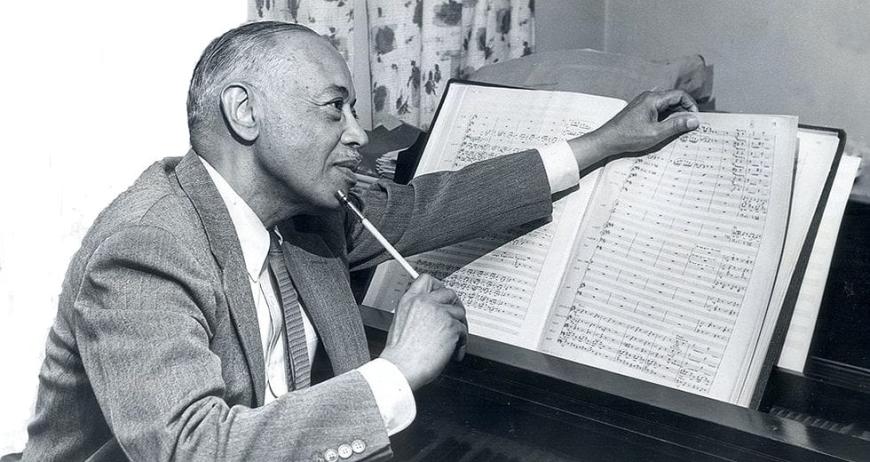 William Grant Still is widely considered as the “Dean of Afro-American Composers,” but that title puts him in a box he sought to escape. It seems more appropriate to regard him as an important American composer who introduced black culture to the American symphonic, chamber, and operatic repertoire. His output also includes multicultural works that celebrate other American ethnic groups.
Like many African Americans of his generation, Still objected to “black.” R. Donald Brown, who taped an interview with him in 1968, noted
Dr. Still never referred to himself, or to any other member of the Negro race, as “Black.” In his opinion, the term “Black” connoted separatism between the races and suggested not only that there was a wide gulf between the White man and the Black man, but also that White and Black were, by nature, in opposition to each other. For him, such opposition did not exist.
Still’s music represents three trends in the music of the early 20th century:
- Most composers who were not German sought to escape the aesthetics of German Romanticism.
- As a subset, American composers sought to create a distinctively American body of music of equal artistic quality to any European music.
- In part a further subset, the Harlem Renaissance asserted the artistic and intellectual merits of the African-American heritage in all the arts.
Still aimed to mix African-American and European techniques and forms, as well as blur the distinction between “serious” and “popular” music
William Grant Still’s childhood

William Grant Still historical marker, Woodville, Mississippi / Photographed by Cajun Scrambler, March 25, 2016 via HMdb.org
William Grant Still was born on May 11, 1895, in Woodville, Mississippi to William Grant and Carrie Lena (Flambo) Still. Technically, then, he was William Grant Still, Jr., although I have never seen any reference to him by that name. Both parents were of mixed race. His father had African, Indian, and Scotch roots, his mother African, Indian, Spanish, and Irish. With the “one drop” rule of the Jim Crow era, however, nothing legally counted except the African.
Both parents had graduated from college, rare for Negroes at the time. Their education would have qualified them for a comfortable middle-class existence if Still’s father hadn’t died at age 24. His mother achieved it on her own. She moved to Little Rock, Arkansas to live with her mother and taught high school English.
When William was 11, his mother married Charles B. Shepperson, a music-loving railway postal clerk. The boy learned about opera from his stepfather’s record collection and about hymns and spirituals sung by slaves from his maternal grandmother. He had his own violin and began composing from the time he learned musical notation.
Still graduated as valedictorian of Dunbar High School in 1911 and promptly announced his intention to pursue a musical career. His mother, however, doubted that a Negro could succeed in serious music and insisted that he study medicine.
Early education
Still attended Wilberforce University at his mother’s insistence. He would have preferred to study at Oberlin College, which had an excellent music program, but his mother won that argument. Sort of. He did well enough in his science classes, but his heart remained in music.
Still organized a string quartet at Wilberforce and played violin in it. He also joined the college band, where he played all the woodwind instruments. The band played one concert that consisted entirely of Still’s compositions.
Composing at that time meant writing music on European—specifically German––models. Antonin Dvořák had recommended that American composers turn to American models for thematic material, specifically the music of slaves, Creoles, and Indians. Hardly anyone had taken him up on his suggestion yet.
Still married Grace Bundy in 1915 while a student at Wilberforce. They had four children together but separated in 1932. The marriage ended in divorce in 1939.
Still hears the blues
In 1915, Still quit school without graduating. He performed a variety of odd jobs to support himself, some of them in music. Most important, he worked that summer with W.C. Handy, “Father of the Blues,” in Memphis, Tennessee.
Handy had joined a touring band before he ever heard the blues. His introduction came in 1903 as he waited for a train in Tutwiler, Mississippi. A Negro dressed in rags pressed a knife against the strings of a guitar and sang what Handy called “the weirdest music I ever heard.”
Rather than turn away from it, he decided to learn more about it and added it to the repertoire of the band he conducted. A turning point came when Handy moved to Memphis and a candidate for mayor asked him to write a campaign song. He composed “Mr. Crump” and later retitled it “Memphis Blues,” which became locally popular.
In 1912, he decided to publish it. It became very successful, but Handy made no money from it. In 1914, he founded his own publishing company in partnership with Harry Pace and issued “St. Louis Blues,” which eventually earned him a fortune.
Handy’s publishing company gave Still his first professional arranging experience. Still also played in Handy’s touring band. It was his first introduction to Negro music aside from the songs he heard from his grandmother. Still’s travels with Handy introduced him to the importance of Negro music for the first time, especially the blues, which had low social standing. It also gave him his first real experience with conditions in a segregated society. The experience inspired Still to dignify the blues by incorporating it into art music.
Oberlin College

William Grant Still playing a cello, 1919 / Wikimedia Commons
That fall, he received a small inheritance from his father and used it to enroll in Oberlin College’s music theory program. A faculty member asked why he wasn’t studying composition. He replied that he didn’t have the money. The Theory Committee found a faculty member who agreed to teach Still composition without charge. Again, he left without graduating.
By that time, Pace and Handy had moved their publishing company to New York. Still wrote to Handy and obtained a job.
Toward the end of his life, he wrote, “I entered the field of American commercial music in order to make a living, and there learned many things that my later conservatory training could not and did not give me.”
New York
Vernacular music
Still divided his time in New York between vernacular music and orchestral composition. His stint as staff arranger for Pace and Handy gave him some financial stability.
Pace believed that the future of the music business lay in recordings. Handy had no interest in venturing into anything new, so the two parted. Pace founded Black Swan Records in 1921. All the recording artists from the headliners to accompanists were Negroes.
At that time, if record companies recorded Negro musicians at all, it was limited to novelty songs and minstrelsy. Black Swan’s first hit was Ethel Waters’ recording of “Down Home Blues,” which sold 100,000 copies within six months.
But Pace wanted to go beyond the common stereotypes of Negro musicians as being limited to blues and jazz. He hired Still as arranger. Black Swan went out of business in 1923 for a number of reasons, including massive debt from Pace’s purchase of his own recording and pressing equipment and the marketing muscle of white recording companies once they recognized how profitable marketing to Negro audiences could be.
Still had other important work besides arranging for these two companies. As radio started to become important, he orchestrated for the Don Voorhees orchestra and eventually conducted and arranged music for the CBS radio program Deep River Hour. He honed his orchestration skills by learning to play many different instruments. In addition, he collaborated with such notable musicians as Paul Whiteman, Artie Shaw, Sophie Tucker, and Willard Robinson.
Besides arranging and conducting, Still performed in various orchestras on violin, cello, and oboe.
Harlem Renaissance

Apollo Theater, an important Harlem Renaissance venue / Dr. Wendy Longo via Flickr
Until about 1910, most African Americans live in the South, and most of them were either former slaves or descendants of slaves who lived in poverty. Regardless of economic status, they suffered oppression under strict racial segregation enforced by Jim Crow laws. The year 1910 marks the beginning of the Great Migration to Northern and Western cities.
The Harlem neighborhood in New York became a center for the Negro middle class, including various intellectuals and artists. There, they could assert their racial identity without fear or shame. They started the New Negro Movement, which became better known as the Harlem Renaissance. It represented a flowering of literature, theater, the visual arts, and music. Key figures represented a wide range of political and religious viewpoints, as well as different ideas of what Negros should pursue in the arts.
When I have searched for the names of the major figures of the Harlem Renaissance, I have not come across William Grant Still, but he knew and worked with many of them, including Langston Hughes, who wrote most of the libretto for Still’s opera Troubled Island. Like the more conspicuous leaders, Still asserted his racial identity and labored to make a favorable impression in white-dominated cultural institutions.
Musically, the Harlem Renaissance saw Negro vernacular music—spirituals, blues, and jazz—spread throughout American popular culture despite the strict racial segregation of the time. For all his involvement in it, Still insisted that the Negro experience needed to be in American art music: chamber music, symphonic music, and opera. He warned Negro composers that if they limited themselves to popular music, they would only play into white stereotypes. They could not make as much money in art music as in popular music, but they could benefit their race more.
Orchestral music

Edgard Varèse / John French Sloan, 1924, via Get Archive
In 1921, Still joined the orchestra of the New York production of Shuffle Along by Eubie Blake and others as oboist. It played in Boston during the summer and fall of 1922, and at that time, Still studied composition with George W. Chadwick, director of the New England Conservatory of Music. Chadwick urged him to compose specifically American music. Still’s most important composition instruction, however, came from Edgard Varèse.
Varèse, one of New York’s most influential modernist composers, befriended a Negro army colonel on a transatlantic trip. The encounter encouraged him to offer a scholarship for a Negro composition student. He sent letters to several prominent Negro musicians to find candidates. One of the letters arrived at the Black Swan phonograph company. Still, who worked there as an arranger, answered Varèse immediately. Still studied with Varèse from 1923 to 1925.
He had long intended to introduce the blues to symphonic literature but lacked knowledge of how to write it. Varèse, of course, was one of the most radical composers of hie era. He promoted electronic music long before technology made it possible for him to realize his ideas. But he had studied composition in Paris with Albert Roussel and Charles-Marie Widor, so he certainly knew traditional techniques.
As a student of Varèse, Still experimented with adding the techniques and dissonances of avant-garde music into his treatment of Negro music. Eventually, he decided that it caused the Negro idiom to lose its identity. He also noticed that concert audiences disliked dissonant music. He could show them the beauty of Negro idioms only by composing music they would enjoy hearing.
Besides teaching, Varèse introduced Still to other musicians who promoted his music. These include the conductors Leopold Stokowski, Eugene Goossens, and Howard Hanson.
Performance opportunities
Varèse was cofounder of the International Composers’ Guild, which operated in New York from 1921 to 1927. Of all native-born American composers, Still received more performances than anyone except Carl Ruggles. His first piece performed by the Guild, From the Land of Dreams (1925), is no longer extant. It is his only piece the group performed that lacked an overtly racial theme. He later described it as “ultramodern,” although hardly any of his extant music of the period seems to merit that label.
Goossens conducted a concert at New York’s Aeolian Hall on January 24, 1926, that featured Still’s Levee Land, a three-movement work for soprano solo and orchestra, one of the first attempts to incorporate jazz into symphonic music. The orchestration included a tenor banjo.
Hanson’s American Composer Series in Rochester, New York, presented one or more pieces by Still almost every year from 1927 to 1945, including his most famous work, Afro-American Symphony. Hanson didn’t have the close personal connection with Still that Varèse had, but he had much more conservative tastes. Still’s turn to a more approachable idiom made his music especially attractive to Hanson.
He did not suddenly turn from the avant garde to the Negro idiom, however. He sought to transform it with modernist chromaticism to achieve a fusion.
The Afro-American Symphony
About the Afro-American Symphony, Still wrote, “I wanted to prove conclusively that the Negro musical idiom is an important part of world’s musical culture. That was the reason I decided to create a musical theme in the Blues idiom and develop it into the highest of musical forms- the Symphony.”
The symphony uses not only the blues scale, a blues melodic profile, and a call and response technique, but also the 12-bar blues structure for the themes. For twenty years, it received more performances than any other American symphony, being played by 38 different orchestras.
Reviews of Still’s music indicate that the critics viewed him as an exotic figure in new music composition. They looked for what they considered an appropriately Negro idiom. They became dismissive if they couldn’t recognize one.
If they thought a piece too modern, they lumped it together with all the other ultramodern composers as producing mere noise. On the other hand, if he provided music that seemed all Negro in melody and harmony, they would praise it as simple or naïve.
California

William Grant Still residence, 1262 S. Victoria Ave., Los Angeles, CA, just north of Pico Blvd, Los Angeles Historic-Cultural Monument #169 / 2012 photograph , Wikimedia Commons
The New York years included a sojourn in California (1929-1930), where Still arranged music for Paul Whiteman’s radio program The Old Gold Hour. He began to achieve major success on his return to New York, but he knew that he wanted to live in California for a more serene lifestyle than New York offered. The racial climate there, while not wonderful, was better than New York, too. When he received a Guggenheim Fellowship in 1934, he moved to Los Angeles permanently.
Los Angeles had little reputation for music at the beginning of the century, even though it had more musicians and music teachers per capita than anywhere else in the country. The Great Migration took many Negro musicians to Los Angeles from the South, quite a few following New Orleans trombonist Kid Ory. Musicians fleeing Nazi Germany joined them in the mid 1930s.
Los Angeles had a different demographic than any other city where Still lived. Not only did it have black and white communities, but also large concentrations of Hispanics and Asians. Still had easy access to all the various artistic idioms, which mattered not only for the music he heard but the range of musicians he could work with.
Still’s vernacular music
As was the case in New York, Still made most of his money from the popular music industry and continued to compose concert music, much of it commissioned by local arts organizations.
Hollywood attracted a variety of musicians to work in film, radio, and television. Only a few Negroes managed to find employment there. Still and Hollywood never quite meshed, but he contributed to several films, including Pennies from Heaven, Lost Horizon, St. Louis Blues, Killer of Sheep, and Full Circle. He also provided background music for such television shows as Gunsmoke, Have Gun Will Travel, Perry Mason, and The Three Stooges.
In 1939, Still divorced his first wife and married concert pianist and journalist Verna Arvey, the daughter of Russian Jewish immigrants. They had to go to Tijuana for the ceremony because interracial marriages were illegal in California. They had two children together.
Upon their marriage, Arvey became Still’s chief collaborator. She completed the libretto to Still’s opera Troubled Island, which Langston Hughes had started, and provided librettos for his subsequent operas as well as texts for songs and choral pieces. She also kept archival records of Still’s accomplishments.
The Stills’ marriage invited abuse from bigots but provided Still opportunity for extensive interaction with Los Angeles’ white community. Arvey both performed his piano music and promoted his works through her journalism.
The obstacle of racism
Still rarely commented on the racism he encountered, preferring to highlight good relationships with supportive people. He did, however, write to Claude Barnett of the Associated Negro Press in 1943 to describe his experience with Twentieth Century Fox.
Late in 1942 I was approached to act as Supervisor of Music on the Fox all-colored film called “Stormy Weather,” then titled “Thanks, Pal.” I was told that the film had a very high purpose, and that it would employ some of our finest colored artists. That was the original plan. However, when I came to the studio the music director, Al Newman, began a systematic plan to discard every bit of work I did and to ignore my suggestions, on one pretext or another . . . Naturally, I did not approve of Newman’s ideas that in order to be authentic, Negro music had to be crude and Negro dancing had to be sexy . . . I decided that I would not accept the studio’s money any longer under such circumstances, and although it meant a considerable financial loss, I resigned after six weeks of work.
Still’s art music

Troubled Island libretto / Huntington Library
It turned out for Still’s benefit that he found so little steady work in Hollywood. He could concentrate on building his reputation as a concert composer, and industry did not control the rights to that music. He had a fair amount of his music featured on the radio program Standard School Broadcasts, sponsored by the Standard Oil Company.
Because of the diversity Los Angeles provided, Still turned more and more to multicultural themes
Without turning away from his desire to promote Negro culture in white society, Still turned to a more universal idiom after he moved to Los Angeles. Believing that every ethnic group in the United States had its own contribution to American culture, he began to draw on such traditions as Latin and Caribbean music, cowboy songs, music of pre-statehood missions in California, the music of various Indian tribes, and even Jewish music.
He found opportunities to compose art music through both the black and white communities. Besides local commissions, he won some national prizes. His “Festive Overture” (1944) won one from the Cincinnati Symphony Orchestra. His “The Peaceful Land” (1961) won another for a composition dedicated to the United Nations. He also received a commission to compose “Song of the City” for the 1939 New York World’s Fair.
William Grant Still and the stage
Los Angeles gave Still the opportunity to follow a long-time goal of writing for the stage. He completed nine operas and two ballets. The most famous opera, Troubled Island, brought him both one of his greatest successes and greatest disappointments.
Still completed work on it in 1941. It tells the story of Haiti’s first emperor. Langston Hughes wrote most of the libretto. Verna Arvey finished it.
Still first offered Troubled Island to the Metropolitan Opera Company, which declined to produce it. In 1944, he showed it to his long-time supporter Leopold Stokowski, who had just become conductor of the New York City Symphony. Stokowski recommended the opera to New York City Opera, which was under the same management. He became disillusioned with the organization and resigned after one year, but the opera company produced Troubled Island in 1949.
It only ran for three performances. Audiences responded to it with enthusiasm, but critics were unimpressed. None of the subsequent performances Still anticipated materialized, and he blamed the bad reviews. Indeed, Stokowski told him he thought there was intrigue against the opera.
Not only that, but Still concluded that white critics and modernist composers, who had turned against him as soon as he stopped writing avant-garde-inspired music, had formed a communist conspiracy against him. He hated to think that the opposition was racially motivated, but eventually felt forced to admit it.
Why specifically a communist conspiracy? Because most of his opponents represented the left wing of American politics and had started actively recruiting Negro performers to, in Still’s words, “subordinate their art to political propaganda.”
Possible evidence of a communist conspiracy
Perhaps the clearest example of unfair left-wing criticism, however, precedes the opera. Aaron Copland wrote a stinging comment in Modern Music in 1936.
William Grant Still began about twelve years ago as the composer of a somewhat esoteric music for voice and a few instruments. Since that time he has completely changed his musical speech, which has become almost popular in tone. He has a certain natural musicality and charm, but there is a marked leaning toward the sweetly saccharine that one should like to see eliminated.
Why did Copland, of all people, complain that Still had changed to a more popular musical idiom? He himself had done the same thing for some of the same reasons in 1934. Unlike Still, Copland found communist ideology appealing. Still resented Copland’s remarks for dismissing his efforts at crossing racial barriers as sentimental and pandering for profit.
Some of Still’s “firsts” and honorary degrees
Still was not the first Negro composer in America, but he earned his title as dean of Afro-American composers by being the first in certain key achievements:
- His Afro-American Symphony was the first symphonic piece by a Negro composer to be performed by a symphony orchestra (1931)
- He became the first Negro to conduct a major orchestra, leading the Los Angeles Philharmonic in a concert of his own compositions (1936).
- His opera Troubled Island, produced by the New York City Center Opera Company, was the first performance of an opera by a Negro composer (1949)
- When he conducted the New Orleans Philharmonic, he became the first Negro to conduct an all-white orchestra in the Deep South (1955).
- Three years after his death (1981), his opera A Bayou Legend became the first opera by a Negro composer to appear on national television.
He also received nine honorary degrees, more than any other composer of his generation:
- Master of Music, Wilberforce University (1936)
- Doctor of Music, Howard University (1941)
- Doctor of Music, Oberlin College (1947)
- Doctor of Letters, Bates College (1954)
- Doctor of Laws, University of Arkansas (1971)
- Doctor of Fine Arts, Pepperdine University (1973)
- Doctor of Music, New England Conservatory of Music (1973)
- Doctor of Music, Peabody Conservatory (1973)
- Doctor of Music, University of Southern California (1975)
Sources:
Context and Creativity: William Grant Still in Los Angeles / Jacqueline Cogdell DjeDje, Black Music Research Journal, 31, no. 1 (Spring 2011): 1-27
“Dean of Afro-American Composers” or “Harlem Renaissance Man”: “The New Negro” and the musical poetics of William Grant Still / Gayle Murchison, The Arkansas Historical Quarterly 53 (Spring 1994): 42-74
“Harlem Renaissance Man” revisited: the politics of race and class in William Grant Still’s late career / Catherine Parsons Smith, American Music 15 (1997): 381-406
The multifaceted nationalism of William Grant Still / David Z. Kushner, American Music Teacher 23 (2002): 32-35, 95
“New Music” and the “New Negro”: The background of William Grant Still’s “Afro-American Symphony” / Carol Oja, Black Music Research Journal 22 supplement (2002): 107-130
An outstanding Arkansas composer William Grant Still / The Arkansas Historical Quarterly 24 (1965): 308-314
A tribute to William Grant Still / Fannie Howard Douglass, The Black Perspective in Music 2 (Spring 1974): 51-53
William Grant Still: a voice high-sounding / Judith Anne Still Headlee, Music Educators Journal 70 (February 1984): 24-30 – a taped interview (1968) conducted in Still’s home by R. Donald Brown of California State University at Fullerton, edited with an introduction by Still’s daughter.
William Grant Still in Ohio (1911-1919) / Catherine Parsons Smith, American Music 22 no. 2 (Summer 2004): 203-30
Comments
William Grant Still: Dean of Afro-American composers and more — No Comments
HTML tags allowed in your comment: <a href="" title=""> <abbr title=""> <acronym title=""> <b> <blockquote cite=""> <cite> <code> <del datetime=""> <em> <i> <q cite=""> <s> <strike> <strong>