↓
 

Musicology for Everyone

(Professional research for a general audience)

  • Home
  • About
  • Contact me
Home→Tags American popular music 1 2 3 … 5 6 >>

Tag Archives: American popular music

Post navigation

← Older posts

Patrick S. Gilmore: pioneering American bandmaster

Musicology for Everyone Posted on July 16, 2024 by David GuionJuly 16, 2024  
patrick s.gilmore in uniform

Patrick S Gilmore / Illustration for The New Metropolis edited by E Idell Zeisloft (D Appleton, 1899).

Patrick S. Gilmore was born Christmas Day 1829 in Ballygar, County Gallway, Ireland, near Dublin. He attended the village school and learned to play fife and drum. When he was 14, he started an apprenticeship in Athlone, headquarters of as many as four English regiments. They all had bands, and Gilmore fell in love with band music. One regimental bandmaster, the renowned Patrick Keating, taught the young boy musical notation, composition, instrumentation, and conducting.

Gilmore put together his own thirty-piece band to play at the masses in Athlone’s St. Peter’s church. At the end of each service, he hurried out to listen to whatever the parishioners said about the music. In 1849, Keating advised Gilmore to move to America. Continue reading →

Posted in Bands and band music, Uncategorized | Tagged American popular music, bands, composers, conductors, Gilmore (Patrick S), nineteenth century | Leave a reply

Sousa’s Band: the most famous American wind band

Musicology for Everyone Posted on January 6, 2024 by David GuionJanuary 16, 2024  
Sousa's Band, 1893

Sousa Band, St. Louis Expo 1893

Before television, movies, radio, or sound recordings, people either had to learn to play musical instruments or attend concerts to experience music. Wind bands provided the majority of concerts. In the golden age of American wind bands, none was as successful and well known as Sousa’s Band.

John Philip Sousa gained the experience and reputation needed to start a successful touring band as leader of the U.S. Marine Corps Band, America’s oldest professional musical ensemble. Before Sousa, it functioned as little more than Washington, DC’s town band. In his twelve years of service, Sousa transformed it to a nationally recognized band.

Under his leadership, the Marine Band started recording for the Columbia Record company. Sousa’s marches became some of the earliest hit records.

After years of trying, Sousa obtained permission to take it on tour. He hired David Blaikley, the former manager of the Gilmore Band, to organize the first tour throughout the Midwest. Its success encouraged a second tour that took the band as far as San Francisco. The success of that tour directly led to the end of Sousa’s leadership of the Marine Band and the formation of Sousa’s Band. Continue reading →

Posted in Bands and band music, Composers | Tagged American popular music, bands, music in society, nineteenth century, Sousa (John Philip), twentieth century | Leave a reply

Francis Johnson: a life of musical firsts

Musicology for Everyone Posted on February 26, 2022 by David GuionFebruary 4, 2026  
Francis Johnson historical marker

Marker at 536 Pine St. Philadelphia / Wikimedia Commons

Francis Johnson, also known as Frank Johnson, was among the first noteworthy American composers of instrumental music. He was the first black composer to have his music published. His band was among the first to achieve a nationwide reputation and tour extensively. And it was the first to go on a foreign tour. Johnson was also among the first musicians to participate in interracial performances.

Although there was some speculation that Johnson was born in Martinique, historians have determined that he was born in Philadelphia as a free black on June 16, 1792. And it’s certainly in Philadelphia where he made his first mark.

Johnson’s childhood, early musical training, and personal life are little known, but he was playing music professionally in Philadelphia by 1812. He probably first gained attention as a fiddler for dances. He later became known for performances on multiple instruments, especially violin and keyed bugle. Continue reading →

Posted in Bands and band music, Composers | Tagged American popular music, bands, composers, Johnson (Francis), nineteenth century | Leave a reply

Fly Me to the Moon by Bart Howard

Musicology for Everyone Posted on October 23, 2021 by David GuionMarch 18, 2023 2
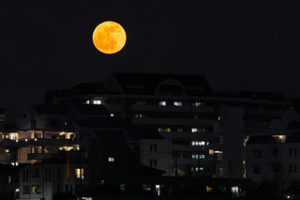
full moon. fly me to the moon

halfrain via Flickr

People nowadays tend to attribute songs to whichever singer made the most famous recording. That’s too bad if they’re ignoring one of the great songwriters. In the case of “Fly Me to the Moon,” people might as well attribute it to Frank Sinatra or some other singer. It’s the only hit song by the almost unknown Bart Howard.

Bart Howard was born in 1915 in Burlington, Iowa. His birth name was Howard Joseph Gustafson. In 1931, at the age of 16, he started his musical career, touring as accompanist for a dance band that featured Siamese twins Daisy and Violet Hilton.

In 1934, he moved to Los Angeles, hoping to write songs for Hollywood. It didn’t work out, but he kept busy playing piano. As accompanist for comedienne Elizabeth Talbot-Martin, he performed at Rockefeller Center’s Rainbow Room in New York in 1937. New York became home professionally for the rest of his life.

Shortly after moving to New York, he met the singer Mabel Mercer. She had a long engagement at Tony’s on 52nd Street, with Howard as her accompanist, and became famous. She introduced “If You Leave Paris,” the first of Howard’s songs ever performed publicly. For many years afterwards, she sang and promoted his songs.

Howard worked as master of ceremonies at the Blue Angel nightclub. He composed numerous songs for the various performers, including Mercer, Johnny Mathis, and Eartha Kitt. He usually wrote both the words and music, like his idol Cole Porter. Continue reading →

Posted in American popular music | Tagged American popular music, American popular songs, twentieth century, videos | 2 Replies

W.C. Handy and the history of the blues

Musicology for Everyone Posted on September 14, 2020 by David GuionJanuary 16, 2024  
W.C. Handy. father of the blues

US postage stamp issued May 17, 1969

W.C. Handy has earned the title “Father of the Blues.” That doesn’t mean that he invented the blues, but he’s responsible for making the genre known outside the Mississippi Delta where it originated.

The slave trade brought millions of people from West Africa to  America. As much as slaveowners tried to stamp out vestiges of African culture, they couldn’t succeed. African rhythms and melodic inflections blended with the European music of white culture to make a completely new musical culture.

White musicians began to appreciate slave music as early as the 1840s. Some of them even went to the effort to learn to transcribe the music and dialect accurately. They just had no sympathy for or understanding of black culture. The minstrel shows where whites performed black-influenced music in blackface continued in popularity after the Civil War.

W.C. Handy himself toured the country with a minstrel show. And never heard the blues during all that time. Continue reading →

Posted in American popular music, Composers | Tagged American popular music, composers, Handy (W.C.), jazz, nineteenth century, twentieth century | Leave a reply

The Fantasticks, by Tom Jones and Harvey Schmidt

Musicology for Everyone Posted on June 22, 2020 by David GuionJune 20, 2020  

The Fantasticks: signThe Fantasticks represented such a radical departure from the normal musical that it looked at first like a flop. Then it set records never likely to be broken.

Musicals, or at least so it seemed according to the example set by Irving Berlin or Rogers and Hammerstein, ought to be big, bold, and impressive. They need elaborate production numbers, fancy costumes, and lighting effects. Tom Jones and Harvey Schmidt thought so when they became friends at the University of Texas and dreamed of conquering New York.

Even while serving in different army units, they managed to collaborate on songs by mail. Jones got out of the army before Schmidt, so he and composer J. Donald Robb tried to make an elaborate musical out of a parody of Romeo and Juliet by Edmund Rostand: Les Romanesques.

In hindsight, they failed where Leonard Bernstein succeeded with West Side Story. Their Texas version of Romeo and Juliet, called Joy Comes to Deadhorse, even included a character and song called “Maria.” But after a three-year struggle between 1954 and 1956, they couldn’t make it work. Continue reading →

Posted in American popular music | Tagged American popular music, musical theater, program notes, twentieth century | Leave a reply

Post navigation

← Older posts

Musicology for Everyone

Search by category

  • American popular music
    • Civil War music
    • Jazz
  • Anecdotes
    • Quotations
  • Bands and band music
  • Christmas music
  • Classical music
  • Composers
  • European musical history
  • Humor
  • Music education
  • Music Festival
  • Opera
  • Orchestras
  • Program notes
  • Trombone and other brass
  • Uncategorized

Archives

Music composer jobs
Footer HTML
©2026 - Musicology for Everyone - Weaver Xtreme Theme
↑