Patrick S. Gilmore: pioneering American bandmaster

Patrick S Gilmore / Illustration for The New Metropolis edited by E Idell Zeisloft (D Appleton, 1899).
Patrick S. Gilmore was born Christmas Day 1829 in Ballygar, County Gallway, Ireland, near Dublin. He attended the village school and learned to play fife and drum. When he was 14, he started an apprenticeship in Athlone, headquarters of as many as four English regiments. They all had bands, and Gilmore fell in love with band music. One regimental bandmaster, the renowned Patrick Keating, taught the young boy musical notation, composition, instrumentation, and conducting.
Gilmore put together his own thirty-piece band to play at the masses in Athlone’s St. Peter’s church. At the end of each service, he hurried out to listen to whatever the parishioners said about the music. In 1849, Keating advised Gilmore to move to America.
Salem
Gilmore settled in Salem, Massachusetts and became cornet soloist and band leader. He conducted a succession of bands, beginning with the Charlestown Band, the Suffolk Band, the Boston Brigade Band, and, in 1855, became the handpicked successor to Jerome Smith as leader of the Salem Brass Band. His bands displayed not only musical excellence, but also his abilities as a promoter.
In 1856, Gilmore engaged the popular keyed bugle virtuoso Ned Kimball to be guest soloist. Kimball’s solos in the first half of the concert thrilled the audience. The second half became a contest. Kimball played a favorite solo, and then Gilmore played the same piece on his cornet. Gilmore played it faster and cleaner than Kimball could, proving conclusively the cornet’s superiority as a virtuoso display instrument.
Gilmore also started a series of annual concerts to celebrate the Fourth of July and, in 1857, started the Boston Promenade Concerts. By that time, he had already earned enough respect to be invited to lead President James Buchanan’s inauguration parade.
The so-called Know Nothing movement arose in the 1850s in opposition to the Democratic Party. Among other things, they feared the rising influence of Catholics and therefore looked on Irish immigrants with disfavor.
Some of them objected to Gilmore’s success and attempted to teach this Irishman his place. Gilmore barely escaped violence. Some friends suggested that he change his first name to seem less Irish. Instead, he changed his middle name from Stephen to Sarsfield. It may have seemed more English to his adversaries, but it was an act of defiance; Irish hero Patrick Sarsfield had stood up to English King William III’s siege of Limerick in 1690.
Some early Gilmore compositions
Gilmore composed and published numerous pieces, starting while he was in Salem. Bands did not yet have a standard instrumentation, so band music was published for piano. Any bandmaster who purchased it would have to make arrangements suitable for the instruments in his band. Some of Gilmore’s compositions achieved and retained sufficient popularity to earn him election to the Songwriters Hall of Fame in 1970.
Here are some of the pieces he published in the 1850s:
- Sons of Maine Quickstep (1853)
- Breakfast Bell Polka (1853)
- Dinner Bell Polka (1853)
- Good News from Home (words and music by Gilmore, 1854)
- The Prize Baby Polka (1855)
- Bonnie Woman’s Smile (a song with words by E.J. Weller, 1856)
- Grape Vine Polka (1857)
- New England Guards Polka (1857)
- The Bewitching Polka (1857)
- Sons of Temperance Quickstep (1858)
- Supper Bell Polka (1858)
- Astor House Polka (1859)
- Academy Polka (1859)
Boston
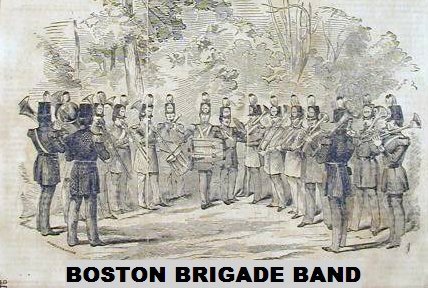
Boston Brigade Band (date unknown)
The Boston Brigade Band again invited Gilmore to be its leader in 1859. At the time, the Dodworth Band in New York was considered America’s best band. Like most American bands, it comprised exclusively brass and percussion instruments.
Gilmore accepted the invitation from Boston on the condition that it would become the Gilmore Band, a professional and proprietary organization like the Dodworth band. He insisted on the right to make not only musical decisions but also take control of bookings and other financial matters. By that time, some New York bands had started to include woodwind instruments. Gilmore followed that trend, recruiting 32 musicians to play a mix of woodwind and brass instruments.
As the name Boston Brigade Band suggests, the band was associated with a military brigade. Most American bands until near the end of Gilmore’s life were nominally military bands but, for all practical purposes, actually civilian bands. They were usually attached to a local militia unit, but most members did not have regular military duties. Their activities went beyond parades and ceremonial music.
To be financially successful, bands had to provide music to anyone willing to pay for it. They gave concerts and provided dance music for social entertainments. Their repertoire comprised quadrilles, waltzes, polkas, marches (which also served as dance music), patriotic music, popular songs, and for concerts, both instrumental and vocal soloists. Eventually, band repertoire expanded to include operatic excerpts and arrangements of orchestral masterpieces.
The new Gilmore band excelled in every aspect of band performance. By this time, Gilmore had developed enough of a national reputation that his band provided music for both the Republican and Democratic national conventions in 1860.
Civil War service

Inauguration of Michael Hahn, April 1864, the occasion of Gilmore’s first “monster concert” / Frank Leslie’s Illustrated News
When the Civil War broke out, Gilmore and his entire band enlisted in the army, becoming the band of the 24th Massachusetts Volunteer Regiment. It served with distinction during Gen. Ambrose Burnside’s occupation of much of North Carolina. In 1862, however, the federal government abolished regimental bands to save money. Gilmore and his band returned to Boston, and the governor of Massachusetts put him in charge of military bands statewide.
Union armies occupied New Orleans in 1862, and Gen. Nathaniel Banks, a former governor of Massachusetts, invited Gilmore to take charge of music for the inauguration of Louisiana’s new Republican Governor Michael Hahn. They both hoped that music would pacify a sullen population.
Gilmore assembled 500 army bandsmen as the Grand National Band and supplemented it with a 5,000-voice chorus of local children to perform patriotic music for the finale, Gilmore had electric buttons on the podium and used them to fire 36 canons. On that cue, church bells rang out all over the city. It was the most gigantic musical performance in America since Jullien’s 1853 tour and the first of Gilmore’s own monster concerts.
Gilmore continued to compose music throughout the war, often using the pen name Louis Lambert. These pieces include:
- God save the Union (“national anthem composed in honor of the day set apart by President Buchanan as the day of national fast and prayer for the preservation and peace of the Union, January 4, 1861”)
- Voice of a Departing Soul: bass aria (words and music by Gilmore, 1861)
- What Is Home without a Baby? (words and music by Gilmore, 1861)
- Adams and Liberty (“a popular and favorite melody as introduced in a great medley by Gilmore’s Band at Gilmore’s Promenade Concerts,” 1862)
- We Are Coming, Father Abrahams (1862)
- Laura Haunts My Fancy Still (song with words by G. Turnbull, 1863)
- Spirit of the North Quickstep (1863)
- When Johnny Comes Marching Home (1863)
- For Bales! an O’er True Tale (1864)
Jubilees and monster concerts
National Peace Jubilee, Boston
Gilmore presented a National Peace Jubilee in Boston in 1869 to celebrate the end of the Civil War. He assembled a band of 1,000 players and a chorus of more than 11,000 voices, plus a 7,000-voice children’s chorus. Performances took place in a new building constructed for the occasion, with 50,000 seats and the largest pipe organ in the country.
Such a huge performing ensemble is simply too large for successful performance of most of the repertoire Gilmore selected, but plenty of people recalled Jullien and appreciated the sheer immensity and showmanship of the project. The “Anvil Chorus” from Verdi’s Il trovatore especially excited the audience. Gilmore arranged to have one hundred firefighters, all wearing scarlet uniforms, march into the hall to play one hundred anvils. It was played on all the concerts.
The National Peace Jubilee made Gilmore famous all over the country. It whetted his appetite for something even bigger.
World Peace Jubilee, Boston

View of the great coliseum for the World’s Peace Jubilee and International Musical Festival / Emil Ackermann, from an original water color by Edward Knobel and Emil Ackermann, published by New England Lithographic Company
Gilmore presented an even larger festival, the World Peace Jubilee, in Boston in 1872, to celebrate the end of the Franco-Prussian War. He built a larger hall, the one built in 1869 having been destroyed by a storm, and doubled the size of the performing forces. He also invited 29 other American bands and, to give the jubilee an international flavor, three distinguished European military bands: the English Grenadier Guard Band, the French Garde Républicaine, and the Prussian Grenadier Regiment Band. His greatest coup, however, was to persuade the Waltz King Johann Strauss, Jr. to participate. Strauss later reported about his first concert:
I gave my signal, my 100 assistant conductors followed me as quickly and as well as they could and then there broke out an unholy row such as I shall never forget. As we had begun more or less simultaneously, I concentrated my whole attention on seeing that we should finish together too! — Thank heaven, I managed even that. It was all that was humanly possible. The 100,000 mouths in the audience roared and I breathed a sigh of relief when I found myself in fresh air again and felt the firm ground beneath my feet.
Fortunately, he had opportunity to conduct his own more reasonable-sized orchestra in many of his best-known waltzes, as well as the Jubilee Waltz he composed for the occasion.
If the massed concerts at the World Peace Jubilee failed artistically, the foreign bands were a revelation. Especially the French band achieved a variety of expression comparable to a symphony orchestra. Gilmore recognized that even his regular band at its best couldn’t match it.
Chicago Jubilee
Much of the public anticipated that he would try to top his Boston jubilees for the 1876 centennial of the Declaration of Independence, probably in a larger city than Boston. Gilmore had other plans.
He had already accepted an invitation to devise the Chicago Jubilee, which took place in Chicago’s new railway passenger terminal in June 1873. The Great Chicago Fire happened in 1871, and the city had begun a rapid recovery. Organizers recruited an orchestra of about 300 members, a 1,000-voice choir, and a 1,000-voice children’s choir. And they insisted on the Anvil Chorus.
Gilmore seems to have no longer been interested in such large-scale events. He only took about half of his own band. He set up a different location for the stage for each of the three concerts, but the shape and acoustics of the train station utterly defeated any hope of a good musical performance.
As in Boston, the audiences enjoyed the concerts anyway, but by that time Gilmore had decided that he wanted to make his band better and better, not bigger and bigger. It was his last monster concert.
New York 22nd Regiment Band

Gilmore Band, Manhattan Beach 1884
Gilmore learned from the World Peace Jubilee that his band and the Marine Band, though the best bands in the United States, couldn’t compare with the best European bands. The English, French, and German bands had outclassed Gilmore’s, and he wanted to surpass them by achieving a delicacy normally associated with string orchestras.
He decided that he needed a larger metropolitan area than Boston to recruit the best musicians. He moved his base of operations to New York City, which had a population of 950,000. Brooklyn was still an independent city of 400,000.
New York boasted numerous good military bands, that of the 7th Regiment having the greatest prestige. In 1873, Gilmore signed a contract with the city’s second most respected band, the 22nd Regiment, with which he remained associated for the rest of his life.
He and the regiment sought to surpass the 7th Regiment on the way to surpassing the Europeans. To that end, the regiment agreed to allow Gilmore to select 65 musicians and provide them with colorful uniforms. It paid the band for certain services either at the armory or on parade. Otherwise, the contract left Gilmore free to arrange whatever other engagements or tours he wanted.
In contrast to the brassy sound of the 7th Regiment Band, Gilmore hired mostly woodwinds, including luring some clarinetists from the French band. The musicians he recruited included several well-known soloists.
Possibly more important for his success, he designed a new management system. Traditionally, conductors had taken on the responsibilities of both the artistic and business sides of their bands. The combination bankrupted many excellent musicians. Gilmore maintained control of artistic decisions and turned such details as contracts over to a management team.
Building an excellent band
 The band’s inaugural concert took place at Brooklyn’s Academy of Music on November 16, 1873, to excellent reviews. Newspapers announced a concert by “Gilmore’s 22d Regiment Band!” Gilmore’s name appeared on a line by itself, with smaller type than the band’s name, but in bold. While it was always officially the 22nd Regiment Band, it soon became known as Gilmore’s Band.
The band leased P.T. Barnum’s Hippodrome, redesigned it, and renamed it Gilmore’s Garden. When the lease was up, the owner renamed the space Madison Square Garden. Gilmore’s Band continued as a main attraction. It performed nearly every day, often twice a day.
Most of the year, Gilmore’s band played concerts, balls, parades, and for various regimental duties in New York. They played a three-month summer season at Manhattan Beach, one of three luxury hotels on Coney Island. The hotels kept separate from the crowds of less wealthy people at the amusement park that occupied the western portion the island. In the spring, the band toured, sometimes just up and down the east coast but occasionally farther away. The tours barely covered expenses, but they kept the musicians employed and together year-round.
Besides excellent musicianship, good business sense, and a flair for showmanship, Gilmore had another important attribute that helped his success. In an industry marked with colossal egos and fierce rivalries, Gilmore was a genuinely nice person. No one could stay angry with him for long, and he was able to keep peace within the organization.
Long tours
In 1876, Gilmore took a 50-piece band and five soloists on a transcontinental tour, traveling by rail. It included stops in Buffalo, Detroit, Chicago, Omaha, Salt Lake City, and San Francisco. Never before had an ensemble of professional musicians made such a tour.
Two years later, Gilmore embarked on a European tour to test his band against the best in Europe. He was not the first American conductor to take a band to Europe. That honor goes to Francis Johnson, but Johnson had a much smaller band and toured only England. Gilmore’s tour was much more ambitious.
The band arrived in Dublin in May1878 and played six concerts to packed audiences. Then it spent 30 days in England, playing 65 concerts in 30 cities. The tour continued in France, Holland, Belgium, and Germany. The Leipzig concert opened with the “Tannhäuser Suite,” arranged from Wagner’s music. Wagner sat in the front row and was so delighted with the performance that he started sending all his new compositions to Gilmore in New York.
The tour was a complete triumph. A Leipzig critic attempted to explain why Gilmore’s band was probably the best in the world. In Gilmore’s report to his commanding officer, he noted, “The press everywhere has passed high encomiums on the band and has gone so far as to assert that even here in musical Germany we have inaugurated a new era in the progress of military music.”
Gilmore’s legacy

Illustration of Zouaves from broadside of “When Johnny Comes Marching Home” (1863)
Having accomplished his goal of leading a band acknowledged as superior to the best European bands, Gilmore continued his rigorous schedule of performances in New York and on tour. His success encouraged other conductors, including John Philip Sousa, to form their own touring bands. He had inaugurated the golden age of American wind band music, which saw not only dozens of professional bands but also countless municipal bands, school and college bands, and bands sponsored by various industrial entities to provide recreation for their employees.
He planned to spend several months in Chicago for the Worlds Columbian Exposition (May-November 1893) and then take a second European tour, but he died suddenly in St. Louis in September 1892. No other potential leader could keep the band together. Sousa had just started to form his own band, and the first piece his band performed was Gilmore’s “Voice of a Departing Soul.”
In his memoir, Sousa recalled,
The passing of Patrick Sarsfield Gilmore . . . saddened the musical world. Mr. Gilmore had organized and gathered together the very best woodwind and brass players of both Europe and America. He had gone into the highways and byways of the land, playing Wagner and Liszt, and other great composers, in places where their music was absolutely unknown, and their names scarcely more than a twice-repeated sound.
Not only had Gilmore’s tours taken music of great composers to the hinterlands, but his band also introduced bassoons and other instruments previously unknown there. All those bands that followed in his wake emulated his repertoire and his instrumentation. Wherever Gilmore’s band didn’t go, another similar band provided the locals’ first opportunity to hear great music.
More compositions by Gilmore
None of Gilmore’s compositions after the Civil War matched the popularity of “We Are Coming Father Abraham” or “When Johnny Comes Marching Home,” but some continue to be reasonably well known to this day. This music includes:
- Emblem Schottische (1866)
- The Everlasting Polka (1866)
- Norwich Cadets Polka (1866)
- Sad News from Home (1866)
- President Grant’s March (1869)
- Coliseum Grand March (co-written with Adolph Schmidt, 1872)
- 22nd Regiment March (1874)
- Columbia: A New National Song (1879)
Sources:
Johann Strauss, Jr. in the United States, 1872 / MaestroDJS, The Classical Music Guide Forums. June 18, 2008
Opera at the bandstand: then and now / George W. Martin (Scarecrow Press, 2014)
Patrick S. Gilmore: pioneer in big band arranging / Songwriters Hall of Fame
Strike up the band! The legacy of Patrick S. Gilmore / Jere T. Humphries, Music Educators Journal (October 1987)
With perfect pitch: Patrick Sarsfield Gilmore / Jarlath MacNamara, New York Irish History Roundtable 27 (2013): 20-3
The wind band: its literature and technique / Richard Franko Goldman (Allyn and Bacon, 1961)
WorldCat
Comments
Patrick S. Gilmore: pioneering American bandmaster — No Comments
HTML tags allowed in your comment: <a href="" title=""> <abbr title=""> <acronym title=""> <b> <blockquote cite=""> <cite> <code> <del datetime=""> <em> <i> <q cite=""> <s> <strike> <strong>