↓
 

Musicology for Everyone

(Professional research for a general audience)

  • Home
  • About
  • Contact me
Home→Author David Guion - Page 55 << 1 2 … 53 54 55 56 57 >>

Author Archives: David Guion

Post navigation

← Older posts
Newer posts →

Trois gymnopédies by Erik Satie

Musicology for Everyone Posted on February 8, 2010 by David GuionMay 14, 2022 2
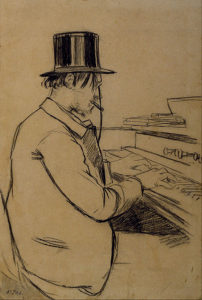
Erik Satie

Portrait of Erik Satie Playing the Harmonium / Santiago Rusiñol (1891)

Erik Satie, an eccentric composer of minor talent but great imagination, exercised enormous influence on twentieth-century musical thought. Above all a musical humorist, he issued his first published composition as op. 62. His longest work, Vexations, consists of just over a minute’s worth of music played 840 times without pause.

The Gymnopédies, composed in 1888 for piano solo, exhibit a different kind of humor, based on Satie’s conscious and deliberate antagonism to verifiable facts.

In ancient Greece, the gymnopedia, or festival of naked youth, was celebrated every year in Sparta to honor Apollo, Pythaeus, Artemis, and Ledo. The days-long festival concluded with gymnastic exhibitions and frenzied dancing offered not to the four deities already named, but to Dionysius.

Satie composed slow, dignified, pieces utterly devoid of passion and chose to give them a title that conjured up images of a boisterous celebration. Having thus deliberately misrepresented the gymnopedia, perhaps he would be astounded to learn that the whole concept of serene classicism just as thoroughly misrepresents ancient Greek esthetics as a whole.

Scholars have since determined that the gleaming whiteness of the marble, which we admire so greatly, does not reflect the original intent of the artists. They did not consider their works complete without application of flamboyant colors, which the passage of centuries has stripped away.

That Satie became so well known and influential can be traced in part to his friendship with Claude Debussy. In 1911 Debussy orchestrated the third and first of the Gymnopédies, in that order. Many critics have complained that the orchestration obscured Satie’s clear outlines. Be that as it may, the pieces gained more in prestige than they lost in clarity. It is in Debussy’s version that they, and Satie himself, first became well known.

Posted in Orchestras, Program notes | Tagged Debussy (Claude), Gymnopédies, orchestral music, piano music, program notes, Satie (Erik) | 2 Replies

Rapsodie espagnole by Maurice Ravel

Musicology for Everyone Posted on February 1, 2010 by David GuionMay 14, 2022  
Orchestra performing Dvorak's eighth symphony

Immaculata Symphony Orchestra / Jim, the Photographer via Flickr 

Ironically, in view of Maurice Ravel’s reputation as a brilliant orchestrator, he conceived only Rapsodie espagnole as a purely orchestral display piece from the beginning, and that only in part. He either wrote his other orchestral works for the stage or transcribed them from piano pieces. In fact, the “Habanera” in Rapsodie espagnole was written originally for two pianos.

Ravel shared the enthusiasm of many French composers for Spanish music. In his case, he absorbed an understanding of both French and Spanish culture as a child. Son of a Swiss father and Basque mother, he grew up in the Basque region. In a review of Rapsodie espagnole, Spanish composer Manuel de Falla wrote:

“It surprises me by its genuinely Spanish character. In absolute agreement with my own intentions this “Hispanization” is not achieved merely by drawing upon popular or “folk” sources (except the Jota in “Feria”), but rather through the free use of modal rhythms and melodies and ornamental figures of our “popular” music, none of which has altered in any way the natural style of the composer.”

The first movement, “Prélude à la nuit” (Prelude to the night), never gets louder than mezzo-forte. Ravel achieved the veiled sound in part by spacing muted violins and violas two octaves apart. Two dance movements follow, “Malagueña” and “Habanera.” In the final movement, “Feria” (The fair), several instruments exchange the solo lines. The opening dancelike material gives way to a quiet middle section before returning to bring the piece to a rousing close.

Posted in Orchestras, Program notes | Tagged orchestral music, program notes, Rapsodie espagnole, Ravel (Maurice), twentieth century | Leave a reply

Le bourgeois gentilhomme, by Richard Strauss

Musicology for Everyone Posted on January 22, 2010 by David GuionOctober 26, 2020  

Richard Strauss and Hugo van Hoffmannstthal had already achieved operatic success with Elektra and Der Rosenkavilier when Hoffmannsthal suggested Molière’s comedy Le bourgeois gentilhomme for their next collaboration.

In that play, Jourdain, a social-climbing cloth merchant, wishes to be thought an aristocrat. A boorish fool concerned only with appearances, he hires teachers of music, dance, fencing, and philosophy so he can learn aristocratic ways. Hofmannsthal proposed to shape Molière’s hopelessly tangled plot into an opera within a play. Continue reading →

Posted in Program notes | Tagged Hoffmansthal (Hugo von), Le bourgeois gentilhomme, orchestral music, Strauss (Richard), suites, twentieth century | Leave a reply

Girls and trombone: odder than I first thought?

Musicology for Everyone Posted on January 15, 2010 by David GuionMay 15, 2021  
trombonists in girls bands

Members of the Dong Ju High School girls band perform during the arrival of the aircraft carrier USS MIDWAY (CV 41). Picryl

I had just begun seventh grade the first time I met a girl trombonist, who was also in seventh grade. It didn’t take long to realize that she was better than any other trombonist in the band, and there were lots of them. When we got to ninth grade (freshman year of high school), she played better than any of the seniors.

Her older sisters, recent graduates, had been just as outstanding on  horn and tuba. The best trumpet player was a girl, as were all of the hornists, and a euphonium player. It never occurred to me that there was anything odd about girls playing brass instruments.

Once out of high school, I continued to meet women who played various brass instruments. Many were very good, but as I talked with them and read about musicians in orchestras and on college faculties, I learned that many people did find women brass players more than a little disconcerting.

Many years later, I heard a friend from graduate school deliver a paper based on her doctoral research. She had studied references to music in almost fifty years of Godey’s Lady’s Book, an important magazine of the mid-nineteenth century. One particular thought sticks with me. Society expected respectable young women to play piano. I do not recall if violin was considered suitable for women, but respectable women did not play wind instruments of any kind.

That surprised me. I had always thought of flute as a woman’s instrument. No boys in my high school played flute, and I met only one boy flutist at another school. A man taught flute at my undergraduate school, but only one man studied with him. A woman taught flute in my graduate school, and I don’t recall any men students.

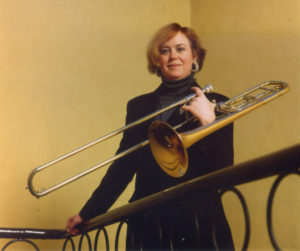
Abbie Conant’s struggle for acceptance as trombonist

Abbie Conant. girl trombonists

Abbie Conant /

These musings came to mind recently as I read an account of Abbie Conant’s troubles with the Munich Philharmonic Orchestra. Playing behind a screen, she won an audition for principal trombonist when conductor Sergiu Celebidache exclaimed, “that’s the one we want” and sent seventeen other applicants away without hearing them. Only then did he learn that he  had selected a woman.

According to Malcolm Gladwell, holding auditions behind a screen, which takes away all visual cues, has resulted in the hiring of many women in orchestras. Any number of orchestras may have been surprised that the best-sounding candidate was a woman or non-white, but most trusted their ears and adjusted.

Celibidache made no attempt to turn away from his hidebound prejudice that a woman could not possibly play principal trombone adequately. Conant took the orchestra to court, and the  litigation lasted more than a dozen years. She won every round. Celibidache, having decided to trust his eyes instead of his ears, could no longer hear what any other musician testified, that Conant fully deserved the position that she had won.

Now, when I see “Who says girls can’t play trombone?” in a woman’s signature line, I’m no longer surprised, but it’s sad. Everyone is good at something and no good at something else. No one can determine a person’s aptitudes merely by observing sex or ethnicity. I wish everyone would stop trying.

Meanwhile, check out this clip of an all-woman trombone quartet called Bones Apart playing an arrangement of Stars and Stripes Forever. You’ll be thinking, “Hey, you can’t play that on trombones!” But they do.

References:
Music and references to music in Godey’s Lady’s Book : 1830-77 / by Julia Eklund Koza (Ph.D. dissertation: University of Minnesota, 1988).

Blink: the power of thinking without thinking / by Malcolm Gladwell (New York: Back Bay Books, 2005), pp. 245-54.

Posted in Trombone and other brass | Tagged brass players, Celibidache (Sergiu), classical music, Conant (Abbie), equal opportunity, orchestras, prejudice, trombonists, video, women musicians | Leave a reply

Who wrote the first opera in the United States?

Musicology for Everyone Posted on January 12, 2010 by David GuionDecember 6, 2012  

The usual answer to that question, William Henry Fry, produced Leonora in Philadelphia in 1845. A skillful imitation of Bellini and Donizetti it ran for twelve performances, successful enough to justify publication of a piano-vocal score. Fry’s brother Joseph adapted the libretto from a novel by Bulwer-Lytton.

In the November 23, 1843 issue of the Daily Picayune, a New Orleans newspaper, appears notice of a new opera:

“The idea of a Native American Opera is something so new and unexpected that our musical amateurs and connoisseurs were not a little taken aback by the announcement of Andre at the American Theatre, and, the consequence was . . . a considerable stirring up of curiosity. The name of Cioffi, in connection with the affair, was alone sufficient to give it respectability, and ensure for its proper consideration. . . .”

Felippe Cioffi was best known as an excellent trombonist. Apparently Italian born but educated and trained in this country, he had many years experience playing in theater orchestras. He was also a military band master, composer of marches, and winner of a local contest for the best arrangements of American patriotic melodies.

The article goes on to say that Andre “afforded satisfaction” for two performances. Then it disappeared from sight. Fry, an experienced and well-rounded composer, undoubtedly wrote a better opera. Cioffi produced his more than a year earlier.

Posted in Composers | Tagged American music, Cioffi (Felippe), Fry (William Henry), nineteenth century, opera | Leave a reply

Gate crashers: trombones in Handel’s Messiah

Musicology for Everyone Posted on December 25, 2009 by David GuionDecember 5, 2020  
trombonist

Illustration by Charles Reinhardt for an 1875 story in Harper’s Magazine about a man with the misfortune to live upstairs from a trombonist.

Merry Christmas! Although Messiah is, strictly speaking, not Christmas music, having been composed for Lenten performances, today we most often hear it at Christmas.

Handel used trombones to great effect in two of his oratorios, Saul and Israel in Egypt, both first performed in 1738. Apparently he did not have access to trombones in any later year; he considered adding trombones to two later oratorios, not including Messiah, but soon abandoned the effort.

Unlike most other music of his time and earlier, Handel’s did not suffer posthumous neglect. The Concert of Ancient Music, founded in 1776, actually had a rule that it would perform no music unless it was at least 20 years old.

There was hardly any music with authentic trombone parts that came within these limits, but Adam Carse reports that W. Greatorex, its secretary and librarian, “an incorrigible arranger and adder of accompaniments, was kept fairly busy gilding lilies.” The orchestra regularly included clarinets, four horns, and three trombones.

Mozart adds trombones

Not only did English audiences continue to enjoy his oratorios, they even came into vogue in Vienna. Mozart reorchestrated Messiah, among other Handel works, to bring them up to date. Typical of Mozart’s own church music, his Messiah arrangement includes three trombones (1789).

The Handel commemoration of 1789

The English apparently did not use a standard orchestration. The great Handel commemoration of 1789 assembled a large chorus and orchestra, including every instrument Handel had ever used. Sources differ, but the orchestra had either three or six trombonists, who all played other instruments when there were no trombone parts. That does not mean that they played trombone only for Saul and Israel in Egypt. Various accounts of the performance mention trombones in several other pieces.

After the three performances originally scheduled, the king commanded that some of the music be repeated in two more concerts. Commenting on the repetition of Messiah on the second of these, Charles Burney, the event’s official historian, noted  some significant differences in the manner of playing it: “Another new and grand effect was produced to-day in the Hallelujah, and last Chorus, “Worthy is the Lamb,” by the introduction of the tromboni, which were not used in these Choruses, on the former occasion.”

Later added trombone parts to Messiah

circus trombonist. trombone reputation 19th century

A poster by C. Burckardt advertising for a circus, ca. 1880

The Times of London advertised at least twelve Lenten performances of Messiah between 1797 and 1800 “assisted by the Trombones and Double Drums, used at Handel’s Commemoration at Westminster Abbey.” As far as I can tell, Mozart’s orchestration was not yet known in England. Its eventual discovery did not keep meddlers from adding to it, as this complaint from the Times about the 1846 Birmingham Festival attests:

The brass instruments (two serpents, an ophicleide, and three trombones included) completely murdered the choruses, “the Lord of hosts,” and “Hallelujah.” Surely Mozart has done as much with Handel’s score as is necessary, and, indeed, permissible; the noisy unmeaning additions of loud instruments by Greatorex and others, only serve to transmogrify the sublimity of Handel into mere rant; and moreover, the object of increased power is not obtained, since those choruses in which the score of Handel remains untouched, except by the mastery and considerate hand of Mozart, are twice and loud and brilliant as those which have been smothered under a weight of brass, &c., by incompetent and injudicious meddlers. The intrusion of two serpents, three trombones, and an ophicleide, into the score of such a complete masterpiece as the Messiah, is absolutely ridiculous; and it should be the duty and wish of judicious conductors to restore Handel to his primitive integrity.

“Greatorex and others” appears to include John Smithies, one of the most active trombonists in London at least from the early 1820s into the middle of the 1840s. Apparently, most later conductors continued to use the same arrangement for the rest of the century. The Times summarized a lecture about the subject in 1899:

Gresham Lectures in Music.

The last two of the series of four lectures given by Sir Frederick Bridge on Handel’s Messiah were exceedingly interesting; that on Thursday could not fail to be most amusing throughout, since it dealt with the incredible “improvements” of Mozart’s additional accompaniments, and with the added trombone parts of a certain Mr. Smithies, who perpetrated an appalling number of dissonances and harmonic errors, which apparently have been retained down to the present day.

Perhaps by that time, someone started to make an effort to clean up the standard score and parts, but performances with a thousand choristers and orchestras with instruments Handel never heard of continued until the attempt to find authentic performance practice started in earnest after the Second World War.
Posted in Christmas music, Trombone and other brass | Tagged eighteenth century, Handel (George Frideric), Messiah, performance practice, trombone | Leave a reply

Post navigation

← Older posts
Newer posts →

Musicology for Everyone

Search by category

  • American popular music
    • Civil War music
    • Jazz
  • Anecdotes
    • Quotations
  • Bands and band music
  • Christmas music
  • Classical music
  • Composers
  • European musical history
  • Humor
  • Music education
  • Music Festival
  • Opera
  • Orchestras
  • Program notes
  • Trombone and other brass
  • Uncategorized

Archives

Music composer jobs
Footer HTML
©2026 - Musicology for Everyone - Weaver Xtreme Theme
↑