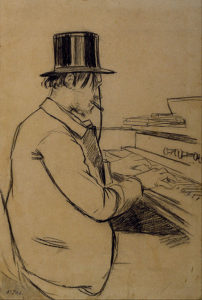
Portrait of Erik Satie Playing the Harmonium / Santiago Rusiñol (1891)
Erik Satie, an eccentric composer of minor talent but great imagination, exercised enormous influence on twentieth-century musical thought. Above all a musical humorist, he issued his first published composition as op. 62. His longest work, Vexations, consists of just over a minute’s worth of music played 840 times without pause.
The Gymnopédies, composed in 1888 for piano solo, exhibit a different kind of humor, based on Satie’s conscious and deliberate antagonism to verifiable facts.
In ancient Greece, the gymnopedia, or festival of naked youth, was celebrated every year in Sparta to honor Apollo, Pythaeus, Artemis, and Ledo. The days-long festival concluded with gymnastic exhibitions and frenzied dancing offered not to the four deities already named, but to Dionysius.
Satie composed slow, dignified, pieces utterly devoid of passion and chose to give them a title that conjured up images of a boisterous celebration. Having thus deliberately misrepresented the gymnopedia, perhaps he would be astounded to learn that the whole concept of serene classicism just as thoroughly misrepresents ancient Greek esthetics as a whole.
Scholars have since determined that the gleaming whiteness of the marble, which we admire so greatly, does not reflect the original intent of the artists. They did not consider their works complete without application of flamboyant colors, which the passage of centuries has stripped away.
That Satie became so well known and influential can be traced in part to his friendship with Claude Debussy. In 1911 Debussy orchestrated the third and first of the Gymnopédies, in that order. Many critics have complained that the orchestration obscured Satie’s clear outlines. Be that as it may, the pieces gained more in prestige than they lost in clarity. It is in Debussy’s version that they, and Satie himself, first became well known.
 Debussy wrote his last ballet and last orchestral work, Jeux, (or Games for Sergei Diaghilev’s Ballet Russe, with Vaslav Nijinsky as choreographer and lead dancer. The first performance puzzled its audience, and as it took place only two weeks before the tumultuous premiere of Stravinsky’s Le sacre du printemps, it was nearly forgotten in the uproar.