↓
 

Musicology for Everyone

(Professional research for a general audience)

  • Home
  • About
  • Contact me
Home→Tags piano music

Tag Archives: piano music

Four tangos by classical composers

Musicology for Everyone Posted on July 1, 2013 by David GuionMay 7, 2018  
Tango dancers

Tango dancers

The tango, in a sense, is to 20th-century music what the waltz was in the 19th century. It originated from the lower social classes of Argentina.

Polite society found it scandalous (as respectable people had scorned the waltz in Bohemia, Austria, and Bavaria a century earlier).

But like the waltz it became insanely popular in Paris and eventually embraced at home.

Paris has long served as the launching pad for dances that, whatever their origin, become internationally popular.

Just as classical composers of the 19th century embraced the waltz, so those of the 20th century (and at least one who jumped the centennial gun) embraced the tango. Here are four examples from three composers: Albéniz, Stravinsky, and Babbitt. Continue reading →

Posted in Classical music, Program notes | Tagged classical music, nineteenth century, piano music, tango, twentieth century, videos | Leave a reply

What they say about the piano

Musicology for Everyone Posted on October 8, 2012 by David GuionApril 23, 2022  

buy classical musicLife is like a piano… What you get out of it depends on how you play it. ~Author Unknown

The piano is the social instrument par excellence… drawing-room furniture, a sign of bourgeois prosperity, the most massive of the devices by which the young are tortured in the name of education and the grown-up in the name of entertainment. ~Jacques Barzun

PIANO, n. A parlor utensil for subduing the impenitent visitor. It is operated by pressing the keys of the machine and the spirits of the audience. ~Ambrose Bierce

Life can’t be all bad when for ten dollars you can buy all the Beethoven sonatas and listen to them for ten years. ~William F. Buckley, Jr.

Pianos

Pianos at the Sauder Village and Museum, Archibold, Ohio

A piano store looks like a funeral parlor for music. ~ Ramon Gomez de la Serna

Love is a piano dropped from a fourth story window, and you were in the wrong place at the wrong time. ~Ani Difrenceo

I see the player piano as the grandfather of the computer, the ancestor of the entire nightmare we live in and the birth of the binary world where there is no option other than yes or no and where there is no refuge. ~William Gaddis

When she started to play, Steinway came down personally and rubbed his name off the piano. ~Bob Hope

The piano is able to communicate the subtlest universal truths by means of wood, metal and vibrating air. ~Kenneth Miller

Get up from that piano. You’re hurtin’ its feelings. ~ Jelly Roll Morton

On television I feel like a man playing piano in a brothel; every now and again he solaces himself by playing ‘Abide with Me’ in the hope of edifying both the clients and the inmates. Malcolm Muggeridge

The notes I handle no better than many pianists. But the pauses between the notes – ah, that is where the art resides! ~Artur Schnabel

The piano is a monster that screams when you touch its teeth. ~Andre Segovia

The typewriting machine, when played with expression, is no more annoying than the piano when played by a sister or near relation. ~Oscar Wilde

They afterwards took me to a dancing saloon where I saw the only rational method of art criticism I have ever come across. Over the piano was printed a notice- ‘Please do not shoot the pianist. He is doing his best. ~Oscar Wilde

Photo credit: David M. Guion

Posted in Quotations | Tagged piano music, quotations | Leave a reply

Theodore von La Hache: a leading composer of Confederate songs

Musicology for Everyone Posted on January 3, 2012 by David GuionAugust 7, 2023 2

I had never heard of Theodore von La Hache until recently, but he is a fascinating figure in American musical history who deserves to be better known.

One of the many German musicians who moved to the United States, he settled in New Orleans in about 1842. There he served as organist and choirmaster at St. Theresa of Avila Church, co-founded the New Orleans Philharmonic Society, and composed prolifically.

During the Civil War, La Hache wrote his Missa Pro Pache (op. 644) in response to its horrors. He also wrote many songs and piano pieces related to the war. Continue reading →

Posted in Civil War music, Composers | Tagged American Civil War, American popular songs, composers, nineteenth century, piano music | 2 Replies

Trois gymnopédies by Erik Satie

Musicology for Everyone Posted on February 8, 2010 by David GuionMay 14, 2022 2
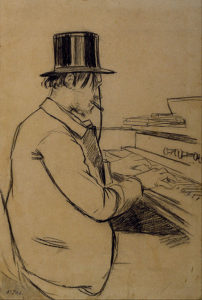
Erik Satie

Portrait of Erik Satie Playing the Harmonium / Santiago Rusiñol (1891)

Erik Satie, an eccentric composer of minor talent but great imagination, exercised enormous influence on twentieth-century musical thought. Above all a musical humorist, he issued his first published composition as op. 62. His longest work, Vexations, consists of just over a minute’s worth of music played 840 times without pause.

The Gymnopédies, composed in 1888 for piano solo, exhibit a different kind of humor, based on Satie’s conscious and deliberate antagonism to verifiable facts.

In ancient Greece, the gymnopedia, or festival of naked youth, was celebrated every year in Sparta to honor Apollo, Pythaeus, Artemis, and Ledo. The days-long festival concluded with gymnastic exhibitions and frenzied dancing offered not to the four deities already named, but to Dionysius.

Satie composed slow, dignified, pieces utterly devoid of passion and chose to give them a title that conjured up images of a boisterous celebration. Having thus deliberately misrepresented the gymnopedia, perhaps he would be astounded to learn that the whole concept of serene classicism just as thoroughly misrepresents ancient Greek esthetics as a whole.

Scholars have since determined that the gleaming whiteness of the marble, which we admire so greatly, does not reflect the original intent of the artists. They did not consider their works complete without application of flamboyant colors, which the passage of centuries has stripped away.

That Satie became so well known and influential can be traced in part to his friendship with Claude Debussy. In 1911 Debussy orchestrated the third and first of the Gymnopédies, in that order. Many critics have complained that the orchestration obscured Satie’s clear outlines. Be that as it may, the pieces gained more in prestige than they lost in clarity. It is in Debussy’s version that they, and Satie himself, first became well known.

Posted in Orchestras, Program notes | Tagged Debussy (Claude), Gymnopédies, orchestral music, piano music, program notes, Satie (Erik) | 2 Replies

Musicology for Everyone

Search by category

  • American popular music
    • Civil War music
    • Jazz
  • Anecdotes
    • Quotations
  • Bands and band music
  • Christmas music
  • Classical music
  • Composers
  • European musical history
  • Humor
  • Music education
  • Music Festival
  • Opera
  • Orchestras
  • Program notes
  • Trombone and other brass
  • Uncategorized

Archives

Music composer jobs
Footer HTML
©2026 - Musicology for Everyone - Weaver Xtreme Theme
↑