↓
 

Musicology for Everyone

(Professional research for a general audience)

  • Home
  • About
  • Contact me
Home→Tags orchestras

Tag Archives: orchestras

Youth orchestras: killing two stereotypes at once

Musicology for Everyone Posted on November 30, 2015 by David GuionNovember 10, 2023  
Berkeley Youth Orchestra

Berkeley Youth Orchestra beginning bass class

Young people these days can’t be pried away from their cell phones. They’re lazy and undisciplined. At least, that’s the prevailing stereotype.

Classical music is just about dead according to obituaries that seem to appear in magazine articles and well-read blogs every year.

No one cares about such old-fashioned music except an increasingly aging population. At least, that’s the prevailing stereotype.

Don’t be fooled. Youth orchestras all over the country (and all over the world, for that matter, in case the stereotypes cross international borders) work very hard to polish performances of the standard orchestral repertoire. They love the music, and they work hard to master it, taking lessons, practicing, and attending rehearsals (including sectional rehearsals).  Continue reading →

Posted in Music education, Orchestras | Tagged children, orchestras, taste, videos | Leave a reply

The Recycled Orchestra of Paraguay

Musicology for Everyone Posted on January 21, 2013 by David GuionApril 21, 2022  
Recycled orchestra

Luis Szarán and the recycled orchestra

How did the town of Cateura, Paraguay get an internationally known youth orchestra?

It sits on the largest landfill in the country. Its citizens pick through the trash to find things to recycle and sell.

It’s almost as if both the contents of the landfill and the people who live on it are discards, out of sight and out of mind for most of the rest of the country.

The story begins with Luis Szarán, since 1990 the conductor of the Symphonic Orchestra of Asunción. He grew up poor, the eighth child of Paraguayan farmers. He had musical talent. A professional musician, José Luis Miranda, discovered him, taught him, and enabled him to study music in Europe.

The story of a poor child being discovered, rescued from poverty, and achieving success and acclaim is quite common. Frequently these people search for ways to give back to the community. At that point, the stories cease to be common and become unique.

Sonidos de la Terra (Sounds of the Earth)

In 2002, Szarán began a project he called Sonidos de la Terra to bring free music education to poor children. Cateura is only one town among several where Szarán became active. He had five violins, but 50 children expressed interest in learning to play them.

One of his associates, Favio Chávez, noticed a craftsman named Colá among the trash pickers. He provided a violin to see if Colá could make something similar.

Colá took careful measurements and fashioned a copy from aluminum cans and other scrap. It looked sort of like a violin. Was it a usable instrument, or just a violin-shaped object? A professional violinist tested it and found it playable and functional. Colá also made a soprano saxophone and a flute from a water pipe, spoons, buttons, and assorted other junk, as well as a whole family of stringed instruments.

By the way, Colá knew nothing of music before he met Chávez. He had never heard of Mozart. I would imagine that most of what he made eventually left Cateura for sale elsewhere. The instruments stayed nearby, and he got to see how much they meant to the children who learned to play them.

The children who received the instruments and learned to play them loved them. Only after several children had recycled instruments did Szarán get the idea of forming some kind of ensemble. He has since taken it on a European tour. He received the Skoll Foundation Award for Social Entrepreneurship in 2005. The video is a preview of a feature length film scheduled for release in 2014.

Implications for music education in the US

Will any of these children become professional musicians? It really doesn’t matter. Will they become good citizens, making some kind of contribution to Paraguayan society? Almost certainly. That’s the whole point.

Music will not change harsh living conditions. It won’t cure health care issues or banish hunger. But it certainly will give the participants and the surrounding community the means to avoid being crushed and victimized by their circumstances.

The poorest and most deprived children in the US might not live on a garbage dump, but they certainly know hopelessness, despair, and the feeling of being discarded by the rest of society.

I don’t need to argue that music education can lift them up as it has the children of Cateura. That fact has been demonstrated many times, in many ways, and in many poor neighborhoods. The catalyst doesn’t even have to be music. It can be dancing. It can be art. It can be chess.

The fact is that the world of poverty and lack is not really significantly different from the world of material comfort and affluence. One has more money, but people living in both partake of the same culture. Bridges exist to carry people from one world to the other. Music is one of them.

It’s hopeless people who join gangs, who get caught up in the culture of drugs and alcohol, who commit acts of vandalism. Hopelessness is certainly not limited to poor neighborhoods, but it’s in poor neighborhoods where music has the greatest power to combat hopelessness.

Will the story of the recycled orchestra inspire Americans to warm and fuzzy feelings for a while? Or will it instead inspire a number of Americans to use whatever resources and skills they have to take the message of hope to where it is needed most?

Sources:
Luis Szarán biography
Skoll Foundation page on Luis Szarán

Posted in Music education, Orchestras | Tagged conductors, music education, music in society, orchestras, Szarán (Luis), twenty-first century, videos | Leave a reply

A pre-history of orchestra conductors

Musicology for Everyone Posted on September 3, 2012 by David GuionMay 7, 2018 3

orchestra conductorLong ago, the leader of the instrumental ensemble at a court or large church was called the concert master.

Orchestras came later. Nowadays, orchestras still have a concert master.

The public notices this person mostly because he or she is the last member of the orchestra to come on stage. The conductor comes next.

The earliest orchestras had no conductor the way we think of conductors.

Conducting as we know it, was well known by the fairly small choirs of the Middle Ages and Renaissance. In fact, some choirmasters held a rolled up sheaf of paper in their hand (or in both hands if need be) as they did so.

Usually, though, instead of simply moving their hands, they tapped on something to make an audible sound.

Violinists would lead instrumental ensembles with gestures, and possibly tapping sounds, from their bow. By the beginning of the 1600s, violinists were the leaders, or concert masters, more often than not.

As ensembles got larger and more spread out, hand gestures and tapping with the bow no longer seemed to work. Some leaders even resorted to pounding a large stick on the floor to make a louder sound, although no one really liked the racket it presented to the audience.


Divided responsibility in early orchestras

The orchestra emerged in the last half of the 1600s, or the middle Baroque period. By that time, the practice of basso continuo was well established. So who would lead? The concert master with his violin? Or the keyboard player, who was often the composer of the piece? Or somehow both?

In a treatise of 1752, C.P.E. Bach advocated leading instrumental ensembles from the keyboard.

The following year, his colleague Johann Joachim Quantz wrote a treatise that recommended the violinist as leader, although not necessarily if the keyboard player was a distinguished composer.

Anecdotes abound of violinists and keyboardists trying to wrest control of a performance from each other.

At least in part because of the chaos surrounding the French Revolution, public concert life ceased for more than 20 years in the three major capitals of Europe: Paris, London, and Vienna.

By the time public concert series resumed, the continuo had become obsolete. In most of Europe, therefore, leadership of the orchestra was firmly in the hands of the principal violinist. When the Philharmonic Society of London was formed in 1813, though, they adopted a very strange kind of divided leadership.

Someone known as the “leader” played violin while standing in front of the orchestra, but he only had his own part to read from. Most of the rest of the orchestra stood to play, too. They stood so far apart, that it was difficult for the leader to keep them all together.

The person presiding at the piano had the score. He did not play constantly. His most important leadership role was to play when the ensemble fell apart enough that the leader could not keep them together. Or whenever else it suited his fancy.

Neither the violinist designated leader nor the pianist held that position permanently. Usually a different pair took responsibility for each concert. Individually, therefore, the orchestra consisted of excellent players, but they did not play well together as an ensemble.


Conducting with a baton

Except for the very odd leadership participation of the pianist with the score, the role of the English “leader” was not unusual in the rest of Europe. The principal violin gave time with his bow and had only the first violin part in front of him.

His part had important cues for other parts, and he did not actually play during the performance unless it seemed necessary. The best of these violinist/conductors must have studied the score and prepared the orchestra in rehearsal.

Some conductors chose, at least part of the time, to roll up paper instead of using their bows. Something shorter than the bow would obviously be easier to handle. A few actually adopted a wooden baton before the end of the 1700s. It caught on slowly, and many orchestras resisted it.

Louis Spohr

Portrait by Franz Adam Schröder, 1850

Louis Spohr claimed to have introduced the baton to the London Philharmonic Society when he was invited to be guest leader in 1820:

So numerous an orchestra, standing so far apart from each other at that of the Philharmonic, could not possibly go exactly together, and in spite of the excellence of the individual members, the ensemble was much worse than we are accustomed to in Germany. I had therefore resolved when my turn came to direct, to make an attempt to remedy this defective system.

Fortunately at the morning rehearsal on the day when I was to conduct the concert, Mr. Ries took the place at the Piano, and he readily assented to give up the score to me and to remain wholly excluded from all participation in the performance.

I then took my stand with the score at a separate music desk in front of the orchestra, drew my conducting baton from my coat pocket, and gave the signal to begin. Quite alarmed at such a novel procedure, some of the directors would have protested against it; but when I besought them to grant me at least one trial, they became pacified.

The symphonies and overtures that were to be rehearsed were well known to me, and in Germany I had already directed at their performance. I therefore could not only give the tempi in a very decisive manner, but indicated also to the wind instruments and horns all their entries, which ensured to them a confidence such as hitherto they had not known there.

I also took the liberty, when the execution did not satisfy me, to stop, and in a very polite but earnest manner to remark upon the manner of execution, which remarks Mr. Ries at my request translated for the orchestra.

Spohr went on to claim that the orchestra played with a spirit and correctness never before heard in London. He further claimed that the orchestra was so pleased with the result of the way he conducted that “no one was seen any more seated at the piano during the performance of symphonies and overtures.”

In fact, the traditional divided leadership in London lasted for several more years before the orchestra finally changed to a permanent conductor with a baton.

Over the next twenty years, though, baton conductors became the norm everywhere. Mostly, they remained violinists, although Felix Mendelssohn, a pianist, notably conducted with a baton.

All that remained to arrive at the orchestral leadership we know today was for orchestra conducting to become known as a separate discipline–and for conductors to become stars and virtuosos in their own right.


Source: an 1865 English translation of Spohr’s Autobiograph, in Music in the Western World: a History in Documents, selected and annotated by Piero Weiss and Richard Taruskin (New York: Schirmer Books, 1984), pp. 345-6. I substituted the word “translated” where the original translator used “interpreted.”
Portrait credit: Speer portrait. Public domain.
Source of conductor’s hands not determined.

Posted in European musical history, Orchestras | Tagged conductors, nineteenth century, orchestras, performance practice | 3 Replies

Serpent, ophicleide, bombardon: the tuba’s forerunners

Musicology for Everyone Posted on November 21, 2011 by David GuionAugust 7, 2023 2

The tuba is the youngest regular member of the orchestra. Quite a bit of orchestral music is older. It had to depend on one of three other instruments to provide a bass voice for the brass section.

The serpent, ophicleide, and bombardon long ago disappeared from public view, but with the rise of historically informed performance, they have returned to concert halls at least occasionally. Continue reading →

Posted in Trombone and other brass | Tagged brass instruments, musical instruments, orchestras, technology in music | 2 Replies

Jullien in America

Musicology for Everyone Posted on July 15, 2010 by David GuionOctober 23, 2014  

Before the Civil War, at a time when the United States boasted only one financially stable concert orchestra and few native composers and solo performers of “classical” music, what taste there was for it had to be supplied by foreign visitors. In 1853 the conductor Jullien brought forty members of his London orchestra to the United States and hired sixty Americans to supplement them.

Jullien had come at the invitation of P. T. Barnum, who had talents for promotion and marketing rivaling Jullien’s own. During the year, his orchestra gave 214 concerts.

At least some of them were the “monster concerts,” for which he was famous in London. According to advertisements, they included 20 soloists among 1,200 total performers! As one critic wrote, “The music is magnificent, and so is the humbug.”

When Jullien presented his Fireman’s Quadrille at New York’s Crystal Palace, he warned the audience that something unusual “might  happen.” On cue, three companies of firemen invaded the palace with their firehouses to combat real flames.

Ushers had to deal with fainting women and other minor panic, even though Jullien had as much told the audience to expect something of the kind. But the firemen all left on cue, too. The quadrille ended with the doxology, and the audience sang along. During the whole thing, of course, the orchestra kept playing, totally undisturbed.

For all of his showmanship, Jullien was an excellent musician who trained his orchestra very thoroughly. When he played the music of the masters, he would limit his antics to before a piece and after it.

He ostentatiously put on special gloves to conduct Beethoven, or selected a jeweled baton. When a piece was finished, he sometimes sank into his ubiquitous velvet chair, exhausted by his hard work. He was all business during the performance.

After a little less than a year, he returned to England, leaving a remarkable legacy:

Although the New York Philharmonic virtually ignored American composers, Jullien performed the music of such composers as William Henry Fry and George Bristow.  He performed some of these pieces several times back in England, giving American concert music its first international audience.

He set higher standards of ensemble discipline and musicianship than American orchestras and bands had yet achieved. Thus, he inspired them to improve their own standards.

Patrick Gilmore, who founded the first of America’s professional touring military-style bands, adopted the concept of monster concerts and other aspects of Jullien’s showmanship.

Jullien’s influence probably explains why Gilmore arranged to have firemen pounding on anvils during a performance of Verdi’s “Anvil Chorus,” and why he even used an actual canon in another piece.

American bands and orchestras played the Fireman’s Quadrille for years, complete with uniformed firemen tramping across the stage (although probably not with fire hoses to put out a real fire).

Jullien also had members of his orchestra put down their instruments from time to time and sing. That practice can still be found in American pops concerts. Jazz bands adopted it, too.

Posted in Classical music, Orchestras | Tagged American music, classical music, conductors, entertainment, Gilmore (Patrick S), Jullien, mass audience, nineteenth century, orchestra concerts, orchestras, popular culture, programing, showmanship | Leave a reply

Girls and trombone: odder than I first thought?

Musicology for Everyone Posted on January 15, 2010 by David GuionMay 15, 2021  
trombonists in girls bands

Members of the Dong Ju High School girls band perform during the arrival of the aircraft carrier USS MIDWAY (CV 41). Picryl

I had just begun seventh grade the first time I met a girl trombonist, who was also in seventh grade. It didn’t take long to realize that she was better than any other trombonist in the band, and there were lots of them. When we got to ninth grade (freshman year of high school), she played better than any of the seniors.

Her older sisters, recent graduates, had been just as outstanding on  horn and tuba. The best trumpet player was a girl, as were all of the hornists, and a euphonium player. It never occurred to me that there was anything odd about girls playing brass instruments.

Once out of high school, I continued to meet women who played various brass instruments. Many were very good, but as I talked with them and read about musicians in orchestras and on college faculties, I learned that many people did find women brass players more than a little disconcerting.

Many years later, I heard a friend from graduate school deliver a paper based on her doctoral research. She had studied references to music in almost fifty years of Godey’s Lady’s Book, an important magazine of the mid-nineteenth century. One particular thought sticks with me. Society expected respectable young women to play piano. I do not recall if violin was considered suitable for women, but respectable women did not play wind instruments of any kind.

That surprised me. I had always thought of flute as a woman’s instrument. No boys in my high school played flute, and I met only one boy flutist at another school. A man taught flute at my undergraduate school, but only one man studied with him. A woman taught flute in my graduate school, and I don’t recall any men students.

Abbie Conant’s struggle for acceptance as trombonist

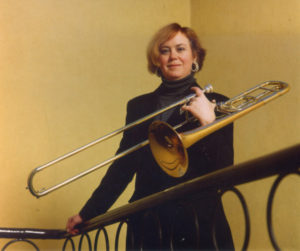
Abbie Conant. girl trombonists

Abbie Conant /

These musings came to mind recently as I read an account of Abbie Conant’s troubles with the Munich Philharmonic Orchestra. Playing behind a screen, she won an audition for principal trombonist when conductor Sergiu Celebidache exclaimed, “that’s the one we want” and sent seventeen other applicants away without hearing them. Only then did he learn that he  had selected a woman.

According to Malcolm Gladwell, holding auditions behind a screen, which takes away all visual cues, has resulted in the hiring of many women in orchestras. Any number of orchestras may have been surprised that the best-sounding candidate was a woman or non-white, but most trusted their ears and adjusted.

Celibidache made no attempt to turn away from his hidebound prejudice that a woman could not possibly play principal trombone adequately. Conant took the orchestra to court, and the  litigation lasted more than a dozen years. She won every round. Celibidache, having decided to trust his eyes instead of his ears, could no longer hear what any other musician testified, that Conant fully deserved the position that she had won.

Now, when I see “Who says girls can’t play trombone?” in a woman’s signature line, I’m no longer surprised, but it’s sad. Everyone is good at something and no good at something else. No one can determine a person’s aptitudes merely by observing sex or ethnicity. I wish everyone would stop trying.

Meanwhile, check out this clip of an all-woman trombone quartet called Bones Apart playing an arrangement of Stars and Stripes Forever. You’ll be thinking, “Hey, you can’t play that on trombones!” But they do.

References:
Music and references to music in Godey’s Lady’s Book : 1830-77 / by Julia Eklund Koza (Ph.D. dissertation: University of Minnesota, 1988).

Blink: the power of thinking without thinking / by Malcolm Gladwell (New York: Back Bay Books, 2005), pp. 245-54.

Posted in Trombone and other brass | Tagged brass players, Celibidache (Sergiu), classical music, Conant (Abbie), equal opportunity, orchestras, prejudice, trombonists, video, women musicians | Leave a reply

Musicology for Everyone

Search by category

  • American popular music
    • Civil War music
    • Jazz
  • Anecdotes
    • Quotations
  • Bands and band music
  • Christmas music
  • Classical music
  • Composers
  • European musical history
  • Humor
  • Music education
  • Music Festival
  • Opera
  • Orchestras
  • Program notes
  • Trombone and other brass
  • Uncategorized

Archives

Music composer jobs
Footer HTML
©2026 - Musicology for Everyone - Weaver Xtreme Theme
↑