The Stoughton Musical Society: early New England music’s savior
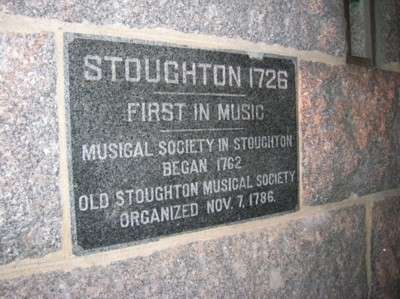 The Stoughton Musical Society, founded in 1786, is America’s oldest continuously operating musical institution. It was founded under the inspiration of a singing school presented in Stoughton by William Billings, America’s first notable composer.
When Lowell Mason drove Billings’ music out of New England churches, the society continued to sing it. Preserving the tradition eventually became a core aspect of its mission.
The society incorporated under the laws of Massachusetts in 1908 and changed its name to Old Stoughton Musical Society.
The beginnings of musical performance in Stoughton
When English colonization started, settlers found life hard. They had no time or energy to devote to cultivating the arts. The strict brand of Christianity practiced in New England strongly disapproved of any music except church music, and without good musical instruction, congregations usually sang badly.
As towns became well established and people began to prosper, interest in music and the arts began to increase. An entry in Samuel Talbot’s diary for January 13, 1762, mentions a lecture by a Mr. Adams in Stoughton, Massachusetts. After the lecture, a singing meeting took place at Robert Capen’s tavern. It was the first documented singing meeting in the town. Other meetings may have occurred earlier. Talbot’s diary mentions 11 singing meetings in all.
In January 1774, William Billings offered a singing school in Stoughton, also at Capen’s. It was not the first singing school in New England, but it is the first for which a complete list of its 49 pupils is still extant. One of the tenors, Jacob French, became a notable composer.
William Billings
 William Billings (1746-1800) was born to a poor family and received little formal education. Besides some instruction from John Barry, a choirmaster in Boston, he was largely self-taught in music. His familiarity with the works of English composer and author William Tans’ur gave him a solid theoretical foundation.
Tans’ur, a contemporary of Handel, dominated the publication of English psalm and hymn tunes as used in rural churches. Instead of the syllables do-re-mi-fa-sol-la-ti, Tans’ur kept an earlier system known as fasola, which used only fa-sol-la-mi.
Billings established the first distinctly American style of composing and published instructions based on the fasola system. His New England Psalm Singer appeared in 1770, the first published collection of music by an American composer.
Contemporaries with more urbanized tastes mocked Billings’ music. A biographical sketch of Billings in the Stoughton Musical Society’s Centennial Collection records:
His residence, office, and place of business, whence his music was issued, was in Newbury Place . . . Here he wrote and printed much of his music— being a printer withal—and sold the same. Over the door was a projecting sign with the words on either side: “Billings’ Music,”—across which, once on a time, in derison of his compositions—
“Two furious cats, suspended by the tail,
Were swinging cheek by jole.”* * * * * *
“Not man could bear, nor demon’s ear sustain
The fiendish caterwaul of rage and pain.”In other forms, more gentlemanly, if not less severe, were his works criticised. In one instance, he was charged with utter ignorance of Harmony and its laws.
Nevertheless, Billings and many of the composers he inspired became widely popular. In 1801, Philadelphia publishers William Little and William Smith published The Easy Instructor, which assigned separate shapes for the fasola syllables. It contained more than one hundred hymn tunes, many if not most representing Billings’ style. The shape-note system soon spread throughout the country.
Lowell Mason and the banishment of Billings’ music
Lowell Mason (1792-1872) was born into a musical family in Medfield, Massachusetts. He attended his first singing school at about age 13 and learned the tradition established by Billings. As a teenager, he became choir director in his parents’ church, but in 1812, he moved to Savannah, Georgia and taught singing schools there.
In 1817, German-born musician Frederick Abel moved to Savannah, and Mason started to study music with him. Abel introduced Mason to the music of such European composers as Mozart and Haydn. Mason also discovered Englishman William Gardiner’s Sacred Melodies, which had been arranged from their music. Mason considered this European music superior to what he had learned at home.
A Boston publisher issued The Boston Handel and Haydn Society Collection of Church Music in 1822 without naming an editor. Mason, still living in Georgia, had prepared it but did not yet want to be known as a professional musician. This collection of European hymn tunes became very successful, and he acknowledged his role in later printings.
Mason had also started composing his own hymn tunes. In 1827, he returned to Massachusetts to promote reform of church music. And to him, reform of church music meant driving the Billings style and fasola theory out of churches.
He largely succeeded. Shaped-note tune books became entrenched in the rural South. but largely disappeared from the urban North. One of the Southern books, The Sacred Harp has given its name to the Sacred Harp style of singing.
The Stoughton Musical Society adopted The Boston Handel and Haydn Society Collection of Church Music in 1826 but never stopped singing the older music. Although the Stoughton style of singing and the Sacred Harp style both came from the work of William Billings, they differ in sound.
The establishment of the Stoughton Musical Society
The Revolutionary War interrupted the pursuit of musical activities, but according to the preface of the Stoughton Musical Society’s Centennial Collection, “The enthusiasm which attended the advent of Billings, with his fascinating melodies and rare accomplishments as a singer and teacher, had not passed away; and this society was the outcome of this patriotic ardor, combined with taste and ability for musical performance.”
The first meeting of the Stoughton Musical Society took place on November 7, 1786, in the same house where Billings had given his singing school. Its song leader, Harvard graduate Elijah Dunbar, served as the society’s first president for 22 years. The society also elected a vice president, a secretary, and two treasurers. Members lived in Stoughton and surrounding communities.
Stoughton had experienced least 30 previous singing meetings beginning in 1762. These had all been one-time events in a house or tavern. Some sources erroneously claim that the 1762 meeting marked the beginning of the Stoughton Musical Society, but that meeting set up no institutional structure.
The error seems to have started in connection with the Musical Society in Stoughton (established in 1802). It was open only to Stoughton residents, some of whom were members of both societies. A later president of the group painted “1762” over the date on the original sign board. This society had a long history, but its membership dwindled until, in 1982, it disbanded and gave its remaining assets to the older Old Stoughton Musical Society.
It is often stated that, according to the original membership book, lifetime membership in the Stoughton Musical Society cost 50 cents (or in the currency of the time, two shillings). In fact, this was the price of joining the society. Members still had to pay for music, whatever they drank, and other costs of sustaining the society.
The fee did not preclude membership dues. In fact, at the first meeting where expenses were discussed, the minutes included, “Voted that each member of the Society be holden to pay his proportionate part of the expense of said Society till he be regularly dismissed from the same.”
America’s first singing competition
In about 1790, “or so the tradition runneth,” several ministers in Massachusetts reported that they had heard better music in Stoughton than elsewhere. The old First Parish in Dorchester had a well-trained choir of mixed voices, accompanied by a bass viol, and could not believe reports than any other choir was better than they. So they challenged the Stoughton singers to a contest. Challenge accepted, the trial took place in Dorchester. Stoughton sent “twenty selected male voices, without instruments.”
The Dorchester party sang first an anthem, recently published, executing it with grace and precision. The Stoughton party followed with Jacob French’s new anthem, “The Heavenly Vision” rendered without book or notes. The applause was unbounded as they took their seats. Again the Dorchester choir sang; then, to close the tournament, the Stoughton choir sang, without book, Handel’s grand “Hallelujah Chorus,” recently published in the country by Isaiah Thomas. The Dorchester singers acknowledged defeat, and endorsed the taste and judgment of the ministry.
This account comes from the reminiscences of Samuel Tolman in the Stoughton Musical Society’s Centennial Collection. The heading says he was 71 at the time, in other words, born decades after the event. He must have based it on oral tradition.
Publications of the Stoughton Musical Society
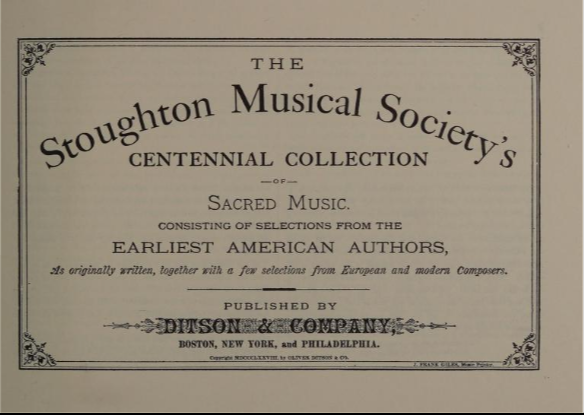 The society issued two notable collections of music: The Stoughton Collection of Church Music (1829) includes music by Billings, French, and other local composers. The Stoughton Musical Society’s Centennial Collection of Sacred Music(1878) includes music by 62 American and European composers, as well as biographical sketches of 26 New England composers.
Apparently, the publisher of the 1829 collection omitted many pieces the society had submitted and substituted other music without the society’s knowledge or consent. The society appointed a committee to negotiate with the publisher to print 72 pages of music and bind them with the recently published volume.
By 1876, the members of the Society felt “a responsibility, peculiar and imperative, to put forth an effort to rescue from the oblivion that has already overtaken a portion, and threatens soon to ingulf the whole of the works of these pioneers in musical composition and culture in our country.”
Planning for the collection began in earnest in 1877, apparently at the annual Christmas gathering. The society received the finished publication at its meeting on November 8, 1878.
The planning committee selected what it considered the best works of early American composers and a few more pieces by European and more recent American composers. “No pains have been spared to secure exact conformity in music and words to the original publications by the authors themselves, except that the then counter is adjusted to the modern alto.”
Before the acknowledgments of the people who prepared the anthology, the preface concludes, “It is deeply to be deplored that this attempted work had not been done years ago, when tradition, if not positive history, would have availed much in enlightening the obscurity that hangs over the lives of some of these benefactors.”
Women members
Although Billings’ singing school had included both men and women, the Stoughton Musical Society started as a men’s group. At first, alcohol seems as important in the meetings as singing. It is not clear when drinking at meetings was discontinued.
Two women were invited guests at the Christmas meeting in 1827, although no record exists that they joined the singing. According to the history the society published in 1928, “A story has been handed down that Mrs. Ezekiel Dickerman from Stoughton was the first woman soloist to take part in the ‘sings,’ in the year 1829. We are told she had a beautiful soprano voice.”
On Christmas 1844, “it was voted that the ladies be invited to sing with the Society, their suppers to be paid for by the Society.” Apparently, they were not considered permanent members. Records indicate another invitation to the ladies made at the January 11, 1849, meeting. Only on Christmas 1873 did the society vote to invite the ladies present to become members of the society. Many ladies joined in 1874. By 1876, the chorus had increased to 200 members. The stage at the Music Hall had to be enlarged to make room for all of them.
The second hundred years and beyond
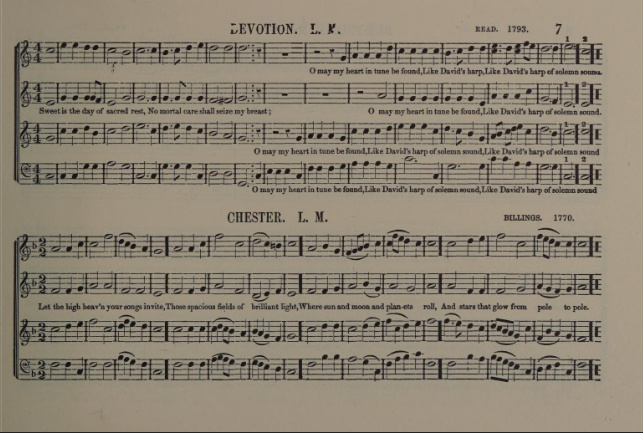
A page from the Stoughton Musical Society’s Centennial Collection, showing Billings’ “Chester,” one of his cherished tunes.
The Stoughton Musical Society celebrated its centennial with a full day of events on June 9, 1886, concluding with a concert that featured Haydn’s The Creation with orchestra.
At the Christmas 1892 gathering, the society decided to apply to secure an invitation to the World’s Columbian Exposition, which had been announced to take place in Chicago in 1893. By the March 15, 1893, meeting, the secretary of the Musical Bureau had extended an invitation to perform two concerts in August.
A 100-voice chorus conducted by Leander Soule and an 11-piece orchestra conducted by Edwin Arthur Jones performed concerts on August 14 and 15, dressed in colonial costumes. It was the only chorus to perform early New England music at the fair. According to the program published by American Music Preservation, most of its selections came from the Society’s own Centennial Collection. Both performances drew large and enthusiastic audiences.
In 1908, the society officially incorporated, changing its name to the Old Stoughton Musical Society. Its articles of incorporation state its objective as “the preservation, cultivation and practice of the music of the earlier native composers, together with general musical and antiquarian activity.” The society published a historical volume in 1928.
The conveniences of the automobile, recordings, broadcast technologies, and film greatly disrupted the performance of live music in America over the course of the 20th-century. The Old Stoughton Musical Society is not nearly as large as it used to be. Membership has dipped as low as 10. Nevertheless, it continues to offer two concerts a year and make other local appearances.
Sources
Music in Stoughton: a brief survey / Roger Hall (Stoughton: Hansen Brothers, 1989)
The new Grove dictionary of music and musicians (Grove Dictionaries of Music, 1980) s.v. “Billings, William” and “Lowell Mason”
The Old Stoughton Musical Society / edited by Lemuel W. Standish (1928)
Singing Stoughton / Roger Hall, American Music Preservation
The Stoughton Musical Society’s centennial collection of sacred music: consisting of selections from the earliest American authors, as originally written, together with a few selections from European and modern composers / (Oliver Ditson, 1878—reprinted by Da Capo Press, 1980)
Thank you for posting this very good description of the Stoughton singing tradition with the oldest singing society in the USA. The (Old) Stoughton Musical Society also has the oldest constitution of any choral organization in the USA, written in 1787 the same year as the U.S. Constitution. I have been researching and publishing music materials about this singing tradition for many years. I was Chairman for the Old Stoughton Musical Society Bicentennial Season in 1986 and also composed a few songs for them to perform over the years.