Hail Columbia: almost the national anthem

Early printing of Hail Columbia, with a portrait of President John Adams
“Hail Columbia” is not a well-known song today, but it has a prominent place in American history. It became a hit immediately after its first performance and remained popular for more than a century.
Of all patriotic songs before the Civil War, only “The Star-Spangled Banner” and “America” rivaled “Hail Columbia” in popularity. The former uses the old English drinking song “Anacreon in Heaven” and the latter the English national anthem “God Save the King.”
Oscar Sonneck, who examined these and many of the patriotic songs that never caught on with the public, noted, “”’Hail Columbia’ holds a position quite unique in the history of our national songs for both the words and the music were written in America.”
The word “Columbia” obviously comes from the name Christopher Columbus. The District of Columbia and Columbia University share the name. Columbia is a lady, by the way.
Who was Lady Columbia?

Europe and America / Unidentified artist., 1804. Colored engraving published by P. Gally, London. New-York Historical Society Library.
Poems and sermons in colonial Massachusetts introduced a lady named Columbina. According to a 1697 essay by Samuel Sewall, the colony’s chief justice, she was an emblem of the “New Heaven” that the American colonies represented.
Soon thereafter, she became widely known throughout the colonies as Columbia and started to appear in numerous newspapers, political cartoons, and posters. Lady Columbia appeared as a classical Greek goddess, often holding a sword to represent justice, an olive branch to represent peace, and a laurel wreath to represent victory. She came to represent the highest aspirations of the colonies and, after the Revolution, of the new nation.
In colonial times, she appeared as a nurturing mother figure. She took on a more martial aspect during the Revolution. During the War of 1812, the new figure of Uncle Sam joined her on posters, where they both symbolized American independence. As the issue of slavery divided the nation, both the North and South invoked her. After the war, she became a symbol of Manifest Destiny and nurturer of the waves of poor immigrants who came to these shores.
Lady Columbia thus served as the American mascot throughout the nineteenth century, but then the Statue of Liberty provided a newer and more up to date symbol. Lady Columbia is almost forgotten today except as the logo for Columbia Pictures.
The tune: “The President’s March” by Philip Phile
The British had hired Hessian mercenaries to help their troops try to fight the American rebels. After the Revolution, some of them decided to stay. One, Philip Phile (variously spelled), became a professional musician in Philadelphia and New York. Philadelphia concert programs in 1783 and 1784 show him as solo violinist. He also served as conductor of the American Theater Company’s orchestra.
In 1789, he composed “The President’s March” to honor the newly elected President George Washington. The contemporary press ignored it. Whatever we know comes from somewhat contradictory accounts published shortly before the outbreak of the Civil War.
An 1859 article by an anonymous eyewitness identifies someone named Professor Pfyle as the composer of the march and wrote that it was performed at Trenton, New Jersey as George Washington made his way from Mount Vernon to New York, which served as America’s first capital.
Washington’s adopted son George Custis recalled in 1860 that his father had attended plays in New York. When advertisements announced his presence, as many people went to the theater to see him as to see the play. Upon his entrance, the orchestra would play the march, which Custis attributed to a German named Feyles.
Several other accounts mention a composer with similar spellings. But an article published in 1861, among others, identifies the composer as Johannes Roth, or Roat. Oscar Sonneck, on reviewing all these sources, dismissed the claim for Roth.
The text: “Hail Columbia” by Joseph Hopkinson
Gilbert Fox, an actor-singer in Philadelphia, planned a benefit concert for himself in 1798. It appeared that he would not be able to attract a good-sized audience, so he visited Joseph Hopkinson, a Philadelphia lawyer and an old schoolmate, and asked him to provide a text to fit “The President’s March.” Theater goers frequently demanded performance of the piece. He figured that if he could advertise a suitable text for “The President’s March,” plenty of people would decide to attend his concert.
Joseph Hopkinson was the son of Francis Hopkinson, whose “My Days Have Been So Wondrous Free” (1759) was the first secular song by an American composer. He later became a signer of the Declaration of Independence. The younger Hopkinson supplied suitable words, titled “Hail Columbia” and Fox attracted his audience. Immediately, newspapers and magazines printed the words and music.
Available videos all seem to be either instrumental versions only or vocsls introduced by a Hollywood inspired introduction that fails to fit the style of the tune.
The political background of Hail Columbia
Despite the Founding Fathers’ horror at the thought of factions and political parties, two parties had emerged by the time Fox premiered “Hail Columbia”: the followers of Alexander Hamilton, known as Federalists, and the followers of Thomas Jefferson, known as Democratic Republicans, often Republicans for short.
The two parties disagreed on many important issues. In foreign policy, should the country favor ties with the British, against whom the country had recently fought for independence, as the Federalists advocated? Or the French, who had supported the American cause and which had recently overthrown its own monarchy, as the Republicans advocated?
Put in those terms, a French-leaning foreign policy may seem the obvious choice, but the French Revolution had quickly degenerated into the Reign of Terror and mob rule. The so-called XYZ scandal erupted in 1798, when the French tried to extract bribes from American diplomats. The French navy had also become actively hostile to American shipping interests.
Long before “Hail Columbia,” “The President’s March” had already become embroiled in partisanship. When the Chestnut Street Theatre opened in Philadelphia in 1794, which patriotic tune would best represent public sentiment?
“The President’s March” had always been popular with Federalists. Democratic Republicans favored the French Revolutionary song “Ça Ira,” which had been inspired by Benjamin Franklin’s assurances to the French about the American Revolution. The orchestra played “Ça Ira” to open the first week’s performances.
Then, it played “The President’s March instead when George Washington attended. A pro-Republican newspaper objected to “a mimickry [sic] of British customs,” which made “an indirect comparison between a king, the creature of chance, and a President, the choice of the People.”
Reception of Hail Columbia
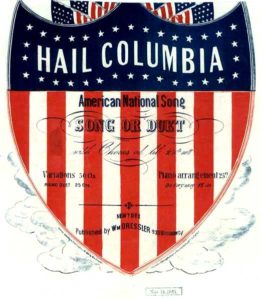
A cover from 1861
Hopkinson claimed that he had devised his text “to get up an American spirit which should be independent of—and above the interests, passion, and policy of—both belligerents [i.e., Republicans and Federalists].” But he was a Federalist, and it showed despite his intentions.
George Fox planned his concert at a time when anger over the XYZ affair had weakened the American public’s loyalty to France. He took the text of “Hail Columbia” to the strongly pro-Federalist newspaper publisher William Cobbett, who printed the program and followed it with an editorial.
It is not often that I interest myself in the success of Theatrical Representations; but, I cannot help bestowing a word or two in approbation of what is advertised for tomorrow night. Mr. Fox has, with singular propriety, admitted a Song, written by a gentleman of Philadelphia, adapted to the President’s March, which has long been the national, and is now the popular tune. Long, much too long, have the lovers of the drama been shocked and insulted with the sacrilegious hymns of atheism and murder; and the actor, let his theatrical merits be what they may, who, by his voluntary choice, first breaks through the disgraceful practice, and appeals to the virtues in place of the vices of his audience, deserves every mark of applause, which it is in the power of the public to bestow.
The “sacrilegious hymns of atheism and murder” included “Ça Ira” and the equally popular “Marseillaise.”
But Philadelphia’s leading Republican newspaper complained,
For some days past, the Anglo Monarchical-Tory party, have appeared at the Theatre in full triumph—and the President’s March and other aristocratic tunes have been loudly vociferated for, and vehemently applauded. . .
For what reason the managers presume to offend a great body of the citizens of Philadelphia by devoting their theatre to party purposes, we are at a loss to determine; or why the Orchestra who had so readily gratified one party, should refuse to play Ca Ira when repeatedly called for by the others, is equally mysterious. . .
It is said, that the same song is to be again sung on Friday.—The Republican party would do well therefore to absent themselves entirely from the Theatre, unless they wish to have their noses pulled by the Tories.
Hail Columbia as the unofficial national anthem

Lady Columbia / Unidentified artist, ca. 1890
Inevitably, political wrangling moved on to other issues and other personalities. “Hail Columbia” soon became a hit nationwide.
President Thomas Jefferson, the first Democratic Republican President, apparently did not subscribe to the Republican editorial’s disdain for “Hail Columbia.” He had the U.S Marine Band perform it for a Fourth of July celebration in 1801. Thereafter, song was frequently performed at formal White House ceremonies.
President Abraham Lincoln once remarked that he had to stand up and take his hat off when he heard it being sung.
“Hail Columbia” was not the American national anthem, but many Europeans assumed it was. They performed it whenever a national anthem was appropriate. The United States had no official national anthem until 1931, but “Hail Columbia” served unofficially in that capacity until about the time the nation started to lose interest in Lady Columbia.
In 1899, the US Navy officially established “The Star-Spangled Banner” for its formal ceremonies. President Woodrow Wilson ordered all military bands to use it for official ceremonies. In 1931, Congress passed a law designating is as the national anthem and President Herbert Hoover signed it.
As for “Hail Columbia,” its time of greatest popularity had passed. It faded into obscurity. Today, it announces the entrance of the Vice President, just as “Hail to the Chief” announces the President. Isn’t it suitable that a now-obscure piece has become associated with a long-obscure office? It took a great deal of hunting to find that the association became official on August 1, 1969. Spiro Agnew was the first Vice President to be so honored.
Sources:
Before Lady Liberty, there was Lady Columbia, America’s first national mascot / Carl Shane, Smithsonian. September/October 2023
Critical notes on the origin of “Hail Columbia” / Oscar Sonneck. Sammelbände der Internationalen Musikgesellschaft 3 (November 1901)
Hail Columbia / Library of Congress
Hail Columbia: together with a favorite song, celebrating the naval prowess of America at the commencement of the Revolution / Isaiah Thomas Broadside Ballads
A partisan national song: the politics of “Hail Columbia” reconsidered / Myron Gray. Music & Politics 11 (Summer 2017)
Even though “The Star Spangled Banner” was written in The South by a Southerner whose direct descendants likely intended to secede The Sovereign State of Maryland into the CSA in 1861 (before dishonest Abe immorally and illegally threw them in prison), nevertheless I consider “Hail Columbia” to be the finest American patriotic anthem musically and lyricallly of all time, and as a veteran Church Organist I play it whenever possible, though practically nobody here in 20th and 21st Century Southern Mississippi seem to know or care about it. “God Bless America” Kate Smith-style is my close second favourite American Anthem! These timeless classics are for Authentic American Patriots–not these fake woke anti-American pretenders.