Phillippe Musard, promenade concerts, and mass taste

Philippe Musard / Anonymous portrait from Le monde musicale, 1841
Too many people think classical music appeals only to some elite class. They haven’t seen children listening to it. In fact, at the time when the social elites started distinguishing between classical music and popular music, Philippe Musard invented promenade concerts for the masses.
He played mostly dance music, but he included classical music on them. He knew his audience would enjoy it.
Musard was born to a poor family in Tours, France in 1793. There, he learned to play the horn. He joined the orchestras at some very minor ballrooms in Paris sometime in the 1810s. At that time, he learned a little violin and started composing quadrilles and conducting dance orchestras.
Nothing about him appeared to destine him to rise from obscurity, but he had both talent and ambition. By the 1830s when he conceived of promenade concerts, he had become the dominant force in Parisian dance music for the lower classes.
Music and social class in the early nineteenth century
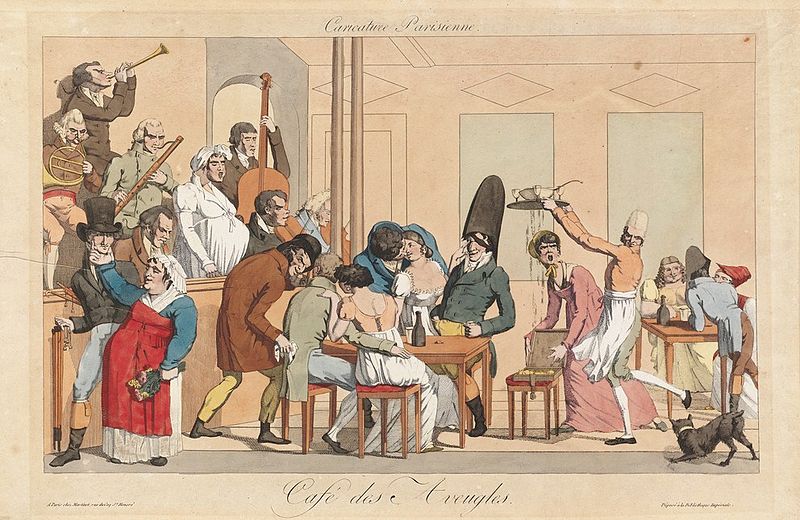
Café des Aveugles in the basement of the Palais-Royale. Famous for its blind orchestra, the café served cheap food to lower-class people. It’s about the only picture I could find of the class of people who could afford to go to promenade concerts, but not more high-status ones.
Orchestra concerts of the eighteenth century drew audiences from the aristocracy and the middle class. Artisans, shopkeepers, and clerks only began to partake of concert life, both as performers and members of the audience, in the middle of the nineteenth century.
In his Music and the Middle Class, William Weber considered three broad categories of music: high culture (classical music), high-status popular music, and low-status music.
High-status popular music, largely comprising what Robert Schumann dismissed as Philistine music, took place largely in the salons of the aristocracy or upper middle class—especially in Paris and London.
The famous musicians who performed there also put on annual “benefit” concerts for themselves. The wealthy families who hired them for their salons were expected to buy tickets for these benefits. But ticket sales often didn’t yield large audiences.
Because the performers relied on these concerts to validate their popularity, they gave away free tickets to members of the lower classes. In Parisian theaters, managers would also hire artisans to serve as a claque, professional applauders.
The lower classes had not participated in concert life before, but that didn’t mean they were unmusical. They had long traditions of both singing and playing musical instruments. But by ear. Until the nineteenth century, they had no opportunity to learn to read musical notation. Starting in the 1820s plenty of entrepreneurs opened singing schools for the musical education of the masses.
Some artisans had long supplemented their income by providing music for weddings and other domestic feasts. When they moved from the countryside to the cities, they found opportunities to form amateur orchestras and attend concerts by professionals.
Members of the lower classes couldn’t afford the price of tickets to the major concert series. When Musard and others began to offer cheap concerts, they found eager audiences.
Paris and dance music
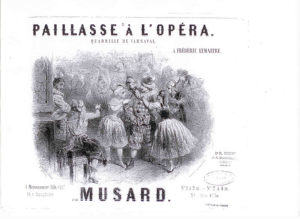 French taste had long had a dominant influence on dance throughout Europe. Courtly dances required careful training. Not only did they have elaborate steps to learn, but also suitable postures. Even before the French Revolution, the middle class had begun to challenge the aristocracy as social trendsetters.
Once the Revolution attempted to destroy the aristocracy, dancing the vulgar waltz and other dances the aristocracy disdained became practically a patriotic duty in Parisian ballrooms.
The other dances included above all the quadrille. One of the most popular social dances of the early nineteenth century, it had five distinct parts or figures. Usually, four couples danced it in a square formation.
Opera in Paris had long included elaborate ballet scenes. So naturally, operatic music seemed suitable dance material. The Parisian public frequently encountered popular operas on the dance floor before they saw them on stage.
Unlike a traditional suite of dances, the quadrille had a uniform pulse in duple meter throughout. Composers could not make such drastic contrasts as between any two different dances. They set off different figures with contrasting melodies and striking harmonies. Lovers of art music—or even lovers of Rossini––had little respect for the quadrille as music.
Nonetheless, in dance-crazy Paris, it would have been nearly impossible for anyone to avoid quadrilles. Wherever people, regardless of social class, gathered to hear music, they would encounter quadrilles.
Musard’s career
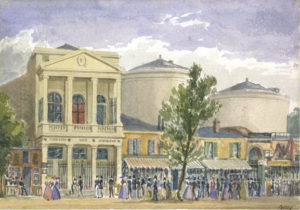
Théâtre des Variétés and the Panorama buildings in Paris / Benjamin Ferrey, watercolor on paper, 1829
The ambitious Musard wanted faster success than he could find in Paris. So he moved to London. There he became conductor of the dance orchestra at the court. He published several quadrilles in 1817 and sent them back to Paris.
Musard returned to Paris in 1830, now well known, and became music director for the masked balls at the Théâtre des Variétés. He also studied harmony at the Conservatory and earned a first prize.
As a composer, he specialized in popular dance music. He composed more than 150 quadrilles and quite a few waltzes. He based many quadrilles on operatic hits, but many others on original themes.
His concert quadrilles, unlike those of his contemporaries, included some very imaginative use of counterpoint. And he wasn’t content to limit the trombones to accompanimental figures. His trombones played tunes. Sometimes he even entrusted the principal melody to them.
Apparently, he wanted to be known as more than a conductor and composer of quadrilles. He published three string quartets and the first seven installments of a composition treatise, which he never finished.
After the revolution of 1830, light concerts that combined classical music with dancing became popular in Paris. Musard conducted his first such concerts in 1833 and called them promenades.
Beginning in 1837, he offered summer promenade concerts on the Champs-Elysées under the name Concert Musard. He had rivals in Paris. Jullien offered his own promenades in Paris from 1836 to 1839. Henri Valentino offered his from 1837 to 1841.
From 1840 to 1845, Musard also conducted promenade concerts in London. For two decades, he was the most popular conductor and composer of dance music in Paris. When he retired in 1852, however, he was quickly forgotten. His death in 1859 passed almost unnoticed in the press.
Promenade concerts and classical music
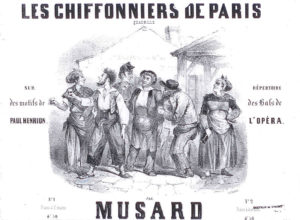 Branching out into concerts made sense for a dance orchestra conductor. It kept him and his musicians busy and in the public eye during the offseason. The name “promenade” recalled concerts of the previous century where aristocrats promenaded in fashionable parks while the music played. Musard offered very cheap tickets in rooms without seats.
The orchestra occupied the center of the room. Ticket holders stood and listened if they wanted. Or they could dance. Others gathered in groups to chat, eat, and drink. Some read. Someone even slept! These lower-class people, in other words, behaved at the promenade concerts the same way aristocrats had behaved at the opera for generations.
William Weber implies that Musard played only excerpts of classical pieces and that not very well. He writes that the audiences at promenade concerts could hear entire Beethoven symphonies played well only at the more expensive concert series. I find that hard to believe.
An Englishman who attended one of Musard’s concerts in 1837 described the orchestra’s musicianship. Most members were students at the Conservatory. Musard had them playing as a unit. They didn’t try to outdo each other. Instead, the orchestra played as a single instrument whether very softly or very loudly. The program consisted mostly of Musard’s quadrilles, but also included operatic overtures by Mozart, Auber, Rossini, and Méhul.
Besides using operatic music for quadrilles, Musard’s promenade concerts also featured arrangements of arias. He substituted solo wind instruments for the singers.
Musard as showman
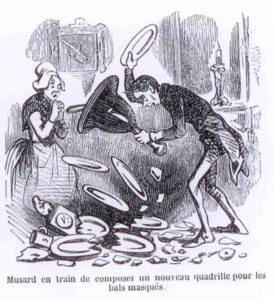
“Musard composing a new quadrille for the masked balls” (1851)
As a conductor, Musard played quite the showman. A somewhat satirical account in Le Ménestrel describes his antics.
Sometimes he rolls his eyes like two inflamed balls; sometimes he gazes calmly from right to left and from left to right. His indefatigable bow marks every note, from the whole note to the sixteenth note, and seems to lead the sounds to the ears of listeners.
With his gaze, Musard attracts all that surrounds him; with his bow, he brings back the lost, contains the audacious, warns the distracted, rallies the laggards, and restrains the impetuous. In the adagio, in the andante, his face is uncut, his mouth is smiling, his attitude is full of dignity and contemplation well formed.
In the allegro, his eye throws lightning, his nerves are agitated, and his body realizes the chimera of perpetual motion. Then he no longer beats the measure, he strikes it with redoubled blows, feet, hands, elbows and knees. His foot causes the dust to fly in the air and throws powder in his eyes.
Sometimes he gets up, looks at the ceiling, measures the audience from the height of his majesty, scratches his head or holds his ribs; sometimes he sits down and passes his hand over his forehead, seat of so much genius, receptacle of so much harmony, warehouse of so much responsibility.
In certain moments, the tip of his bow hovers over the note until its agony, and helps it to die; in others, the bow seems to pick up the note on the floor and to return to the desk. It is a curious spectacle, I assure you, that that of Musard conducting his orchestra. We never tire of admiring it.
He ordinarily conducted a large orchestra, but he outdid himself when he led balls at the Opéra. There he had 24 each of first and second violins and a proportionate number of violas, cellos, and basses. He had 14 cornets and 12 trombones in his brass section.
Not content with standard instruments, he introduced eccentricities such as breaking chairs in time to the music or firing a pistol.
Musard’s influence

Jullien, conductor of popular promenade concerts
The world may have quickly forgotten Musard after he retired, but the promenade concerts lived on. Jules Rivière began to conduct them in Paris.
Jullien couldn’t compete with Musard in Paris, so he moved to London and inaugurated a very successful series of promenade concerts. All social classes attended. If Weber is correct that Musard didn’t program complete symphonies, Jullien did. He was often more faithful to the score than contemporaries who played to audiences with higher social status. Unlike them, he never “updated” the classics by adding more instruments.
Promenade concerts continued in London after Jullien’s death. The Henry Wood Promenade Concerts, which started in 1895, continue to this day.
Musard’s influence reached places he never visited. Johann Strauss, Sr., whose orchestra visited Paris in 1837, took the concept of the promenade concert back to Vienna.
If anyone had less prospect of becoming rich and famous than the young Musard, it must have been Philadelphia’s Francis Johnson. A free black man, Johnson somehow became Philadelphia’s leading bandleader.
In 1837 he announced his intention to leave Philadelphia temporarily to improve his musical knowledge abroad. An editorial in the Public Ledgerlamented that the city was about to suffer a great loss. What would the military corps or dancers do without Johnson for a whole year? It proposed that the city put on a benefit ball to help finance the journey.
Musard hadn’t yet personally conducted promenades in London, while Johnson was there, but his name had already become firmly attached to them. When he returned to Philadelphia, Johnson promised Philadelphia the same kind of experience audiences enjoyed in Paris, called concerts “à la Musard.”
Musard-inspired concert series also took place in New York and New Orleans.
What promenade concerts say about mass taste

Chief Musician Roberta Haworth helps a young student direct the Seventh Fleet Band during a rousing concert for the children of Sasebo Elementary School
Classical music is not and has never been music written only for connoisseurs. The working-class people who eagerly bought Musard’s cheap tickets had no leisure time to become connoisseurs. Promenade concerts featured classical music because the promoters knew the audiences would enjoy it.
The upper classes liked to take credit for giving culture to the masses. If providing free tickets to inflate the size of audiences counts, they did. They can hardly claim to have elevated public taste, however. The aristocracy and upper middle class never appreciated classical music any more than the working classes did. They fought pamphlet wars over the relative merits of classical music and salon music.
The music appreciation movement, which started in the late nineteenth century, did attempt to elevate mass taste, with little success. School bands and orchestras have long given children the chance to learn to play instruments and read and perform music. They can’t make anyone like or not like any particular kind of music.
Certainly, the more people know and understand classical music, the more they can relish listening to it. But a taste for music has nothing to do with income, education, or social class. Beethoven could not have succeeded with promenade audiences if it did.
Nowadays, some influential people actively try to keep classical music away from a mass public on grounds that it’s elitist. They should watch a room full of school children and preschoolers listening to a string quartet with rapt attention. Shame on grownups who try to keep them from hearing it.
Sources:
Artisans in concert life of mid-nineteenth-century London and Paris / William Weber, Journal of Contemporary History 13 (April 1978): 253-267.
Frank Johnson of Philadelphia and his promenade concerts / Eileen Southern, The Black Perspective in Music vol. 5, no. 1 (Spring 1977):3-29
Musard, Philippe / Arthur Pougin, in Supplément et complément to Biographie universelle des musiciens et bibliographie générale de la musique by François-Joseph Fétis. Paris : Culture et Civilisation, 1880
The quadrille as embodied musical experience in 19th-century Paris / Maribeth Clark. Journal of Musicology 19 (Summer 2002):503-526
Comments
Phillippe Musard, promenade concerts, and mass taste — No Comments
HTML tags allowed in your comment: <a href="" title=""> <abbr title=""> <acronym title=""> <b> <blockquote cite=""> <cite> <code> <del datetime=""> <em> <i> <q cite=""> <s> <strike> <strong>