↓
 

Musicology for Everyone

(Professional research for a general audience)

  • Home
  • About
  • Contact me
Home→Tags trombone - Page 4 << 1 2 3 4 5 >>

Tag Archives: trombone

Post navigation

← Older posts
Newer posts →

Trombones on five continents during the Renaissance

Musicology for Everyone Posted on January 7, 2013 by David GuionFebruary 25, 2021  
Renaissance trombone

A stone carving on one of the 4 posa chapels occupying the corners of the atrium of the church of the Franciscan monastery of San Miguel, Huejotzingo, Puebla, Mexico

A recent book by Stewart Carter The Trombone in the Renaissance: a History in Pictures and Documents, sheds light in some previously dark corners of the history of the trombone. Among other things, it documents the use of the trombone on five different continents in the sixteenth century.

This post will examine only the least known of these areas: Asia, Africa, and the New World. Continue reading →

Posted in Trombone and other brass | Tagged sixteenth century, trombone | Leave a reply

An old oddity: the contrabass trombone

Musicology for Everyone Posted on May 7, 2012 by David GuionNovember 10, 2021 2

Exceptionally large instruments, including contrabass trombone (no. 2)

Trombones come in several sizes. Tenor and bass trombone are the most common. Orchestral trombonists frequently use alto trombones. Soprano and contrabass trombones remain novelties. The latter is by far the older of the two.

Someone described a performance on a contrabass trombone (probably) in 1568. Michael Praetorius provided the first really comprehensive description of the trombone in the second volume of his Syntagma musicum (1619). He described and illustrated sizes from the alto trombone to the contrabass.

The contrabass must have been an oddity in his own lifetime, because his description is rather vague. The one pictured here is proportionately the same as the ordinary (tenor) trombone, but twice as long so that it sounded an octave lower.

Today, contrabass trombones aren’t exactly oddities, but they’re not common, either. What’s odd is that two very different instruments go by the name contrabass trombone. Do you find that confusing? Blame the bass trombone. Continue reading →

Posted in Trombone and other brass | Tagged bass trombone, contrabass trombone, trombone | 2 Replies

Trombone ensembles: a brief history

Musicology for Everyone Posted on March 5, 2012 by David GuionApril 22, 2021 2

buy classical musicThe trombone has been primarily an ensemble instrument from the beginning. It found its first use in the bands sponsored by towns beginning in the 1300s. In fact, the bands predate the trombone. They started out as ensembles of shawms and trumpets, but rising standards of shawm playing left the natural trumpet in the dust. The trombone came along because shawms needed a competent companion. Ensembles of trombones alone came later.

The 1500s saw a great deal of experimentation with new instrumental combinations. Courts in Italian city-states, notably Florence, led the way. They presented elaborate theatrical entertainments to project their power on such occasions as births and marriages of members of the ruling family. The long-established, everyday standard ensembles did not provide sufficient opportunity to show the court’s riches and extravagance. Little music is extant, but records indicate that several pieces called for a singer backed only by (usually four) trombones.

Meanwhile, the ordinary town bands grew in numbers all over Europe. The earliest ones had had three members. Even at the dawn of the 1500s, by which time cornetts had largely supplanted the shawm, a five-piece band was exceptionally large. By the end of the century, towns all over Europe boasted a professional cornett/trombone ensemble of seven or eight players, plus one unpaid but surely active apprentice for each member.

Such a large group rarely played as a single ensemble. Their size enabled them to provide several four or five-part bands for jobs in different parts of the city. Some of these may have been trombone ensembles. Little music survives until well after 1600.


Trombone ensembles from the 17th to  19th centuries

Praetorius described how to combine voices and instruments into separate choirs of different registers. Following his instructions, choir masters could assign four trombones to play one of the lower-voiced choirs. It was not necessary to have written arrangements for these ad hoc performances. On the other hand, seventeenth-century composers began to write pieces for singers accompanied by trombones. Heinrich Schütz’ masterpieces “Fili mi, Absalon” and “Attendite, popule meus,” both for bass voice and four trombones, are but two of numerous such pieces by German composers.

Providing players for church music was one important task of German town bands. They also played daily concerts from the city hall tower. PIeces for three and four trombones by Daniel Speer have become a familiar part of today’s repertoire. Speer wrote them as teaching pieces, but they must be representative of the kinds of music heard in German cities long before and long after Speer’s time. Leipzig’s town band maintained its ancient structure and privileges into the 1860s.

Beethoven wrote his “Equali” for four trombones in 1812. It was played at his funeral, and then has dignified countless more funerals ever since. Frenchman François René Gebauer published six trombone trios in about 1795. Three are arrangements of music by better-known composers. Like Speer, Gebauer wrote them as teaching pieces, in this case for use at the newly formed Paris Conservatory.

A later Conservatory trombone professor, Antoine Dieppo, created a sensation when he presented some very difficult trombone quartet arrangements on one of Jules Rivière’s Promenade concerts. Since novelty was the name of the game in Promenade concerts, Rivière did not program trombone quartets again for several years. Other popular conductors probably did from time to time.

Near the end of the 1800s, the rediscovery of Schütz’ music included numerous performances of “Fili mi, Absalon.” At least one professional trombone quartet emerged to take advantage of this new vogue for the sound of trombone ensembles. The Times of London carried advertisements for the Concert Trombone Quartet from 1894 into 1896. Unfortunately, when it expanded its repertoire beyond the Beethoven and Schütz pieces, it turned to arrangements of mediocre tunes. The only newspaper review I have seen called them tiresome.


Modern trombone ensembles

Buy classical music

Trombone choir at the 2009 Eastern Trombone Workshop

Trombone ensembles, from duets to twelve-part choirs, continue to be an important adjunct to trombonists’ education. Students play duets with their teachers at the very least. Once they reach the college or conservatory level, they take part in larger ensembles. Well into the 1900s, they played mostly arrangements of other music. After graduation, trombonists still love to gather together to play large ensemble music. Informal groups comprise both professional and amateur trombonists and occasionally perform in public.

Over the past sixty years or so, trombone ensembles have collected a considerable repertoire of original compositions. There is no point in trying to list significant pieces here. Trombonists know them and, for the most part, the composers will not be at all familiar to concert goers. Of course, trombone ensembles still play arrangements. They’ve gotten much, much better–better music, more imaginative arrangements, and probably a higher standard of playing than in the days of the Concert Trombone Quartet.

Trombone ensembles are by no means limited to student or amateur ensembles. Los Angeles studio trombonists used to gather in a garage every week to play through some often difficult music by Hoyt Bohannon, Tommy Pederson, and others. This music has become an important part of every other ensemble’s available repertoire.

At least two professional European trombone quartets achieved international fame and stayed together for over 25 years: The Paris Quartet and the Slokar Quartet. Although both have long since disbanded, a Google search for “professional trombone quartet” brings up a number of currently active ensembles from all over the world. Check out the video below for a stunning performance by a quartet called Bones Apart.

Photo credit: Some rights reserved by The United States Army Band

Posted in Trombone and other brass | Tagged instrumental music, trombone, videos | 2 Replies

Adolphe Sax’s marketing campaign for new brass instruments

Musicology for Everyone Posted on February 6, 2012 by David GuionApril 26, 2021  
Buy classical music

RGMP March 31, 1872, detail

If people know only one thing about Adolphe Sax, it’s that he invented a lot of new instruments in the nineteenth century. Today, the saxophone is the most successful. That basically amounts to an ophicleide (a forerunner of the tuba with keys instead of valves) fitted with a clarinet reed.

His redesign of the trombone with six independent valves, first introduced in 1852, was much more radical than any of the new instruments he invented. I’d like to look at at least part of his marketing campaign for that instrument as an illustration of his business methods.

The important journal Revue et gazette musicale de Paris (RGMP) shows a number of activities he undertook to promote his new trombone, among other instruments. These include

  • Obtaining good press through friendly writers in a leading journal
  • Buying journal advertisements
  • Hiring a skilled soloist to demonstrate the instrument’s capabilities. For the trombone, it was a Mr. Hollebecke. A different specialist represented other instruments.
  • Presenting concerts in various venues, notably including his own concert hall, very likely in or near his factory
  • Persuading influential foreign visitors to promote his instruments back home
  • Commissioning new music by respected composers. The name Demersmann (see the article from July 12, 1863 below) may not mean much today, but he was a prolific composer of music for wind instruments. He composed the required contest piece for the trombone class at the Paris Conservatory in 1863 and provided 17 more by the end of the century. — According to Constant Pierre, Le Conservatoire Nationale de Musique et de Déclamation / Constant Pierre (Paris: Imprimérie nationale, 1900), p.652
  • Having the trombones participate as featured members of the orchestra only after about three and a half years of a sustained publicity campaign
  • Taking his instruments and soloists on a foreign tour.
  • Rivals considered Sax’s successful bid to reorganize French military music to be a marketing ploy. They initiated legal action that ultimately bankrupted everyone involved. I mention the reorganization and rivalries here only because the articles below occasionally allude to them.


Below the illustration are translations of several articles or parts of articles (and another ad) from Revue et gazette musicale de Paris that describe these aspects of Sax’s marketing campaign in greater detail. I have divided the longer articles into paragraphs and omitted some passages.
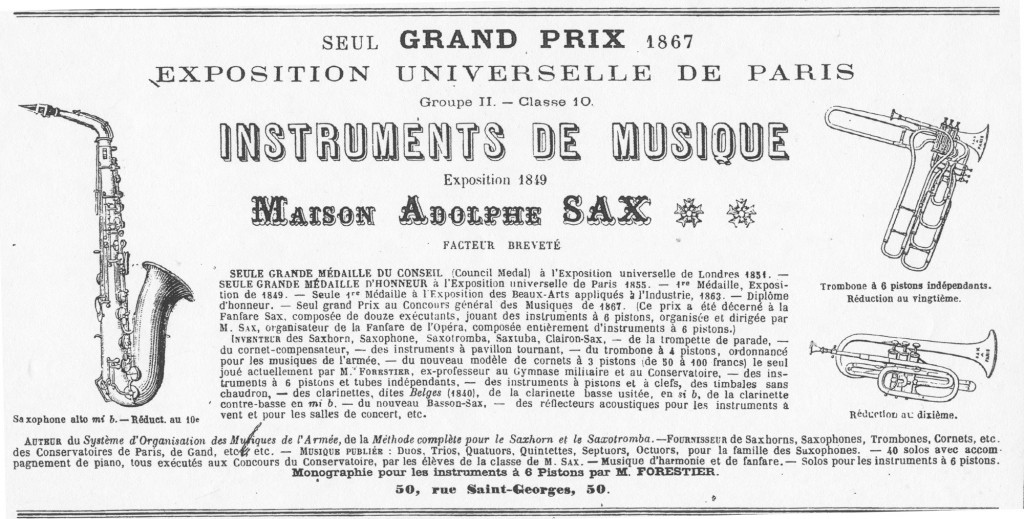


Buy classical music

RGMP, March 31, 1872

v. 26, no. 37. Sept. 11, 1859, p. 306

Read in the Belgian Independence of September 1: At the concert on Tuesday in the zoological garden, a new instrument was heard, the invention of Alphose (sic) Sax, Jr., our skillful maker, currently resident of Paris. This instrument, named the saxonmitonic trombone, was played in a remarkable way by Mr. Hollebecke, also Belgian. A second hearing is promised for Thursday.

v.29 no.32, August 10, 1862, p. 262

The brother of Gen L’vov, distinguished composer and director of music of the emperor of Russia, knowing the excellence of French military music, organized according to the system and with the instruments of Mr. Adolphe Sax, resolved to introduce this useful reform into his country.

Much progress in this direction is already realized; a certain quantity of Sax’s instruments were sent to Russia and put into the hands of the most intelligent artists among the military musicians, who, after a few months of study, performed for the emperor. His Majesty was so satisfied with this first test and the results already obtained, that he did not hesitate to continue with the already-started plan. To this end, the director of the band of the Russian guard was sent to Paris in order to hear the best regimental bands of this capital.

The first audition for this band master, along with two senior Russian officers, kindly joined by Gen. Mellinet, took place last Tuesday in the attractive hall of Mr. Adolphe Sax. The excellent band of the 1st regiment of the grenadiers of the guard, directed by its able chief, Mr. Léon Magnier, was called to do the honors, and it can be said that it acquitted itself to general satisfaction.

Between the two parts of the program, Mr. Hollebecke played with infinite success an air with variations on the new trombone with six ascending valves, designed by Sax. The distinguished audience appeared entirely satisfied with the test of it that they attended. On several occasions they complimented the instruments as well as the music, nearly all of it composed by Magnier.

The second performance of music took place Wednesday in Sax’s hall in the presence of the same people. This time they heard the splendid band of the guard of Paris. It is made up largely of artists who are the most distinguished soloists. Mr. Paulus, the eminent conductor, has always had an excellent band, but today what one heard was even more beautiful and more perfect.

Since the piano part for Mr. Hollebecke’s trombone solo was missing, Mr. Ambroise Thomas agreed to improvise an accompaniment. Gen. Mellinet offered to turn pages.

Last Tuesday, the music of the 11th mounted artillery guard, under the skillful direction of its conductor Mr. Klosé, gave a remarkable concert in the hall of Adolphe Sax. A pas redouble and a march from The Cries of Paris, score by Mr. G. Kastner, and The Dream of Oswald, parts of another excellent work by the learned member of the Institute, in turn excited the interest and elicited the applause of an elite audience, in which were noticed General Mellinet, A. Elwart, Emile Jonas, Laurent de Rillé, Jules Simon, etc.

The concert ended with a fantasy on the Pardon of Ploermel and the Coronation March of the illustrious Meyerbeer. In the form of interludes, Mr. Adolphe Sax had a trombone and bass saxhorn performed, made according to a system as new as it is clever. When it was time to leave, at the request of the general and his company, the pas redouble and the march by Kastner were performed a second time, and a charming piece of inspection by Mr. Klosé for a closing obtained a true success.

v. 30 no. 28, 12 jul 1863, p. 220

Buy classical music

RGMP, April 28, 1872

We have already had occasion to speak bout the latest instruments of Adolphe Sax with a mechanism of independent tubes.

A new experience has just shown in a most conclusive way that this system joins together all desirable qualities, and reached, so to speak, ideal perfection in the making of brass instruments.

The many listeners at the concerts in Champs-Elysées on Tuesday could be convinced of that by hearing a duet on motifs from Guillaume Tell, composed by Mr. Demersmann for trombone and bass saxhorn.

Beautiful sonority, accuracy, purity, incomparable agility: such are the principle merits of these exceptional instruments, to which the composer can now entrust all the passages reserved up to now for the violin or the voice; that he can, in a word, look forward to faithful interpretations of his entire thought in whatever form it comes to be produced.

And let us not forget to point out that with the invention of independent tubes, the instrument keeps its special timbre with all sincerity, that is, there is no longer the slightest difference in relation to the voice between the simple instrument and the piston instrument.

This remark is important, because one of the favorite arguments proposed by defenders of the old system is precisely that the addition of any mechanism always results in deterioration of the quality of sound of the simple instrument. With the new invention of Adolphe Sax, this charge is reduced to nothing, and it becomes impossible for it to prevail with any man of good faith.

>snip<

It would be an injustice to forget the protagonists of the new inventions of Sax: Hollebecke (trombone) and Robyns (bass saxhorn), whose intelligent ability can put forward so well the creation of the master, and who must indisputably count among the best soloists of Arban.

v. 30 no. 30. July 26, 1863, p. 237

It is said that one is not a prophet in his own country. M. Adolphe Sax has just provided a bright contradiction to this old proverb. There is no sound in Brussels except about the triumph obtained by the recent inventions of the able maker: his instruments with revolving bells, six valves, and independent tubes. We reported two weeks ago the extraordinary effect produced by the trombone and bass saxhorn in the hands of Hollebecke and Robyns; they are the same artists who undertook to introduce the people of Brussels to the accuracy, sonority, and agility of these incomparable instruments, and again in the beautiful duet on themes of Guillaume Tell by Mr. Demersmann was played by these excellent virtuosos to impress Mr. Adolphe Sax’s compatriots.

>snip<

We are assured that Messrs. Hollebecke and Robyns did not obtain any less success the next day in the presence of several distinguished artists, amateurs, principal professors of the Conservatory, and of its illustrious director, Mr. Fétis; although less noisy than that in the zoological garden, this ovation indoors was certainly quite as pleasant to Mr. Sax. Neither the worth nor the number of the audience, nothing will have failed the clever inventor.


v. 31 no.12, March 20, 1864, p. 94

Until now, the new instruments of Mr. Adolphe Sax have mainly been heard in solo pieces or otherwise concerts intended to emphasize their exceptional qualities. Henri Litolff has just used them with the orchestra. At the time of the benefit for Arban , he wrote a gallop titled Une orgie aux enfers with obligatory Sax trombones with six independent valves. Among other interesting passages, these three trombones carry out in unison a series of ascending chromatic scales, then ascending and descending chromatic scales with striking effect. In a movement so quick, this brass rolling thunder does not result in confusion, but on the contrary offers a feature as clean, free, and arresting as the nimblest instrument could do.

One should not receive this first test born of circumstance with indifference or regard it as unimportant. It solves the question resolutely and shows the most obvious utility of the introduction of the new system into the symphony orchestra, the richness and originality of the new effects that it makes possible. A fantasy on themes from Chalet also put the new bass saxhorn with six independent valves in a most favorable light, singing the part of Max in the challenge duet. We repeat: these two examples appear conclusive to us and are likely to convince the most incredulous.

v. 31 no. 37, September 11, 1864, p. 291

[last paragraphs of a letter to the editor, signed S. , from Brussels, September 6, 1864]

I should speak to you about more satisfactory things of the musical world, for example, the contests of the Brussels Conservatory, which were splendid in all branches of teaching; but it has been a long time since then, and you could reproach me for sending old history. I must, however, tell you something of the artists send by Mr. Adolphe Sax to Belgium to make his new instruments heard, because he really acts in a new and important creation, of a sound world introduced to art, where it will soon cause very considerable changes.

Sax’s instrumentalists, the most distinguished of whom, by the way, are Belgian and educated at the Brussels Conservatory, initially gave a concert in the hall of La Grande harmony, where experts and specialists of the profession were highly impressed by the novel effects made possible by these new sound agents.

The program comprised a duet on Guillaume Tell for trombone and bass saxhorn, both with six valves and independent tubes; a fantasy for trumpet with piano accompaniment on Robert le Diable, in which the extraordinary speed of articulation and the perfect accuracy of the new instruments was highlighted, in which the inventor kept intact its strident and special character; a triumphal march of Mr. Demerssmann; a quartet of trombones on Le comte Ory; solos with piano accompaniment by four different members of the saxophone family; a funeral march for six instruments in memory of Meyerbeer by Henri Litolff, a remarkable composition of original character; finally, several other pieces which all demonstrate the excellence of all aspects of Sax’s new instruments.

The beauty of the sounds, their accuracy, their easy production of the fastest passages, the softness of their timbre, all joined together with power, received the applause and praise of all the assistants. The beautiful sonority of the bass and contrabass saxophones was particularly admired, whose low range exceeds everything that had been produced so far and whose sounds occur with the same facility in soft and loud dynamics.

The next day, Sax’s instrumentalists gave another performance at Vauxhall Garden; the repercussion of the success of the day before attracted a great number of elegant ladies, amateurs, and artists, who for nearly two hours did not cease to give the performers testimony of their admiration for the beautiful effects produced by their skill and their instruments.

After this second session, Sax’s artists left for Holland and Germany. On their return, they stopped again in Brussels and gave a third free concert in the park one Sunday morning, after the customary concert of one of the military bands of the garrison. What these artists wanted was popular success; never did they obtain it more completely, because the people who surrounded the bandstand did not cease their resounding applause, exclamations, and hurrahs. Excitement still reigned in this crowd long after the music ceased to be heard.

Regards, etc. , S.


v.32 no.9. 26 Feb. 1865 p. 68

We extract from the Monitor of 6 February the following correspondence:

The Philharmonic Club of Bordeaux had the good idea, on the initiative of the mayor of the city, to invite Mr. Adolphe Sax to give, in one of the meetings of the society, an audition of the new instruments with which Mr. Sax has enriched the science of music.

Mr. Sax responded to the invitation of the Philharmonic Club by sending his best soloists: MM. Monsen, Hollebeck, Robyns, and Clayette, armed with instruments recently created or perfected by him, such as the bass saxhorn, the contrabass saxhorn, the trumpet and the trombone with independent tubes.

>snip<

The trumpets and the Sax trombones have the immense advantage over the old ones in being able to modulate in all the keys, to play with as much agility as the flute or violin, and to be played safely, without having to fear those bad notes to which the best players are exposed, even those of the Société des concerts du Conservatoire.

Among the pieces most applauded by the Philharmonic Club, we cite a solo for trumpet on motives of Meyerbeer; a duet for bass saxhorn and trombone on Robert le Diable; an Ave Maria for tenor voice, accompanied by saxophone, trombone, and bass and contrabass saxhorns; and finally, what carried off success, variations on Carnival of Venice, for the instruments just named, with the addition of a trumpet. The agility of all these instruments of bizarre and unusual appearance filled the audience with enthusiasm. Mr. Mayeur was charged with initiating the audience into the beauties of the saxophone, and he acquitted himself in a most delicate manner.

In sum, this meeting was a triumph for Mr. Sax, for his students, for his instruments, which have demanded for their creation the talent of a musician, the ability of a manufacturer, and the persistence of an artist.

Posted in Trombone and other brass | Tagged brass instruments, musical instruments, nineteenth century, Sax (Adolphe), trombone, trombonists | Leave a reply

Learning to play the trombone: French and Anglo-American teaching

Musicology for Everyone Posted on October 3, 2011 by David GuionOctober 25, 2018  

A tradition of trombone teaching reaching back to the early days of the Paris Conservatory culminated in a method by André Lafosse (1921, revised 1946). At least two earlier methods have remained in constant use, not only in France, but throughout Europe. While other European countries developed distinctly different performance practice and ideals of playing the trombone, they did not produce a comparable body of teaching material. Within twenty years of Lafosse’s revised edition, American and British authors began to introduce an entirely new concept of how to play the trombone.

French methods

Cornette

An illustration from Cornette’s method

For centuries, the trombone appeared only in books about musical instruments in general, if at all. Then, some time in the 1790s, André Braun published his trombone method. When the Paris Conservatory opened in  1795, Braun and two other trombonists were on the faculty. But before long, the Conservatory no longer offered instruction in how to play trombone. It reestablished a preliminary class in 1833, making trombone instruction permanent in 1836.

Returning the trombone to the Conservatory’s curriculum probably resulted from significant public pressure. Lots of people must have wanted to learn to play trombone. Victor Cornette published a trombone method in 1830. Félix Vobaron, the provisional teacher hired in 1833, published his method in 1834. When the Conservatory established the permanent class, it passed over Vobaron in favor of Antoine Dieppo. Although Dieppo had already issued a method book jointly written with Frédéric Berr, he repudiated it and wrote a new one for his classes.

Dieppo

An illustration from Dieppo’s method

The texts of each of these books is better organized and more informative than the previous. A modern edition of Cornette’s method is still widely used, with different text. Vobaron’s is likewise still available, though less used. I am not aware of any modern edition of Dieppo’s method. Many other trombone method books appeared over the course of the nineteenth century, but it is hard to find even good bibliographic information about them, let alone locate copies. On the other hand, the revised edition of Lafosse’s method is not only easily available, but published with French, English, German, and Spanish text in parallel columns.

Vobaron complained that when he wanted to learn to play trombone, he could find no one to show him the seven positions. All the early methods lay great stress on the positions and the notes available in them. They also aim to produce soloists, so the exercises culminate in various kinds of ornaments and embellishments. At best, they give perfunctory instruction on mouthpiece placement and articulation. Only Dieppo says anything at all about breathing. Only the other two touch on care and maintenance of the trombone.

Lafosse offers reasonably thorough explanation of everything his predecessors barely touched on. He actually says less about breathing than Dieppo did, but much more about mouthpiece selection, embouchure, and articulation than any of them. Much had happened in music in the more than a century that had passed since the appearance of Dieppo’s method, so Lafosse had to deal with the trigger (limited to brief remarks on the bass trombone), legato tonguing (he had a real struggle trying to describe it), mutes (he considered most of them vulgar for orchestral use), and new techniques like the glissando (he thoroughly disapproved).

Lafosse remained as trombone professor at the Conservatory until 1960. By that time, British and American orchestras had begun to lay aside small bore trombones in favor of the Conn 88H or its equivalents. Lafosse resisted basically all twentieth-century innovations and insisted  his students bring small bore trombones to lessons.


American and British recommendations

Kleinhammer

1963 cover

Philip Farkas issued The Art of Brass Playing in 1962. Other books about how to play trombone followed in quick succession, including: The Art of Trombone Playing by Edward Kleinhammer (1963), The Encyclopedia of the Pivot System for All  Cupped Mouthpiece Brass Instruments by Donald S. Reinhardt (1964), The Embouchure by Maurice Porter (1967), and Trombone Technique by Denis Wick (1971). Other notable teachers who did not write books (Emory Remington and Arnold Jacobs, for example) also contributed greatly to a new approach to playing trombone.

These and other authors differ more radically from Lafosse, a near contemporary, than Lafosse differed from Cornette, or Braun for that matter. My readers may be less familiar with Porter’s book than the others. It touches on all  wind instruments, not just brass. But perhaps Porter himself shows the sea change in approaches to teaching how to play trombone more than anything else I can mention: He was a British dentist, who based his entire book on his understanding of human dentition.

Beginning with Farkas, actually, all of these authors demonstrated a keen interest in physiology and science. Where the early French authors could only warn students not to puff their cheeks, and Lafosse added the recommendation to stretch the lips tight, the American and British approach could explain a proper embouchure in much  more detail. They don’t all agree. The recommendations of Farkas and Reinhard differ so much that they have caused controversy. But with even a  modicum of knowledge about facial muscles, by this time everyone knows (I hope) that Lafosse’s recommendation is harmful.

With the greater scientific sophistication came the recognition that the perfect embouchure for one person might not work at all for someone else. All of these authors, therefore, had to address that issue. They also stressed that musicians need to train like athletes. The entire concept of the daily warmup results from this realization. These authors also pay much more attention to posture.

Kleinhammer and Wick carefully explain how to hold a trombone, and details of slide technique far beyond finding the seven positions. They also have the vocabulary, as Lafosse did not, to describe the subtleties of articulation. They  supply much more detail about selecting a trombone and taking care of it.

Incidentally, there is a huge difference in format between the French and American/British books. The French books are complete method books with some illustrative text. They consist mostly of exercises, etudes, etc. Farkas et al. include few if any exercises. Theirs are strictly textbooks.

By the time Lafosse retired, all of his students were champing at the bit to adopt new American large bore tenor trombones with a trigger. His successors have all been much more open to innovation than he. It seems safe to say that the approach to teaching I have described as American and British is now accepted all over the world.

That has at least two consequences. The average trombonist of the last half century or so possesses a range and technique out of the reach of even many virtuoso players of previous generations. But we have lost the distinctiveness of a recognizable French, English, German, Russian, etc. style of playing the trombone. All our soloists, orchestras, and other ensembles sound pretty much alike. That might be a small price to pay for trombonists not only to play better, but know how to do so with so much less danger of injuring themselves.


Posted in Trombone and other brass | Tagged trombone | Leave a reply

Two British composers as trombonists: Holst and Elgar

Musicology for Everyone Posted on August 12, 2011 by David GuionMay 3, 2021 4

Gustav Holst made his living for a while as a trombonist. Edward Elgar, for some reason, decided to learn to play trombone when he was 43. Holst, therefore, was a trombonist who later became a well-known composer. History has known several trombonist composers. If we include jazz trombonists who become noted arrangers, the number becomes legion. Elgar, on the other hand is an example of a well-known composer who later became a trombonist–of sorts. He is probably not unique, but there can’t be very many others.

Continue reading →

Posted in Trombone and other brass | Tagged anecdotes, composers, trombone, trombonists | 4 Replies

Post navigation

← Older posts
Newer posts →

Musicology for Everyone

Search by category

  • American popular music
    • Civil War music
    • Jazz
  • Anecdotes
    • Quotations
  • Bands and band music
  • Christmas music
  • Classical music
  • Composers
  • European musical history
  • Humor
  • Music education
  • Music Festival
  • Opera
  • Orchestras
  • Program notes
  • Trombone and other brass
  • Uncategorized

Archives

Music composer jobs
Footer HTML
©2026 - Musicology for Everyone - Weaver Xtreme Theme
↑