↓
 

Musicology for Everyone

(Professional research for a general audience)

  • Home
  • About
  • Contact me
Home→Tags program notes - Page 8 << 1 2 … 6 7 8 9 >>

Tag Archives: program notes

Post navigation

← Older posts
Newer posts →

Miserere, by Henryk Górecki

Musicology for Everyone Posted on July 29, 2010 by David GuionMay 12, 2022  
Henryk Gorecki

Henryk Górecki, 1993 / Wikimedia Commons

In 1994, when I was living and teaching in the Chicago area, one of my graduate students, a member of the Lira Chamber Chorus, invited me to one of the group’s concerts at St. Mary of the Angels Church on the northwest side of Chicago. The entire concert would be devoted to new choral works by Henryk Górecki. I had never heard of him and found it intriguing that an entire concert would consist of the works of one living foreign composer.

For most of the program, the Lira Chamber Chorus made up only part of a massed choir. They  collaborated with the Chicago Symphony Chorus and the Chicago Lyric Opera Chorus.

I don’t remember if my student had told me how large the chorus would be. I do vividly remember how hard it was to find a parking place and how far my wife and I had to walk from our car to the church. We got there in plenty of time before the concert started, but the only available seats were at the back of a very large church. Continue reading →

Posted in Program notes | Tagged Chicago, choral music, Górecki (Henryk), Miserere, program notes, twentieth century | Leave a reply

Jeu de cartes by Igor Stravinsky

Musicology for Everyone Posted on July 22, 2010 by David GuionOctober 21, 2020 3

After beginning his career as a very Russian composer, Igor Stravinsky became an international composer in at least two very different ways.

First, he decided never to return to Russia after the Revolution of 1917.

Although he lived in France, he traveled a lot.

By the time he moved to the United States in 1939, he had already made numerous contacts.

Second, he opened himself to influences from all over the world.

Despite the French title, Stravinsky wrote Jeu de cartes (Card Game) on commission from American choreographer George Balanchine and the newly formed American Ballet in 1936. By that time, he had been writing in his neoclassical style for more than fifteen years. Continue reading →

Posted in Program notes | Tagged Balanchine (George), ballets, Jeux de cartes, orchestral music, program notes, Stravinsky (Igor), twentieth century | 3 Replies

Second symphony, in D major, op. 73, by Johannes Brahms

Musicology for Everyone Posted on June 21, 2010 by David GuionJuly 2, 2022  
Johannes Brahms 1872. Second Symphony

Johannes Brahms / photo by unknown photographer, 1872

Revised July 2, 2022

Johannes Brahms composed his Second Symphony during the summer of 1877, on the shores of an Austrian lake. Its cheerful, bucolic nature has caused some people to call it Brahms’ “Pastoral” symphony. Unlike Beethoven’s Sixth Symphony, however, Brahms made no attempt to describe birdsong, storm, or any other aspect of nature.

Of his four symphonies, the Second remained his personal favorite. Hans Richter and the Vienna Philharmonic premiered it on December 20, 1877.  Continue reading →

Posted in Orchestras, Program notes | Tagged Brahms (Johannes), nineteenth century, orchestral music, program notes, symphonies | Leave a reply

The Unanswered Question, by Charles Ives

Musicology for Everyone Posted on June 14, 2010 by David GuionMay 12, 2022  


question marks. The Unanswered Question by Charles IvesOne thing Charles Ives learned at Yale: he had no chance of earning a living as a professional musician if he wanted to be true to his own ideals.

Not only did his musical idiom confuse his teachers, it also confused his fellow students. He went into the insurance business and composed music as a hobby.

After a long day at the office, he composed during the evening in his Manhattan apartment. He spent quiet weekends at a cabin in Connecticut, meditating, writing, and planning new compositions.

Ives began two new works in 1906, both called Contemplation. In later years, he had forgotten whether he intended them as a single two-movement piece or not.

The full titles reveal both similarities of intention and profound differences in character: A Contemplation of Nothing Serious; Or, Central Park in the Dark in the Good Old Summer Time and A Contemplation of a Serious Matter; Or, The Unanswered Perennial Question.

Apparently, all of his weekend meditations on the meaning of existence had not given him any satisfactory answers. He decided to express the question in what he called a “cosmic landscape.” Continue reading →

Posted in American popular music, Orchestras, Program notes | Tagged American music, Ives (Charles), orchestral music, program notes, twentieth century, Unanswered Question | Leave a reply

Gianni Schicchi by Giacomo Puccini

Musicology for Everyone Posted on April 30, 2010 by David GuionMay 12, 2022  
Puccini. Claudio Monteverdi 450th anniversary

Giacomo Puccini in 1908.

Puccini was born into Lucca’s most prominent musical family, a dynasty that began with his great-great-grandfather. Only the Bach dynasty (seven generations) lasted longer than the Puccini dynasty. Although Puccini was only five when his father died, everyone assumed that he would eventually take over the now hereditary position of organist and music director at San Martino Cathedral. Instead, he turned away from church music and devoted his life to opera.

He always had trouble finding suitable librettos and even more trouble once he had them. He started and abandoned as many operas as he completed. In 1913, he decided to compose a set of three one-act operas, to be called Il trittico.

Of all of his original ideas, he completed only Il tabarro. His eventual choices for companion pieces, Suor Angelica and Gianni Schicchi, are his only works written (by librettist Giovacchino Forzano) as operas and not adapted from an earlier stage play. Additionally, Gianni Schicchi is his only comic opera. Continue reading →

Posted in Program notes | Tagged Gianni Schicchi, opera, program notes, Puccini (Giacomo), Trittico | Leave a reply

St. Luke Passion, by Krzysztof Penderecki

Musicology for Everyone Posted on April 2, 2010 by David GuionMay 12, 2022  
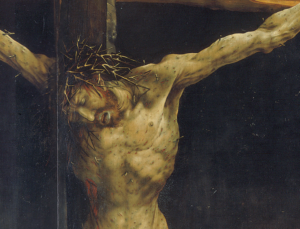
crucifixion. St. Luke Passion Penderecki

Isenheim Altarpiece (detail) / Matthias Grünewald

Polish composer Krzysztof Penderecki grew up under the heavy hand of communism and its socialist realism aesthetic. Like many Eastern Europeans of his generation, he looked to the West for inspiration and a sense of liberation from official dictates.

What he and many other like-minded composers found was the music of Karlheinz Stockhausen, Luigi Nono, Pierre Boulez, and other representatives of a generation of composers who grew up chafing under similarly oppressive Nazism and fascism.

As he commented later, this music gave the illusion of universalism, but strayed too far from the expressive qualities of Western music. Of course, his earliest works to attract international intention, including hisThrenody to the Victims of Hiroshima and St. Luke Passion, were written under the influence of these older composers.

They display, however, emotional qualities that have continued to earn them performances where most post-war avant-garde music has never been welcome. Composing the Passion further allowed Penderecki to express his devout Roman Catholic faith and thereby find yet another way to snub communist orthodoxy. Continue reading →

Posted in Program notes | Tagged Bach (J. S.), Passion music, Penderecki (Krzysztof), program notes, St. Luke Passion, twentieth century | Leave a reply

Post navigation

← Older posts
Newer posts →

Musicology for Everyone

Search by category

  • American popular music
    • Civil War music
    • Jazz
  • Anecdotes
    • Quotations
  • Bands and band music
  • Christmas music
  • Classical music
  • Composers
  • European musical history
  • Humor
  • Music education
  • Music Festival
  • Opera
  • Orchestras
  • Program notes
  • Trombone and other brass
  • Uncategorized

Archives

Music composer jobs
Footer HTML
©2026 - Musicology for Everyone - Weaver Xtreme Theme
↑