↓
 

Musicology for Everyone

(Professional research for a general audience)

  • Home
  • About
  • Contact me
Home→Tags nineteenth century - Page 24 << 1 2 … 22 23 24

Tag Archives: nineteenth century

Post navigation

Newer posts →

Niccolò Paganini: The devil’s violinist?

Musicology for Everyone Posted on May 10, 2010 by David GuionJanuary 28, 2020 2

Revised January 4, 2020

Niccolò Paganini became the world’s first international superstar of the violin. People wondered, could the brilliance of this eccentric, odd-looking man possibly be natural? Or did he have diabolical help?

Paganini could perform technical feats no other violinist could match. If anything, his showmanship was even more marvelous than his technique. The first virtuoso to perform from memory, he could move around the stage and interact with the audience.

In part, he could outdo other violinists because he invented new techniques such as left-hand pizzicato and various new kinds of bowing and tuning. Later violinists have learned them all. But he also had incredible joint flexibility and long fingers, which gave him a reach up and down the fingerboard that no one before or since has been able to match.

Apparently, the physiological uniqueness of his technique came from some kind of congenital condition like Marfan syndrome or Ehlers-Danlos syndrome. The nineteenth-century knew nothing of these conditions. Rumor had it that Paganini had sold his soul to the devil.

Other health conditions gave him a gaunt appearance. A serious illness in 1822 left him with a cadaverous pallor. In 1828, he had two operations on his jaws, which required the extraction of all his teeth. His international fame started a year later.

Whether from his medical conditions or his sense of showmanship, Paganini looked the part of an evil genius. Tall and pale, he had a long nose, long curly hair, and thin lips often formed into a sarcastic smile. Continue reading →

Posted in Anecdotes, Composers | Tagged anecdotes, nineteenth century, Paganini (Niccolò), violinists, virtuosos | 2 Replies

Who wrote the first opera in the United States?

Musicology for Everyone Posted on January 12, 2010 by David GuionDecember 6, 2012  

The usual answer to that question, William Henry Fry, produced Leonora in Philadelphia in 1845. A skillful imitation of Bellini and Donizetti it ran for twelve performances, successful enough to justify publication of a piano-vocal score. Fry’s brother Joseph adapted the libretto from a novel by Bulwer-Lytton.

In the November 23, 1843 issue of the Daily Picayune, a New Orleans newspaper, appears notice of a new opera:

“The idea of a Native American Opera is something so new and unexpected that our musical amateurs and connoisseurs were not a little taken aback by the announcement of Andre at the American Theatre, and, the consequence was . . . a considerable stirring up of curiosity. The name of Cioffi, in connection with the affair, was alone sufficient to give it respectability, and ensure for its proper consideration. . . .”

Felippe Cioffi was best known as an excellent trombonist. Apparently Italian born but educated and trained in this country, he had many years experience playing in theater orchestras. He was also a military band master, composer of marches, and winner of a local contest for the best arrangements of American patriotic melodies.

The article goes on to say that Andre “afforded satisfaction” for two performances. Then it disappeared from sight. Fry, an experienced and well-rounded composer, undoubtedly wrote a better opera. Cioffi produced his more than a year earlier.

Posted in Composers | Tagged American music, Cioffi (Felippe), Fry (William Henry), nineteenth century, opera | Leave a reply

Did Sax invent the saxhorn?

Musicology for Everyone Posted on December 4, 2009 by David GuionDecember 20, 2014  

[ad name=”Google Adsense 728×90″]

(Saxhorns are the top row of instruments in this 1872 advertisement)

In1845, French military music reached the bottom of a long decline. The war ministry, desiring to reorganize it completely, arranged for a contest among bands with various instrumentation. The band led by Adolphe Sax won.

The Belgian-born Sax had only moved to Paris and set up shop three years earlier. His quick success (largely due to the superior craftsmanship of his instruments but also to notable supporters such as Hector Berlioz) annoyed established French makers.

That this upstart should win the right to reorganized French military music added insult to injury. That his instrumentation was built around a family of instruments he had named for himself and patented enraged several of them so much that they banded together and brought suit to nullify Sax’s patents. That suit eventually ruined both Sax and his rivals  financially.

The instruments in question, saxhorns, are valved bugles, that is, brass instruments with a conical bore. Sax was hardly the first instrument maker to add valves to bugles. He copied his valves from the German maker Johann Gottfried Moritz. Two things set saxhorns apart from anyone else’s valved bugles.

First, Sax found a superior proportion for designing the exact taper of the conical sections of his instruments. (They were necessarily cylindrical through the valves.) Second, he built a complete family of instruments from soprano to bass, alternating in pitch between B-flat and E-flat instruments.

A collection of valved bugles by other makers, which lacked similarity of proportion and compatibility of basic pitch cannot sound as good, when played together, as an ensemble of saxhorns. But did these two innovations constitute an entirely new instruments for the purpose of obtaining a patent?

Sax and his adversaries did not have enough money among them to produce a clear legal answer. Even today, differences of opinion exist.  If legal courts have no definitive opinion, the court of history does. Instruments of that kind are musically less important now than in the nineteenth century,  but where they are used at all, they are invariably saxhorns, not instruments of the same design of any of his professional and legal rivals.
[ad name=”Google Adsense 468×60″]

Posted in Trombone and other brass | Tagged France, military music, nineteenth century, Sax (Adolphe), saxhorn | Leave a reply

Franz Liszt at an artistic crossroads

Musicology for Everyone Posted on December 2, 2009 by David GuionSeptember 7, 2016  
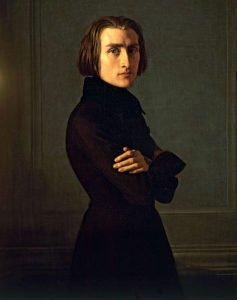
Franz Liszt / painting by Henri Lehmann, 1839

Franz Liszt / painting by Henri Lehmann, 1839

In the early decades of the nineteenth century, a social division arose between two kinds of music.

Some loved what they called classical music. They quarreled with people who preferred what William Weber has called high-status popular music.

Classical music specifically meant the masterpieces of Haydn, Mozart, Beethoven, and a few others.

High-status popular music included popular operas by Rossini, Meyerbeer, and others. It also included traveling virtuosos who performed largely in salons.

That is, they performed before invited guests in the homes of aristocratic or upper-middle-class hosts.

Robert Schumann began his career as a critic specifically to protest against the emptiness of most of the piano virtuosos. They specialized in dazzling arrangements of operatic tunes or variations on popular melodies.

These pieces had little musical substance. They did not reward repeated hearing. But the audience for them preferred novelty. They had no interest in hearing the same pieces over and over.

Schumann recognized greater musical substance in some of them, including Franz Liszt. In his early career, then, Liszt represented high-status popular music. But without the musical emptiness and technical gimmicks that Schumann so despised.

Weber points out that the old aristocracy and upper middle class essentially merged around mid-century and that classical music and high-status popular music likewise grew together.

Previously popular operas, including most of Rossini’s, eventually disappeared from the repertoire, but their overtures became acceptable fare on symphonic concerts.

The virtuosos who did not make some move towards classical music likewise lost public favor.

The new  Liszt

buy classical music

Franz Liszt conducting / unknown artist, ca. 1918

In 1846 one of Liszt’s admirers, who also loved classical music, challenged him to play Beethoven’s music on his programs. So he did.

As a composer, he had always concentrated on solo piano music, occasionally with orchestral accompaniment. Like other virtuosos, he wrote a lot of variations on popular tunes. He did not compose sonatas or other classical forms.

Beginning about the time he started playing classical music in concert, he began to compose differently. He produced purely orchestral music, choral music (both sacred and secular), and songs. His piano music became more serious.

He still didn’t use classical forms. He based his music on literary programs. As a result, he devised his own formal procedures.

Liszt also experimented with new harmonic structures.At least one of his late piano pieces is almost atonal.

They had a profound influence on composers all over Europe who wanted to come out from under the domination of German musical culture.

Liszt made the transition from high-status popular music to the newly defined classical music world so easily and naturally that only in retrospect can scholars discern a transition at all.

Not all remained unified in classical music, however. Some composers (Brahms, for example) continued to write in classical forms, using harmonies, techniques of orchestration, and so on, that built on Beethoven’s legacy gradually and incrementally.

The group represented by Brahms and the group represented by Liszt argued as intensely as formerly groups that preferred “classical” music or “popular” music had argued.

By this time the idea of classical music becomes problematic. Once it meant music with standard forms high artistic ideals. It was mostly old music, or modeled on old music. It required repeated hearings to understand it.

Liszt and allies wrote new music not based on standard forms. It was less listener-friendly and demanded even more of the audience. They still aspired to high artistic ideals. But the world of classical music could no longer agree on what that meant.

Revised September 7, 2016

Source: Music and the middle class: the social structure of concert life in London, Paris, and Vienna / William Weber (New York: Holmes and Meier, 1975)

Photo credits:
Public domain.

Posted in American popular music, Classical music | Tagged classical music, Liszt, nineteenth century, popular music | Leave a reply

Post navigation

Newer posts →

Musicology for Everyone

Search by category

  • American popular music
    • Civil War music
    • Jazz
  • Anecdotes
    • Quotations
  • Bands and band music
  • Christmas music
  • Classical music
  • Composers
  • European musical history
  • Humor
  • Music education
  • Music Festival
  • Opera
  • Orchestras
  • Program notes
  • Trombone and other brass
  • Uncategorized

Archives

Music composer jobs
Footer HTML
©2026 - Musicology for Everyone - Weaver Xtreme Theme
↑