↓
 

Musicology for Everyone

(Professional research for a general audience)

  • Home
  • About
  • Contact me
Home→Tags Liszt

Tag Archives: Liszt

Classical music that used to be popular music

Musicology for Everyone Posted on September 12, 2016 by David GuionSeptember 12, 2016  

composers classical vs popular music You don’t have to be a classical music lover to recognize names of important classical composers.

  • Bach
  • Beethoven
  • Brahms
  • Wagner
  • Liszt
  • Rossini

Except that the music of Rossini and others was considered popular music when it was first heard. And people who liked classical music scorned it. One French writer divided musicians into two kinds: classicists and Rossinists.

So what else that we think of as classical music used to be considered popular? And what changed? Continue reading →

Posted in Classical music, European musical history | Tagged classical music, composers, Liszt, nineteenth century, popular music, Rossini (Gioacchino) | Leave a reply

Classic cartoons: they don’t make ’em that way any more

Musicology for Everyone Posted on May 27, 2013 by David GuionJuly 1, 2021  
Bugs Bunny at piano

Bugs Bunny, preparing to perform Liszt’s Hungarian Rhapsody No. 2

Since this is a music blog, “classic cartoons” means something more specific than just the old ones. Many cartoons used to feature classical music, which is the only reason why they belong in this blog.

I never had any kids, so haven’t paid much attention to the Saturday morning cartoons since I was a kid myself. Every once in a while I see one, though. I’m not qualified to say that they don’t use classical music, but I think I’d remember noticing if I’d heard any. I am principally struck by the lack of richness in the drawing. Continue reading →

Posted in Classical music, Humor | Tagged cartoons, Liszt, music in society, popular music, twentieth century, videos | Leave a reply

Les Préludes, by Franz Liszt

Musicology for Everyone Posted on April 30, 2012 by David GuionOctober 19, 2020 6

Les Préludes, d’après Lamartine is the third of Franz Liszt’s symphonic poems.

It was the first to be performed, and the only one to find a permanent place in the orchestral repertoire.

Liszt invented the symphonic poem, but audiences and orchestras alike found them difficult and forbidding.

Symphonic poems have two basic characteristics.

Musically, they contain all of the structural characteristics of a traditional four-movement symphony within a single movement.

They also attempt to unite music and literature by means of a preface, or program, that Liszt provided. Continue reading →

Posted in Program notes | Tagged Liszt, nineteenth century, orchestral music, program notes, symphonic poems | 6 Replies

Franz Liszt and the symphonic poem

Musicology for Everyone Posted on February 20, 2012 by David GuionFebruary 4, 2022  
buy classical music

Franz Liszt conducting

Early in his career, no one would have guessed that Franz Liszt would ever become capable of writing symphonic poems like Les Préludes. He was a piano virtuoso, known for the flashy brilliance of his playing. Most piano virtuosos of his generation and earlier contented themselves with composing what Robert Schumann scorned as Philistine music. Schumann recognized that Liszt wrote musically more substantial pieces. Therefore it makes sense that out of all the famous virtuosos, Liszt would invent the symphonic poem. Continue reading →

Posted in Composers | Tagged Liszt, nineteenth century, orchestral music, symphonic tone poems | Leave a reply

Franz Liszt at an artistic crossroads

Musicology for Everyone Posted on December 2, 2009 by David GuionSeptember 7, 2016  
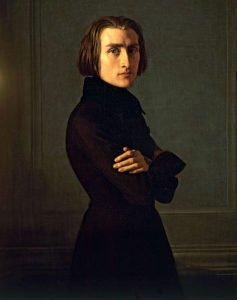
Franz Liszt / painting by Henri Lehmann, 1839

Franz Liszt / painting by Henri Lehmann, 1839

In the early decades of the nineteenth century, a social division arose between two kinds of music.

Some loved what they called classical music. They quarreled with people who preferred what William Weber has called high-status popular music.

Classical music specifically meant the masterpieces of Haydn, Mozart, Beethoven, and a few others.

High-status popular music included popular operas by Rossini, Meyerbeer, and others. It also included traveling virtuosos who performed largely in salons.

That is, they performed before invited guests in the homes of aristocratic or upper-middle-class hosts.

Robert Schumann began his career as a critic specifically to protest against the emptiness of most of the piano virtuosos. They specialized in dazzling arrangements of operatic tunes or variations on popular melodies.

These pieces had little musical substance. They did not reward repeated hearing. But the audience for them preferred novelty. They had no interest in hearing the same pieces over and over.

Schumann recognized greater musical substance in some of them, including Franz Liszt. In his early career, then, Liszt represented high-status popular music. But without the musical emptiness and technical gimmicks that Schumann so despised.

Weber points out that the old aristocracy and upper middle class essentially merged around mid-century and that classical music and high-status popular music likewise grew together.

Previously popular operas, including most of Rossini’s, eventually disappeared from the repertoire, but their overtures became acceptable fare on symphonic concerts.

The virtuosos who did not make some move towards classical music likewise lost public favor.

The new  Liszt

buy classical music

Franz Liszt conducting / unknown artist, ca. 1918

In 1846 one of Liszt’s admirers, who also loved classical music, challenged him to play Beethoven’s music on his programs. So he did.

As a composer, he had always concentrated on solo piano music, occasionally with orchestral accompaniment. Like other virtuosos, he wrote a lot of variations on popular tunes. He did not compose sonatas or other classical forms.

Beginning about the time he started playing classical music in concert, he began to compose differently. He produced purely orchestral music, choral music (both sacred and secular), and songs. His piano music became more serious.

He still didn’t use classical forms. He based his music on literary programs. As a result, he devised his own formal procedures.

Liszt also experimented with new harmonic structures.At least one of his late piano pieces is almost atonal.

They had a profound influence on composers all over Europe who wanted to come out from under the domination of German musical culture.

Liszt made the transition from high-status popular music to the newly defined classical music world so easily and naturally that only in retrospect can scholars discern a transition at all.

Not all remained unified in classical music, however. Some composers (Brahms, for example) continued to write in classical forms, using harmonies, techniques of orchestration, and so on, that built on Beethoven’s legacy gradually and incrementally.

The group represented by Brahms and the group represented by Liszt argued as intensely as formerly groups that preferred “classical” music or “popular” music had argued.

By this time the idea of classical music becomes problematic. Once it meant music with standard forms high artistic ideals. It was mostly old music, or modeled on old music. It required repeated hearings to understand it.

Liszt and allies wrote new music not based on standard forms. It was less listener-friendly and demanded even more of the audience. They still aspired to high artistic ideals. But the world of classical music could no longer agree on what that meant.

Revised September 7, 2016

Source: Music and the middle class: the social structure of concert life in London, Paris, and Vienna / William Weber (New York: Holmes and Meier, 1975)

Photo credits:
Public domain.

Posted in American popular music, Classical music | Tagged classical music, Liszt, nineteenth century, popular music | Leave a reply

Musicology for Everyone

Search by category

  • American popular music
    • Civil War music
    • Jazz
  • Anecdotes
    • Quotations
  • Bands and band music
  • Christmas music
  • Classical music
  • Composers
  • European musical history
  • Humor
  • Music education
  • Music Festival
  • Opera
  • Orchestras
  • Program notes
  • Trombone and other brass
  • Uncategorized

Archives

Music composer jobs
Footer HTML
©2026 - Musicology for Everyone - Weaver Xtreme Theme
↑