↓
 

Musicology for Everyone

(Professional research for a general audience)

  • Home
  • About
  • Contact me
Home→Tags classical music - Page 8 << 1 2 … 6 7 8 9 >>

Tag Archives: classical music

Post navigation

← Older posts
Newer posts →

Jullien in America

Musicology for Everyone Posted on July 15, 2010 by David GuionOctober 23, 2014  

Before the Civil War, at a time when the United States boasted only one financially stable concert orchestra and few native composers and solo performers of “classical” music, what taste there was for it had to be supplied by foreign visitors. In 1853 the conductor Jullien brought forty members of his London orchestra to the United States and hired sixty Americans to supplement them.

Jullien had come at the invitation of P. T. Barnum, who had talents for promotion and marketing rivaling Jullien’s own. During the year, his orchestra gave 214 concerts.

At least some of them were the “monster concerts,” for which he was famous in London. According to advertisements, they included 20 soloists among 1,200 total performers! As one critic wrote, “The music is magnificent, and so is the humbug.”

When Jullien presented his Fireman’s Quadrille at New York’s Crystal Palace, he warned the audience that something unusual “might  happen.” On cue, three companies of firemen invaded the palace with their firehouses to combat real flames.

Ushers had to deal with fainting women and other minor panic, even though Jullien had as much told the audience to expect something of the kind. But the firemen all left on cue, too. The quadrille ended with the doxology, and the audience sang along. During the whole thing, of course, the orchestra kept playing, totally undisturbed.

For all of his showmanship, Jullien was an excellent musician who trained his orchestra very thoroughly. When he played the music of the masters, he would limit his antics to before a piece and after it.

He ostentatiously put on special gloves to conduct Beethoven, or selected a jeweled baton. When a piece was finished, he sometimes sank into his ubiquitous velvet chair, exhausted by his hard work. He was all business during the performance.

After a little less than a year, he returned to England, leaving a remarkable legacy:

Although the New York Philharmonic virtually ignored American composers, Jullien performed the music of such composers as William Henry Fry and George Bristow.  He performed some of these pieces several times back in England, giving American concert music its first international audience.

He set higher standards of ensemble discipline and musicianship than American orchestras and bands had yet achieved. Thus, he inspired them to improve their own standards.

Patrick Gilmore, who founded the first of America’s professional touring military-style bands, adopted the concept of monster concerts and other aspects of Jullien’s showmanship.

Jullien’s influence probably explains why Gilmore arranged to have firemen pounding on anvils during a performance of Verdi’s “Anvil Chorus,” and why he even used an actual canon in another piece.

American bands and orchestras played the Fireman’s Quadrille for years, complete with uniformed firemen tramping across the stage (although probably not with fire hoses to put out a real fire).

Jullien also had members of his orchestra put down their instruments from time to time and sing. That practice can still be found in American pops concerts. Jazz bands adopted it, too.

Posted in Classical music, Orchestras | Tagged American music, classical music, conductors, entertainment, Gilmore (Patrick S), Jullien, mass audience, nineteenth century, orchestra concerts, orchestras, popular culture, programing, showmanship | Leave a reply

Making sense of sonata form

Musicology for Everyone Posted on July 12, 2010 by David GuionJanuary 24, 2025  

Revised June 30, 2018

high school orchestra. making sense of sonata form

Pinellas County All County High School Orchestra, 2016

People today with little or no musical training somehow “get” a 12-measure blues chorus or the standard song forms of various modern styles. Even music majors taking theory classes have a hard time with sonata form. How is anyone else to make sense of it?

Sonata form did not always cause confusion or seem to set up a barrier to understanding music. It actually started off as an attempt to simplify music. I have written several posts about the rise of the middle class, the popularity of what we call “classical” music, and the aftermath of the French Revolution, which destroyed public concert life in the three major capitals of Europe.

    • The birth of the popular music industry
    • Vienna, 1800: the divergence of classical and popular music
    • Classical music: the birth of an idea
    • Popular music: the birth of an idea
    • The birth of the idea of classical music


During the time described in these articles, everyone knew sonata form as well as we know the forms of today’s music. Even people with no musical training could follow it. Even people who enjoyed music only as amusement and not as an art form could appreciate clever things composers did with it. It was a current procedure, not a museum relic.

The principles of sonata form underlie all classical music from early Haydn through Bruckner, and not a small portion since then. How can today’s audiences without musical training make sense of it? Now, when it’s a specialized subject in a music curriculum, people tend to approach it with some trepidation. They think they have to understand this antiquated system in order to enjoy the music.

So take heart from the words of operatic tenor Luciano Pavarotti: “You don’t need any brains to listen to music.”

The listening experience of sonata form

First of all, enjoy the music for its beauty and wide range of emotional expression. Don’t worry about the underlying form.

How many people who enjoy 12-measure blues choruses and 32-measure Tin Pan Alley standards can explain the difference? How many people who thrill to a great improvisation on any familiar tune know or care about the nuts and bolts its structure? Probably not many.

Mozart piano sonata, KV 331

People who don’t understand the structure of music, any music, can enjoy it on a visceral level. In fact, pitiful is the person who gains an intellectual knowledge of music at the cost of losing the ability to enjoy it viscerally.

Nonetheless, I offer this very non-technical, non-academic explanation. If knowledge and technical understanding are not prerequisite to enjoyment, they can certainly enhance it.

Historical information

Mozart family. making sense of sonata form

The Mozart family, ca. 1780 / Johann Nepomuk della Croce

Sonata form grew from dance forms. These, in turn, were mostly two-part forms, with both parts repeated. The music started out in a particular key.

Either by the end of the first part or the beginning of the second part, it moved to another key. After all, too long a stretch of music in the same key can get boring. Then it returned to the first key.

In music classes, the standard diagram for these short forms is ||: A :||: B :||.  The symbols ||: and :|| indicate repeats and A and B represent different music. Sometimes, though, the first part of A returns at the end of B, or graphically, ||: A :||: ba :||. That has a name of course, but if you don’t already know it, there’s no need to learn it.

Conventionally, some dances were presented in pairs, as in two minuets. Both were two-part forms. The second was in a contrasting key.  After the second dance of the pair, in order to get everything back to the same key where it started, the first one repeated, usually without the internal repeats and maybe with some kind of embellishment of the tune.

Together, then, these paired dances made up a three-part form (which we can diagram A B A), with both parts being a two-part form. Operatic arias, another source of sonata form, exhibited a different kind of three-part form.

The first two parts did not repeat, and they contrasted not only in key but in mood. At the end of the second part, the singer went back to the beginning and sang the first part, heavily embellished.

This kind of aria gave the singer a chance to show off his or her technical ability and imagination in embellishment. Within the opera, it gave the composer a chance to portray a dramatic situation to the point of painting a character’s mixed emotions about it.

Sonata form combined aspects of the older dances and arias and built them into something that could last much longer than any previous single movement, and yet maintain unity and coherence.

From dances, sonata form inherited the basic two-part structure. Composers quickly abandoned repeating the second part. After Beethoven, very often they no longer repeated the first, either.

The music in a classical sonata form moves to the new key by the middle of the first part. As in the operatic aria, the new key coincides with a change of mood. A sonata movement, therefore, becomes a drama in itself. (Although we usually associate sonata form with instrumental music, Mozart used it in many of his operatic arias and ensembles.)


Technical (sort of) information

Kuchengarten, Leipzig. making sense of sonata form

Kuchengarten, a pleasure garden in Leipzig / Heinrich Georg Drescher (1847–1925). Owned for a while by trombone soloist Karl Queisser, it offered a relaxed place for the musically unsophisticated to enjoy all kinds of music, including classical sonata-form pieces.

Sonata form may or may not have an introduction. Leaving that aside, the form begins with a recognizable melody called a theme, which might be as long as the entire first part of one of the earlier dances. When it’s finished, the music makes a transition to a new key. This first part, called the exposition, presents the thematic material like characters in a drama.

Sonata form usually has two themes, with transitional music in between. Sometimes the same theme occurs in both keys. Other times, there may be more than one distinctly different theme in each key. The drama inherent in sonata form comes not from the contrast of themes, but the contrast of keys.

We can think of it without any technical language: the music leaves home (the first key) for some other destination (the second key). Eventually, it gets back home. The old dance forms simply modulated to a new key and back, kind of like commuting.  But sonata form makes it a challenge to get there.

Therefore, the second part of our movement does not begin in the first key. It leads back there over the course of great difficulty. Dramatic tension builds as the themes get ripped apart and made to pass restlessly through many new keys. Technically, musicians know this section as the development, or working-out section.

If we look at sonata form as a journey, the music goes fairly directly from the first to the second key in the exposition. Then it takes the scenic route back home in the development. If we look at sonata form as a drama, the characters are the thematic ideas and key centers. They wrestle and contend with each other until they come to a place of rest.

That place of rest, called the recapitulation, starts when the music finally arrives the first key. Aside from music, we usually say recap nowadays. It has taken so much struggle to get there, the music can’t stop yet.

The audience needs reassurance that it has gotten back home. So, in a borrowing from the three-part form, the recap repeats all the thematic material introduced in the exposition. Except this time, it doesn’t change keys.

Once the second theme sounds in the first key, the form has finished. Keeping in mind that the development and recap together constitute the second part of a two-part form, it’s pretty easy to see why composers stopped having it repeated. Repeating the first part gives the audience a second chance to hear all the important themes. Repeating the second part would only repeat the drama and its resolution.

In case you were wondering why I provided textbook graphs for the two-part form after promising not to be academic, we can see sonata form in this one: ||: A :|| ba ||. “A” is the exposition, which is repeated. “B,” divided into “ba,” is the development and recap and is not repeated. Besides omitting the second repeat, then, sonata form is very much like that old dance form where the beginning of the first part returns at the end of the second part.

The composer may or may not tidy things up a bit more with some extra music tied on to the end. It’s called a coda, which is Italian for tail. Beginning with Beethoven, however, the coda didn’t tidy up anything at all. It’s as if the two characters in the drama get to the end of the recap and discover some unfinished business. They get into a fight all over again. The coda gets as long as either the development or the recap.

In a classical concerto, where a soloist plays with the orchestra, the drama plays out a little differently. The orchestra plays all the thematic material without changing keys. Then the soloist comes for the repeat of the exposition. The second time through introduces the contrasting key. The development and recap happen in the usual way, but the soloist has a chance to show off with a cadenza.


Beethoven blurs and breaks sonata form

Beethoven-- making sense of sonata form

Portrait of Beethoven / Joseph Karl Stieler, 1820

Up through the middle of Beethoven’s career, the various sections of a sonata form are fairly obvious once you know what to listen for. Composers usually placed a brief moment of silence between them. Beethoven experimented with blurring the boundaries.

Later composers got so good at hiding the joints that sonata form became almost impossible to hear. It became a nearly indiscernible structure underpinning whatever appears at the surface. It takes a great bit of painstaking study for even the most proficient musicians to find them.

Therefore, when it comes to nineteenth-century music in particular, hardly anyone in the audience can hear the form.

There. I’ve let the secret out.  Even professionals can’t always follow the sonata form just by listening to music after Beeethoven. They don’t necessarily even want to.

So without too much trouble, you can learn to hear sonata forms written in the Classic period––if you want to. Otherwise, just let the sheer beauty of the sound and the music’s dramatic and emotional power wash over your ears and give you a thrill.


For further reading: Sonata Forms / Charles Rosen. Revised edition (New York: Norton, 1988).

Photo credits:
Pinellas orchestra. Screen shot from Vimeo
Mozart sonata. Some rights reserved by Girl flyer
Mozart family. Public domain from Music with Ease
Kuchengarten. Public domain from Wikimedia Commons
Beethoven. Public domain from Wikimedia Commons

Posted in Classical music | Tagged audiences, classical music, instrumental music, music education, sonata form, tonal harmony | Leave a reply

An unexpected crossover: a rock guitarist plays opera

Musicology for Everyone Posted on July 8, 2010 by David GuionAugust 23, 2022  

I will confess that I have never liked very much of the popular music of my lifetime. Once I got out of college, I stopped paying attention entirely. As I have studied the history of popular music, I noticed that from its beginnings at the end of the eighteenth century through the heyday of Tin Pan Alley, it was marketed to adults.

Beginning with the rock music, marketers have sought to appeal to teenagers or even younger children. It appears that the audiences age along with the performers. Many people in their thirties and forties consider the Rolling Stones to old to keep playing rock, for instance.

And so I wondered, where will there be continuity? Is there still an audience for Tin Pan Alley songs that’s much younger than I am? Will any music popular to one generation be of any interest to any later one? And with so many school music programs as risk from funding cuts, how will any critical mass of young people even hear classical music?

Those of you who enjoy recent popular music and know the scene, please hold your laughter, go on to the videos, and enjoy some very expressive performances. But first let me explain why they are a revelation to me. Continue reading →

Posted in American popular music, Classical music | Tagged "Corpus Christi Carol", "Nessun dorma", Beck (Jeff), classical music, crossover, electric guitar, mass audience, opera, popular music, Puccini (Giacomo), rock musicians, twenty-first century, videos | Leave a reply

Girls and trombone: odder than I first thought?

Musicology for Everyone Posted on January 15, 2010 by David GuionMay 15, 2021  
trombonists in girls bands

Members of the Dong Ju High School girls band perform during the arrival of the aircraft carrier USS MIDWAY (CV 41). Picryl

I had just begun seventh grade the first time I met a girl trombonist, who was also in seventh grade. It didn’t take long to realize that she was better than any other trombonist in the band, and there were lots of them. When we got to ninth grade (freshman year of high school), she played better than any of the seniors.

Her older sisters, recent graduates, had been just as outstanding on  horn and tuba. The best trumpet player was a girl, as were all of the hornists, and a euphonium player. It never occurred to me that there was anything odd about girls playing brass instruments.

Once out of high school, I continued to meet women who played various brass instruments. Many were very good, but as I talked with them and read about musicians in orchestras and on college faculties, I learned that many people did find women brass players more than a little disconcerting.

Many years later, I heard a friend from graduate school deliver a paper based on her doctoral research. She had studied references to music in almost fifty years of Godey’s Lady’s Book, an important magazine of the mid-nineteenth century. One particular thought sticks with me. Society expected respectable young women to play piano. I do not recall if violin was considered suitable for women, but respectable women did not play wind instruments of any kind.

That surprised me. I had always thought of flute as a woman’s instrument. No boys in my high school played flute, and I met only one boy flutist at another school. A man taught flute at my undergraduate school, but only one man studied with him. A woman taught flute in my graduate school, and I don’t recall any men students.

Abbie Conant’s struggle for acceptance as trombonist

Abbie Conant. girl trombonists

Abbie Conant /

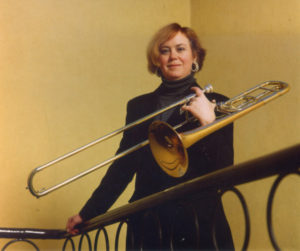
These musings came to mind recently as I read an account of Abbie Conant’s troubles with the Munich Philharmonic Orchestra. Playing behind a screen, she won an audition for principal trombonist when conductor Sergiu Celebidache exclaimed, “that’s the one we want” and sent seventeen other applicants away without hearing them. Only then did he learn that he  had selected a woman.

According to Malcolm Gladwell, holding auditions behind a screen, which takes away all visual cues, has resulted in the hiring of many women in orchestras. Any number of orchestras may have been surprised that the best-sounding candidate was a woman or non-white, but most trusted their ears and adjusted.

Celibidache made no attempt to turn away from his hidebound prejudice that a woman could not possibly play principal trombone adequately. Conant took the orchestra to court, and the  litigation lasted more than a dozen years. She won every round. Celibidache, having decided to trust his eyes instead of his ears, could no longer hear what any other musician testified, that Conant fully deserved the position that she had won.

Now, when I see “Who says girls can’t play trombone?” in a woman’s signature line, I’m no longer surprised, but it’s sad. Everyone is good at something and no good at something else. No one can determine a person’s aptitudes merely by observing sex or ethnicity. I wish everyone would stop trying.

Meanwhile, check out this clip of an all-woman trombone quartet called Bones Apart playing an arrangement of Stars and Stripes Forever. You’ll be thinking, “Hey, you can’t play that on trombones!” But they do.

References:
Music and references to music in Godey’s Lady’s Book : 1830-77 / by Julia Eklund Koza (Ph.D. dissertation: University of Minnesota, 1988).

Blink: the power of thinking without thinking / by Malcolm Gladwell (New York: Back Bay Books, 2005), pp. 245-54.

Posted in Trombone and other brass | Tagged brass players, Celibidache (Sergiu), classical music, Conant (Abbie), equal opportunity, orchestras, prejudice, trombonists, video, women musicians | Leave a reply

Franz Liszt at an artistic crossroads

Musicology for Everyone Posted on December 2, 2009 by David GuionSeptember 7, 2016  
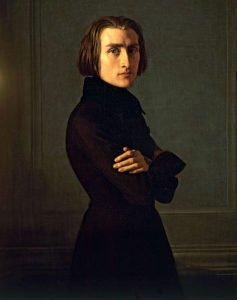
Franz Liszt / painting by Henri Lehmann, 1839

Franz Liszt / painting by Henri Lehmann, 1839

In the early decades of the nineteenth century, a social division arose between two kinds of music.

Some loved what they called classical music. They quarreled with people who preferred what William Weber has called high-status popular music.

Classical music specifically meant the masterpieces of Haydn, Mozart, Beethoven, and a few others.

High-status popular music included popular operas by Rossini, Meyerbeer, and others. It also included traveling virtuosos who performed largely in salons.

That is, they performed before invited guests in the homes of aristocratic or upper-middle-class hosts.

Robert Schumann began his career as a critic specifically to protest against the emptiness of most of the piano virtuosos. They specialized in dazzling arrangements of operatic tunes or variations on popular melodies.

These pieces had little musical substance. They did not reward repeated hearing. But the audience for them preferred novelty. They had no interest in hearing the same pieces over and over.

Schumann recognized greater musical substance in some of them, including Franz Liszt. In his early career, then, Liszt represented high-status popular music. But without the musical emptiness and technical gimmicks that Schumann so despised.

Weber points out that the old aristocracy and upper middle class essentially merged around mid-century and that classical music and high-status popular music likewise grew together.

Previously popular operas, including most of Rossini’s, eventually disappeared from the repertoire, but their overtures became acceptable fare on symphonic concerts.

The virtuosos who did not make some move towards classical music likewise lost public favor.

The new  Liszt

buy classical music

Franz Liszt conducting / unknown artist, ca. 1918

In 1846 one of Liszt’s admirers, who also loved classical music, challenged him to play Beethoven’s music on his programs. So he did.

As a composer, he had always concentrated on solo piano music, occasionally with orchestral accompaniment. Like other virtuosos, he wrote a lot of variations on popular tunes. He did not compose sonatas or other classical forms.

Beginning about the time he started playing classical music in concert, he began to compose differently. He produced purely orchestral music, choral music (both sacred and secular), and songs. His piano music became more serious.

He still didn’t use classical forms. He based his music on literary programs. As a result, he devised his own formal procedures.

Liszt also experimented with new harmonic structures.At least one of his late piano pieces is almost atonal.

They had a profound influence on composers all over Europe who wanted to come out from under the domination of German musical culture.

Liszt made the transition from high-status popular music to the newly defined classical music world so easily and naturally that only in retrospect can scholars discern a transition at all.

Not all remained unified in classical music, however. Some composers (Brahms, for example) continued to write in classical forms, using harmonies, techniques of orchestration, and so on, that built on Beethoven’s legacy gradually and incrementally.

The group represented by Brahms and the group represented by Liszt argued as intensely as formerly groups that preferred “classical” music or “popular” music had argued.

By this time the idea of classical music becomes problematic. Once it meant music with standard forms high artistic ideals. It was mostly old music, or modeled on old music. It required repeated hearings to understand it.

Liszt and allies wrote new music not based on standard forms. It was less listener-friendly and demanded even more of the audience. They still aspired to high artistic ideals. But the world of classical music could no longer agree on what that meant.

Revised September 7, 2016

Source: Music and the middle class: the social structure of concert life in London, Paris, and Vienna / William Weber (New York: Holmes and Meier, 1975)

Photo credits:
Public domain.

Posted in American popular music, Classical music | Tagged classical music, Liszt, nineteenth century, popular music | Leave a reply

Vienna, 1800: the divergence of classical and popular music

Musicology for Everyone Posted on November 25, 2009 by David GuionFebruary 15, 2020  

Revised February 27, 2017

Vienna Kohlmarkt. classical and popular music in Vienna

Vienna ca. 1800. The Kohlmarkt. Artaria, Beethoven’s publisher, is on the right.

What kind of music do you think of when you think of Vienna?

Classical music, of course.

Extra credit if you thought of Johann Strauss and realize that his waltzes aren’t classical music. But did you know classical music was hard to find in Vienna in 1800?

Mozart had been dead for nine years. Haydn was an old man close to retirement from composing.

The young Beethoven had made a strong start in establishing his reputation. Schubert was only three years old.

And most of the public idolized musicians you’ve probably never heard of.

In fact, the concept of classical vs popular music is only about 200 years old. It is foreshadowed by the 18th-century phrase “Kenner und Liebhaber,” or “connoisseurs and music lovers.”

Up until about 1790, many European cities enjoyed an active and varied concert life. Popular music and art music mingled on every concert, but no one yet thought in those terms. Music lovers without much knowledge or training could enjoy the art music, because its style was familiar. Connoisseurs found something to like in the less sophisticated music.

Between 1790 and the middle of the 1810s, concert life ceased entirely in London and Paris, two of the three major musical capitals. By the time it started again, the people with no special knowledge of music no longer knew how to listen to what by that time was recognized as “classical” music.

Consider the foremost musical magazine of the early 19th century, the Allgemeine musikalische Zeitung, or “General Music Newspaper.” It first appeared in 1798 when it was still conceivable for one magazine to appeal to all musical tastes.

An article by its Vienna correspondent in 1800 shows the beginning of a divergence of taste there.

Vienna theaters

St. Michael's Square. classical and popular music in Vienna

St. Michael’s Square, Vienna, ca. 1800. Burg theater (the German theater) is far right

Vienna, the third major musical capital, did not suffer complete loss of its concert life, but the number and quality of concerts diminished. Opera suffered, too.

Vienna had an Italian opera theater and a German opera theater. As far as their orchestras were concerned, the Italians had some excellent players.

But its members frequently sent substitutes to whenever they had a chance to make more money somewhere else.

The director was “obviously unequal to his task.” As a result, the Italian orchestra did not play well.

The correspondent disapproved of the selection of operas: “The recognized older ones are neglected in favor of the newer ones which, taken as a whole, can please no connoisseur.”

The recognized older operas probably included the works of Mozart and Gluck. I haven’t identified the newer ones he complained about. They must have contained spectacular vocal effects without much sophistication of form, harmony, or melody.

In the next decade, Rossini’s operas took all of Europe by storm. Connoisseurs hated them. The arias all sounded alike, they said, and the orchestra drowned out the singers.

As the greatest of German musical centers, Vienna should have had an excellent German theater. The correspondent wrote that it fell short. It didn’t pay its musicians enough. As a consequence, it had fewer good musicians. It had a much more competent leader, though, so it often gave better performances. It still performed Haydn’s symphonies and Mozart’s operas.

Concerts in Vienna

Beethoven. classical and popular music in Vienna

Beethoven in 1804, the year he composed his Fifth Symphony / Detail of a portrait by W. J. Mähler

Except for four annual concerts sponsored by the Fund for Musicians’ Widows, Vienna had no regular concert life in 1800. It also had no place devoted to orchestral concerts.

Instead, composers and performers had to rent the theaters at a high cost. For that reason, traveling artists rarely presented concerts in Vienna.

The correspondent panned two concerts and singled out two with excellent music. The horn virtuoso Punto introduced Beethoven’s horn sonata.

Beethoven himself presented a piano concerto, his first symphony, and his Septet at the Italian theater. The utter incompetence of the orchestra kept the music from making its best effect.

Amateur musicians played an outsized role in musical performances, not only in Vienna, but in other major capitals as well. The correspondent pointed out that in Vienna, everyone took music lessons and performed. Therefore, the city boasted many proficient amateur musicians, although fewer than earlier.

If there were so few public concerts, the number of private concerts made up for it. Nearly every aristocratic or upper-middle-class family opened their homes to invited musical guests all winter long. Unfortunately, Baron van Swieten, author of the words to Haydn’s oratorios, offered nothing that year.

Amateurs and private concerts

Daniel Steibelt. classical and popular music in Vienna

Daniel Seibelt by unidentified artist

Amateurs of all levels of proficiency took turns entertaining. They usually chose uncomplicated, unsophisticated music such as favorite arias from the latest Italian operas or whatever piano pieces were making the rounds.

The correspondent drew a careful distinction between the entertainment value of these concerts (high) and their artistic value (negligible).

Traveling virtuosos, shut out of the public theaters by their high costs, made the circuit of the private concerts.

Of necessity, they appeared everywhere they could and praised the talent of all the amateurs they heard. Those who were good at flattery and public relations made a big hit in Vienna.

Eventually the amateur community divided into parties of those who preferred this or that virtuoso above others. The correspondent noted that the ardor of their partisanship often made up for a lack of true artistic discernment.

When Beethoven bested Daniel Steibelt in their infamous contest in 1800, the substance of a classical master trounced the gimmicks of a man who had been a popular favorite everywhere else.

With so much trivial and frivolous music dominating Vienna, where were the connoisseurs? The correspondent noted,

Yet, truly, the genuine connoisseurs and friends of music––music as art, that is––are more numerous here than strangers seem to think. The reason why they are so little bruited abroad may well be that they themselves make so little noise, preferring to worship and enjoy their idol unobtrusively.

It appears, in other words, that they gathered in each other’s homes to practice chamber music. Or symphonies if enough of them could scrape together an orchestra. They made no attempt to attract an audience.

Vienna and elsewhere

Henri Herz, classical and popular music, Vienna

Austrian pianist and composer Henri Herz (1803–1888), by Achille Devéria (1800–1857)

Vienna had some concert life and a great composer living and working there. London and Paris didn’t. So connoisseurs in those capitals likewise had to band together to entertain themselves. As in Vienna, they represented a small slice of the musical public.

Even with the return of permanent orchestras and public concerts, much of the public didn’t return to the concert halls.

By the time Robert Schumann decided to become a music critic, traveling virtuosos like Henri Herz captured the lion’s share of the audience for music.

They specialized in flashy dance pieces, sets of variations, and all manner of gimmicks.

William Weber has identified Herz and other virtuosos on the salon circuit as representative of “high-status popular music.”

Like all other popular music, it was more business than art. It relied on a combination of easy familiarity and novelty to keep up a steady stream of new sales. These were the Philistines that Schumann devoted his critical career to attacking.

Meanwhile, Beethoven had no immediate followers among composers. He died in 1827. The generation of Schumann, Mendelssohn, and Berlioz started to make their mark internationally in the 1830s. Until then, those who preferred music as an art to music as entertainment had little to listen to by living composers.

A journalistic war of words began between lovers of the artistic ideals of dead composers and the novelty offered by popular living composers. A French critic in the 1830 proclaimed that there were only two kinds of musicians: classicists and Rossinists.

The argument continues along the same lines today.

Related posts

The birth of the popular music industry
Classical and pop music: 200 years of rivalry
Classical music that used to be popular music
Making sense of sonata form

Sources:
“A sketch of the principal features of contemporary musical life in Vienna” / Allgemeine musikalische Zeitung 3 (1800): cols. 41-50, 65-68. Excerpt translated by Piero Weiss in Music in the Western World, selected and annotated by Piero Weiss and Richard Taruskin (New York: Schirmer Books, 1984).

William Weber. Music and the middle class: the social structure of concert life in London, Paris and Vienna. New York: Holmes & Meier, 1975.

Posted in Classical music, European musical history | Tagged art music, Beethoven (Ludwig van), classical music, entertainment, Herz (Henri), music business, musical criticism, popular music, Rossini (Gioacchino), Vienna | Leave a reply

Post navigation

← Older posts
Newer posts →

Musicology for Everyone

Search by category

  • American popular music
    • Civil War music
    • Jazz
  • Anecdotes
    • Quotations
  • Bands and band music
  • Christmas music
  • Classical music
  • Composers
  • European musical history
  • Humor
  • Music education
  • Music Festival
  • Opera
  • Orchestras
  • Program notes
  • Trombone and other brass
  • Uncategorized

Archives

Music composer jobs
Footer HTML
©2026 - Musicology for Everyone - Weaver Xtreme Theme
↑