Tielman Susato offers his Chanson book to Maria of Hungary, governess of the Netherlands, woodcut from “vingt et six chansons musicales & nouvelles”, printed in Antwerp by Tielman Susato, in 1545 / Wikimedia Commons
You can’t find very many trombonists in basic music history textbooks, but some like Gustav Holst and Tielman Susato (ca.1510-after 1570) belong there for their other achievements. As a member of the town band in the Flemish city of Antwerp, Susato played a variety of instruments.
He was also a composer of some merit, but his reputation rests on the publishing company he founded and ran for 18 years. It used to be thought that he died about the time his publishing company ceased operations, but as it turns out, he moved to Sweden and, among other things, dabbled in international diplomacy! Continue reading →
Memorial portrait of Carl Queisser. The caption says, “Member of the Leipzig City Orchestra and Music Director of the City Musicians. The wreath beneath the portrait features both a viola and a trombone.
Trombonists know the name Carl Traugott Queisser (1800-1846) as one of the first internationally famous trombone soloists. A Concertino for Trombone by Ferdinand David that probably every trombone major in college plays at one time or another was composed for Queisser.
A famous virtuoso is certainly not a typical musician, but in many ways Queisser is representative of how many different roles a professional musician of his time had to perform in order to make a living.
Like most German instrumentalists, Queisser received his first musical training as a Stadtpfeifer, or town musician. He began his apprenticeship at age 11 in the town of Grimma and learned to play all of the instruments of the orchestra. He chose to concentrate on the violin and trombone. Continue reading →
According to Gerald Sloan, Willie Colón “has done more than anyone since Tommy Dorsey to keep [the] trombone before the public eye.” Yet in comparison to jazz trombonists he seems little known in this country. He has been closely associated with a style of Latin music known as salsa.
Some Latinos object to the term salsa, which means “sauce,” applied to a musical style. Colón embraces it. After all, it had plenty of idiomatic meanings before it was applied to music. Continue reading →
I saw this on Trombone-L some time ago, chuckled, and deleted it. Now it has just come across another list, and it seems worth sharing. If you like it, you can bookmark it here. Surely that will make finding it again easier than hunting through old emails!
WASHINGTON, D.C. – Each year thousands are people are killed, maimed or
annoyed by trombones. The statistics of head, neck and even shoulder
injuries sustained by reed players, french horn and string sections seated
within reach of the deadly seventh position are truly shocking…not to
mention forced early retirement due to ever-increasing hearing problems
reported by classical musicians of all types who are forced to play the
music of Wagner, Mahler and Brahms, as well as the hundreds of alumni of the
Herman, Ferguson and Kenton bands and OKOM devotees of Kid Ory, Jack
Teagarden, Abe Lincoln Jim Robinson and Lee Gifford.
There is current legislation pending in Congress to restrict the sale of
trombones and equip them with child-safety devices. The influential trombone
lobby is, of course, opposed to this.
There have even been several proposals for requiring a so-called “trigger
lock” on all bass trombones! Every year there are reports of hundreds of
innocent children, attracted by the shiny brass and smooth, seductive curves
of an unattended instrument on a stand in the corner of a room or in an
unlocked case who are traumatized for life by the attempts of a playmate to
get a sound out of it, or who may suffer a collapsed lung or the effects of
hyperventilation by trying the same effort themselves! The owner’s feeble “I
didn’t know the slide was unlocked” is no excuse! Trombones should be stored
out of reach of children.
Efforts to enact a mandatory 10-day waiting period to purchase a trombone-
which would simply allow a reasonable period of time for law enforcement
officials to cross-check the purchaser’s name against an International list
of registered trombone offenders and Slide-O-Mix addicts, have been
repeatedly thwarted by the powerful Conn-Selmer-Yamaha (CSY) lobby.
Law enforcement officials are particularly alarmed over the increase in
crimes involving use of the “sawed-off” trombone or”sackbut.”
Legislation is also pending in several progressive states, including New
York and California, to make carrying a concealed alto trombone a Class A
felony!
Some Governors feel that there are sufficient laws already on the books that
simply need stricter enforcement – such as the 1932 nation-wide ban of
screw-on bells, the indiscriminate use of Pond’s Cold Cream or KY Jelly and
unsupervised emptying of spit valves on public property, a filthy unsanitary
habit which will help spread the flu this year.
One popular response to the spread of delinquent behavior is the imposition
of mandatory longer sentences for those using a trombone while committing a
crime (“Use a trombone – Go to jail”).
Surveillance video tapes have proven especially effective in identifying
violators of this statute because career criminals have often tried to avoid
convictions by having their lawyers insist that what eye-witnesses reported
as a trombone was really only an AK-47 or other legal assault weapon.
Strict enforcement has been especially effective when
used in conjunction with the new “Three sharps, you’re out” statutes that
have already been approved by many state legislatures.
Of course the automatic and semi-automatic valved models – both piston and
the middle-European rotary, are much more dangerous than the traditional
single valve trombone. Interpol has also reported the sudden appearance of
rear-blasting Cavalry models that were thought to have been completely
eliminated during the Great Confiscation mandated by the 1918 Treaty of
Versailles signed by representatives of every civilized country of the
period. You may recall that those instruments were melted down and became an
integral part of the Trans-Atlantic Telephone Cable that helped to unite
America and Europe. It is believed that the new source of these WMD’s are
isolated factories in rural areas of China.
The awesome destructive power of the double trigger bass trombone could
never have been imagined by the founding fathers when they granted us the
right to keep and bear arms.
Remember:
When trombones are outlawed, only outlaws will play
“I’m Gettin’Sentimental Over You.” Joe Podorsek – Local -5, Detroit Michigan
Trombonists are the only instrumentalists who have to push a pair of tubes as much as two feet along a pair of narrower tubes inside. They have a wide variety of choices for lubricating the slide–a variety of oils, creams, silicon.
And they discuss slide lubrication so much that sometimes they even bore each other. Oh no! Not another discussion of Slide-o-Mix™ vs Superslick™! (No need to panic now. That’s not where this is going!)
A recent discussion on Trombone-L, a popular email list, proved worthy of the attention to a wider audience both for its historical erudition and the way it touched on, shall we say, a variety of contemporary issues. Continue reading →
Members of the Dong Ju High School girls band perform during the arrival of the aircraft carrier USS MIDWAY (CV 41). Picryl
I had just begun seventh grade the first time I met a girl trombonist, who was also in seventh grade. It didn’t take long to realize that she was better than any other trombonist in the band, and there were lots of them. When we got to ninth grade (freshman year of high school), she played better than any of the seniors.
Her older sisters, recent graduates, had been just as outstanding on horn and tuba. The best trumpet player was a girl, as were all of the hornists, and a euphonium player. It never occurred to me that there was anything odd about girls playing brass instruments.
Once out of high school, I continued to meet women who played various brass instruments. Many were very good, but as I talked with them and read about musicians in orchestras and on college faculties, I learned that many people did find women brass players more than a little disconcerting.
Many years later, I heard a friend from graduate school deliver a paper based on her doctoral research. She had studied references to music in almost fifty years of Godey’s Lady’s Book, an important magazine of the mid-nineteenth century. One particular thought sticks with me. Society expected respectable young women to play piano. I do not recall if violin was considered suitable for women, but respectable women did not play wind instruments of any kind.
That surprised me. I had always thought of flute as a woman’s instrument. No boys in my high school played flute, and I met only one boy flutist at another school. A man taught flute at my undergraduate school, but only one man studied with him. A woman taught flute in my graduate school, and I don’t recall any men students.
Abbie Conant’s struggle for acceptance as trombonist
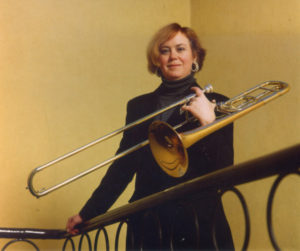
Abbie Conant /
These musings came to mind recently as I read an account of Abbie Conant’s troubles with the Munich Philharmonic Orchestra. Playing behind a screen, she won an audition for principal trombonist when conductor Sergiu Celebidache exclaimed, “that’s the one we want” and sent seventeen other applicants away without hearing them. Only then did he learn that he had selected a woman.
According to Malcolm Gladwell, holding auditions behind a screen, which takes away all visual cues, has resulted in the hiring of many women in orchestras. Any number of orchestras may have been surprised that the best-sounding candidate was a woman or non-white, but most trusted their ears and adjusted.
Celibidache made no attempt to turn away from his hidebound prejudice that a woman could not possibly play principal trombone adequately. Conant took the orchestra to court, and the litigation lasted more than a dozen years. She won every round. Celibidache, having decided to trust his eyes instead of his ears, could no longer hear what any other musician testified, that Conant fully deserved the position that she had won.
Now, when I see “Who says girls can’t play trombone?” in a woman’s signature line, I’m no longer surprised, but it’s sad. Everyone is good at something and no good at something else. No one can determine a person’s aptitudes merely by observing sex or ethnicity. I wish everyone would stop trying.
Meanwhile, check out this clip of an all-woman trombone quartet called Bones Apart playing an arrangement of Stars and Stripes Forever. You’ll be thinking, “Hey, you can’t play that on trombones!” But they do.
References: Music and references to music in Godey’s Lady’s Book : 1830-77 / by Julia Eklund Koza (Ph.D. dissertation: University of Minnesota, 1988).
Blink: the power of thinking without thinking / by Malcolm Gladwell (New York: Back Bay Books, 2005), pp. 245-54.