↓
 

Musicology for Everyone

(Professional research for a general audience)

  • Home
  • About
  • Contact me
Home→Categories Orchestras - Page 4 << 1 2 3 4

Category Archives: Orchestras

Post navigation

Newer posts →

The Unanswered Question, by Charles Ives

Musicology for Everyone Posted on June 14, 2010 by David GuionMay 12, 2022  


question marks. The Unanswered Question by Charles IvesOne thing Charles Ives learned at Yale: he had no chance of earning a living as a professional musician if he wanted to be true to his own ideals.

Not only did his musical idiom confuse his teachers, it also confused his fellow students. He went into the insurance business and composed music as a hobby.

After a long day at the office, he composed during the evening in his Manhattan apartment. He spent quiet weekends at a cabin in Connecticut, meditating, writing, and planning new compositions.

Ives began two new works in 1906, both called Contemplation. In later years, he had forgotten whether he intended them as a single two-movement piece or not.

The full titles reveal both similarities of intention and profound differences in character: A Contemplation of Nothing Serious; Or, Central Park in the Dark in the Good Old Summer Time and A Contemplation of a Serious Matter; Or, The Unanswered Perennial Question.

Apparently, all of his weekend meditations on the meaning of existence had not given him any satisfactory answers. He decided to express the question in what he called a “cosmic landscape.” Continue reading →

Posted in American popular music, Orchestras, Program notes | Tagged American music, Ives (Charles), orchestral music, program notes, twentieth century, Unanswered Question | Leave a reply

Concerto for Orchestra by Béla Bartók

Musicology for Everyone Posted on March 19, 2010 by David GuionMay 14, 2022  
Statue of Bartók in Brussels

Statue of Bartók in Brussels

Béla Bartók’s Concerto for Orchestra occupies a special place in the orchestral repertoire. It’s a wonder he ever composed it.

Bartók and his wife fled their native Hungary and moved to New York in 1940, shortly after he composed his last work in Europe, the Sixth String Quartet. He never felt comfortable in the United States and composed nothing at all for three years.

The money he received from royalties, occasional performances, and a research fellowship at Columbia University hardly provided enough to live on. To make matters worse, he contracted leukemia. The first symptoms appeared in 1940, but he did not receive a definitive diagnosis until 1944. Continue reading →

Posted in Anecdotes, Orchestras, Program notes | Tagged anecdotes, Bartók (Béla), Concerto for Orchestra, conductors, Koussevitsky (Serge), program notes, twentieth century | Leave a reply

Trois gymnopédies by Erik Satie

Musicology for Everyone Posted on February 8, 2010 by David GuionMay 14, 2022 2
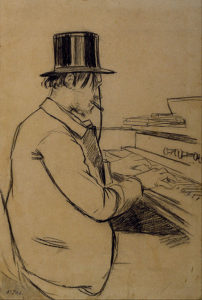
Erik Satie

Portrait of Erik Satie Playing the Harmonium / Santiago Rusiñol (1891)

Erik Satie, an eccentric composer of minor talent but great imagination, exercised enormous influence on twentieth-century musical thought. Above all a musical humorist, he issued his first published composition as op. 62. His longest work, Vexations, consists of just over a minute’s worth of music played 840 times without pause.

The Gymnopédies, composed in 1888 for piano solo, exhibit a different kind of humor, based on Satie’s conscious and deliberate antagonism to verifiable facts.

In ancient Greece, the gymnopedia, or festival of naked youth, was celebrated every year in Sparta to honor Apollo, Pythaeus, Artemis, and Ledo. The days-long festival concluded with gymnastic exhibitions and frenzied dancing offered not to the four deities already named, but to Dionysius.

Satie composed slow, dignified, pieces utterly devoid of passion and chose to give them a title that conjured up images of a boisterous celebration. Having thus deliberately misrepresented the gymnopedia, perhaps he would be astounded to learn that the whole concept of serene classicism just as thoroughly misrepresents ancient Greek esthetics as a whole.

Scholars have since determined that the gleaming whiteness of the marble, which we admire so greatly, does not reflect the original intent of the artists. They did not consider their works complete without application of flamboyant colors, which the passage of centuries has stripped away.

That Satie became so well known and influential can be traced in part to his friendship with Claude Debussy. In 1911 Debussy orchestrated the third and first of the Gymnopédies, in that order. Many critics have complained that the orchestration obscured Satie’s clear outlines. Be that as it may, the pieces gained more in prestige than they lost in clarity. It is in Debussy’s version that they, and Satie himself, first became well known.

Posted in Orchestras, Program notes | Tagged Debussy (Claude), Gymnopédies, orchestral music, piano music, program notes, Satie (Erik) | 2 Replies

Rapsodie espagnole by Maurice Ravel

Musicology for Everyone Posted on February 1, 2010 by David GuionMay 14, 2022  
Orchestra performing Dvorak's eighth symphony

Immaculata Symphony Orchestra / Jim, the Photographer via Flickr 

Ironically, in view of Maurice Ravel’s reputation as a brilliant orchestrator, he conceived only Rapsodie espagnole as a purely orchestral display piece from the beginning, and that only in part. He either wrote his other orchestral works for the stage or transcribed them from piano pieces. In fact, the “Habanera” in Rapsodie espagnole was written originally for two pianos.

Ravel shared the enthusiasm of many French composers for Spanish music. In his case, he absorbed an understanding of both French and Spanish culture as a child. Son of a Swiss father and Basque mother, he grew up in the Basque region. In a review of Rapsodie espagnole, Spanish composer Manuel de Falla wrote:

“It surprises me by its genuinely Spanish character. In absolute agreement with my own intentions this “Hispanization” is not achieved merely by drawing upon popular or “folk” sources (except the Jota in “Feria”), but rather through the free use of modal rhythms and melodies and ornamental figures of our “popular” music, none of which has altered in any way the natural style of the composer.”

The first movement, “Prélude à la nuit” (Prelude to the night), never gets louder than mezzo-forte. Ravel achieved the veiled sound in part by spacing muted violins and violas two octaves apart. Two dance movements follow, “Malagueña” and “Habanera.” In the final movement, “Feria” (The fair), several instruments exchange the solo lines. The opening dancelike material gives way to a quiet middle section before returning to bring the piece to a rousing close.

Posted in Orchestras, Program notes | Tagged orchestral music, program notes, Rapsodie espagnole, Ravel (Maurice), twentieth century | Leave a reply

Post navigation

Newer posts →

Musicology for Everyone

Search by category

  • American popular music
    • Civil War music
    • Jazz
  • Anecdotes
    • Quotations
  • Bands and band music
  • Christmas music
  • Classical music
  • Composers
  • European musical history
  • Humor
  • Music education
  • Music Festival
  • Opera
  • Orchestras
  • Program notes
  • Trombone and other brass
  • Uncategorized

Archives

Music composer jobs
Footer HTML
©2026 - Musicology for Everyone - Weaver Xtreme Theme
↑