Fly Me to the Moon by Bart Howard
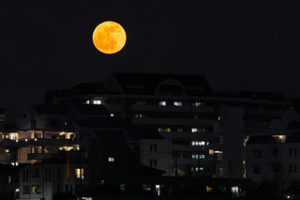
halfrain via Flickr
People nowadays tend to attribute songs to whichever singer made the most famous recording. That’s too bad if they’re ignoring one of the great songwriters. In the case of “Fly Me to the Moon,” people might as well attribute it to Frank Sinatra or some other singer. It’s the only hit song by the almost unknown Bart Howard.
Bart Howard was born in 1915 in Burlington, Iowa. His birth name was Howard Joseph Gustafson. In 1931, at the age of 16, he started his musical career, touring as accompanist for a dance band that featured Siamese twins Daisy and Violet Hilton.
In 1934, he moved to Los Angeles, hoping to write songs for Hollywood. It didn’t work out, but he kept busy playing piano. As accompanist for comedienne Elizabeth Talbot-Martin, he performed at Rockefeller Center’s Rainbow Room in New York in 1937. New York became home professionally for the rest of his life.
Shortly after moving to New York, he met the singer Mabel Mercer. She had a long engagement at Tony’s on 52nd Street, with Howard as her accompanist, and became famous. She introduced “If You Leave Paris,” the first of Howard’s songs ever performed publicly. For many years afterwards, she sang and promoted his songs.
Howard worked as master of ceremonies at the Blue Angel nightclub. He composed numerous songs for the various performers, including Mercer, Johnny Mathis, and Eartha Kitt. He usually wrote both the words and music, like his idol Cole Porter.
Composing “Fly Me to the Moon”
Howard’s cabaret songs enjoyed enough success that he kept writing them, but none became widespread hits. They are so specific to their time that it seems unlikely any other time would have much interest in exploring them.
His publisher had been asking for something more commercial than his usual fare. One day in 1953 he sat down to write a new song with all the conventional imagery of love songs and had it finished in about 20 minutes. He called in “In Other Words,” but the first line of the chorus was “Fly Me to the Moon.”
The publisher loved everything about the song except that first word of the chorus. “Fly” is not a verb that takes a direct object. It’s not grammatical. He suggested “take me to the moon” instead. Howard insisted on leaving the line as he had written it.
Howard’s waltz version
Howard composed the chorus of “In Other Words” as a slow waltz, that is, in triple meter, three beats to a measure. Felicia Sanders introduced “In Other Words” at a cabaret in 1954. Her famous recording came only later. Kaye Ballard made the first recording, and the song became immediately successful.
It really started to take off when Peggy Lee sang it on the Ed Sullivan Show in 1960. She also realized that the chorus makes little sense without the verse. And the verse, by the way, has four beats to a measure.
Before I found Lee’s recording on YouTube, I found Nat King Cole’s lovely rendering. He sings both the verse and chorus in quadruple meter:
Singers’ swing versions
Soon enough, singers began to record it in a faster tempo, four beats to a measure, and a pronounced swing style. Music critic Will Friedwald commented that the slow and fast versions are like different songs. It’s as if, in 20 minutes work, Howard wrote his one and only hit, and it became two standards.
Lee’s music director Joe Harnell was involved in a serious traffic accident in 1962. As he recovered, he arranged “In Other Words” and other popular songs as bossa nova instrumentals. That version made it to number 14 on Billboard’s Hot 100.
Eventually, the song earned Howard so much money that he retired on it and stopped writing new songs.
The hidden significance of “Fly Me to the Moon”
NPR acknowledged Howard when he died in 2004. Michelle Norris introduced the segment as a tribute “to the man who wanted to see what spring is like on Jupiter and Mars.” That’s not at all what the song is about, but it takes the verse, which hardly anyone ever sings and even fewer people remember, to make sense of that line.
Poets often use many words
To say a simple thing
It takes thought and time and rhyme
To make a poem sing
With music and words
I’ve been playing
For you I have written a song
To be sure that you know what I’m saying
I’ll translate as I go along…
Fly me to the Moon
And let me play among the stars
Let me see what spring is like
On Jupiter and Mars
In other words hold my hand
In other words… Darling, kiss me
Fill my heart with song
And let me sing for evermore
You are all I long
For all I worship and adore
In other words please be true
In other words… I love you
In other words, if the beloved kisses and holds the hand of the singer, that’s what spring is like on Jupiter and Mars. Tin Pan Alley songwriters always tried to find novel ways to say, “I love you,” and Howard used the wonder of the night sky as something to translate
Bart Howard’s song flies to the moon
In 1963, with the space race dominating public imagination, Peggy Lee persuaded Howard to change the name of the song to “Fly Me to the Moon.” With that title, the ten-year-old song seemed entirely up to date and its popularity, shall we say, sky rocketed.
Howard later commented, “I didn’t know what I’d written.”
The first moon landing took place on July 21, 1969. Neil Armstrong and Buzz Aldrin took along a cassette tape of four popular songs to play there. The first human music played on the moon was the Frank Sinatra/Count Basie recording of “Fly Me to the Moon,” Aldrin’s favorite.
When the crew returned to Earth, Sinatra served as master of ceremonies at NASA’s welcome-home barbecue. And, of course, he sang “Fly Me to the Moon.” His swing version has a swagger completely at odds with Howard’s slow waltz.
Aldrin found his success and fame too much to bear. He became a depressed alcoholic. It especially bothered him the way the band struck up “Fly Me to the Moon” whenever he entered any venue with live music. He came to hate the song, say that he had never liked it, and even deny that he had played it on the moon.
So play all four of these videos. Then come back and play them again—just not often enough to get sick of the song!
Sources:
Bart Howard, 88; pianist, cabaret composer wrote ‘Fly Me to the Moon’ / Myrna Oliver, Los Angeles Times. February 24, 2004
Fly Me to the Moon: Steyn’s Song of the Week #136 / Mark Steyn, Steyn Online. July 21, 2019
Just discovered this site from the article “Schoenberg vs Stravinsky”, it’s amazing that the posts are still updating:)))
Yes, I add new content regularly and update older posts. Thanks for exploring, and keep coming back!