Leo Arnaud: jazz trombonist, composer, and arranger for Hollywood

Leo Arnaud
Noël Léon Marius Arnaud, also known as Leo Vauchant, was born near Lyons, France, in 1904. His parents soon divorced and nothing much is known of his mother. His father, Noël Léon Arnaud, was a trombonist, among other musical accomplishments. Another family member also had the name Noël, so they always called the boy Léon.
The elder Noël deserted the French military. To avoid arrest, he changed his name to Jean Vauchant. Léon became Leo Vauchant, and it is by that name that he first became well known. In fact, he called himself Leo Arnaud only when he moved to the US in 1931.
In an interview for an article in Jazz Hot in 1968, he said he had lost his father early and been adopted by someone named Vauchant. And why did he do that? He apparently knew the article would be published in France as well. He was still protecting his father’s reputation.
Arnaud’s musical education
Arnaud began his education at age 4. His father and grandmother, a concert pianist, were his first music teachers. His first instrument was the bugle. Then he learned cornet, trombone, horn, saxophone, cello, bass, and various percussion instruments. His father also taught him to compose without relying on a piano.
At 8 years of age, he began his musical career playing drums in his father’s band. He composed his first piece when he was 10.
At 11, Arnaud enrolled at the conservatory in Lyon and graduated in 1917 with a first prize in solfege and theory. He won seven other first prizes, including one in trombone in 1918. In 1922, he moved to Berlin to study conducting with Felix Weingartner. Returning to France, he studied composition with Vincent d’Indy. His formal education culminated in a doctorate in 1950.
By the time he was 15, his home life became unbearable. His father had remarried. Arnaud claimed the two of them gambled away all the money his father made. So he had to feed himself from his own earnings. He finally left home, never to return, when he was 16.
Arnaud’s original career goal
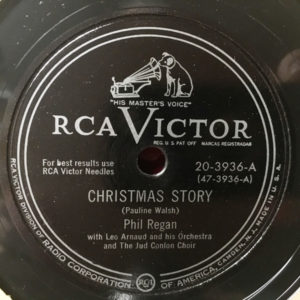
CHRISTMAS STORY / (Pauline Walsh) / Phil Regan / with Leo Arnaud and his Orchestra / and The Jud Conlon Choir
Arnaud intended to conduct opera and ballet, but at the same time he studied with d’Indy, he earned money playing trombone in Parisian night clubs. Much of his repertoire was American dance music.
Several notable French composers spent time at the same clubs. One, Maurice Ravel, took special interest in Arnaud’s trombone playing. Not only could he improvise jazz he could play higher notes than any other trombonist—up to G above high C. For four years, Arnaud visited Ravel’s home every Friday, and they learned a lot from each other.
In April 1928, Ravel showed Arnaud sketches for Bolero. The same tune occurs over and over, played by a different instrument each time. Here’s what Arnaud wrote about that collaboration:
In April of 1928, we resumed our weekly meetings. Ravel was then working on his Bolero, commissioned by Madame Ida Rubinstein. He first wrote the sketch in D Major but at my request changed it to C Major. As it is, there are eleven top 0-flats (9 consecutive) in the trombone solo. In D Major, that amount of E-flats would have been scabrous. I played the solo at the Premier of the ballet, but not that of the orchestral presentation, at the Opera Comique in Paris in November 1928 as I had joined the Jack Hylton’s orchestra in London. The trombonist who replaced me, having been told to play in a jazz style, pencil marked a few glissandos here and there and played it straight otherwise. Ravel being a kind man didn’t say anything at the time; he didn’t think the Bolero would amount to anything. The printed parts were made and include the glissandos in the trombone solo. For the past 47 years, I have told many young trombonists that they were not intended by the composer. Recently, I heard a recording in which the glissandos had been eliminated. Amen!
Arnaud learns jazz
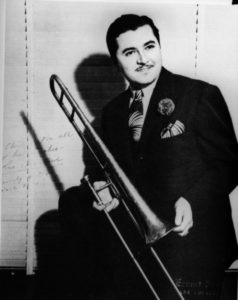
Arnaud when he was known as Leo Vauchant
At the same time he studied with many well-known and respected classical music teachers, Arnaud picked up jazz on his own. He learned it simply by paying careful attention to the mostly black American musicians he played with. His knowledge of harmony and counterpoint helped him.
In 1918, he played drums at the Marigny Theatre. The Jazz Kings, led by drummer Louis Mitchell, had a long engagement there. Arnaud began to sit in on drums and imitated everything Mitchell did. He also paid very careful attention to the trumpet player’s changing pattern of syncopations. Above all, he noticed that although the band played the same songs every night, they never sounded the same.
Frank Withers, the Jazz King’s trombonist became an especially important influence. Withers’ wife also played trombone. He made some arrangements for three trombones for them to play together for fun. Arnaud was the only white person accepted at a black nightclub where Withers performed. Again, Arnaud imitated everything Withers did, but his own technique was better.
From then until he moved to the US, Arnaud listened to numerous other jazz groups that visited Paris. He performed with some of them. He also listened to recordings by many leading jazz ensembles, both black and white. Whether listening to music, performing with jazz groups, or just talking and trading ideas with other jazz musicians, Arnaud used all this experience to develop his own performing style.
All the while, he continued to play “straight” music as well. After all, his initial career goal was to conduct opera and ballet.
Here are five trombone solos he recorded between 1928-1931:
Leo Vauchant, French jazz master
But in about 1922, in his words, “the lure of money, jazz, and America was too great to resist.” Arnaud, known as Leo Vauchant, had played mostly cello and percussion instruments up till that time but changed his emphasis to trombone and jazz. He especially loved playing high notes. He developed new technical possibilities for the trombone and started teaching other trombonists. Beyond his abilities as trombonist, he was one of the few French musicians who knew how to improvise.
While not neglecting the cello and other instruments entirely, Arnaud played trombone in many different clubs and ensembles. In 1924, when he was playing cello in a tango band, an American Dixieland group, the Chicago Hot Spots arrived in Paris. It played alternate sets with Arnaud’s tango band. When the band’s trombonist got homesick and returned to the US, the band’s leader asked Arnaud to recommend a replacement. He recommended himself.
During the mid 1920s, Arnaud was an especially well-known trombonist. He became acquainted with other important musicians who patronized the clubs where he played. Besides Ravel, these included Darius Milhaud and Cole Porter. He also played the trombone part for a performance of Igor Stravinsky’s L’histoire du soldat, conducted by Stravinsky himself. He also made recordings with musicians such as Benny Goodman, Gene Krupa, Joe Venuti, and Fred Waring.
At about the same time, he started to teach theory and harmony and conduct the orchestra at the Ormesson Academy of Music. He also became an active arranger and conductor of other ensembles.
The lure of America
By 1927, Arnaud’s reputation had reached the United States. The Boston Symphony Orchestra offered him a position as cellist and percussionist. He might have accepted it, except the United States required a three-year waiting period for the necessary visa.
Once he obtained it in 1931, he played trumpet for a while with Arlene and Norman Selby’s American tour. He also arranged music for them and danced. At that time, he left the name Vauchant behind him and became known as Leo Arnaud.
Soon afterward, however, he left the Selbys to join Fred Waring and the Pennsylvanians as chief arranger and composer.
Serge Koussevitsky offered Arnaud the position of principal trombonist with the Boston Symphony Orchestra at a salary of $80 per week. He was already making $275 a week with Waring, so he turned down the offer.
Arnaud’s career in Hollywood
 In 1934, Arnaud met and married a Broadway actress named Blanche Bow. She had connections in Hollywood that eventually enabled him to leave Waring’s touring group and settle in Los Angeles as arranger for Metro-Goldwyn-Mayer.
Although he occasionally worked for other studios, he continued to work primarily for MGM until his retirement, with an interruption for service in the US Navy during the Second World War. He also found time to conduct several orchestras and compose a symphony.
Jimmy and Tommy Dorsey commissioned Arnaud to compose a double concerto for trombone, alto saxophone, jazz band, and symphony orchestra. He had begun to sketch the work when both Dorseys died in 1956.
During his time in Los Angeles, Arnaud worked as arranger, composer, or performer for uncounted motion pictures. Michael Kolstad’s doctoral dissertation on Arnaud lists 146. Other sources claim he worked on up to 300.
He was nominated for the 1964 Academy Award for scoring The Unsinkable Molly Brown, but Dr. Zhivago is probably the best known of his films. Arnaud claimed to have suggested a change of the third note in Lara’s theme, which gives it its magical quality.
But Arnaud’s best-known work by far was not movie music. In 1958, Felix Slatkin decided to issue a record album of military music, Charge! He commissioned Arnaud to compose a piece for it. Arnaud provided a brass suite that included a fanfare he called “Bugler’s Dream.” In 1968, ABC News obtained permission to use it for its broadcast of the Winter Olympics. It has been heard on every American Olympics broadcast since then, even after NBC acquired the rights to broadcast the games.
Here is the entire suite from Charge!. Only the familiar opening section is actually named “Bugler’s Holiday”
Retirement in North Carolina
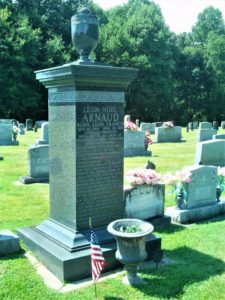
Leo Arnaud’s grave stone in Hamptonville, North Carolina / Elkin Tribune
By the time Arnaud retired in 1981, Blanche had died and he had married Fay Brooks. The couple moved to Hamptonville, North Carolina to be closer to her family. He became active with several notable North Carolina musical institutions, including the Salem Band and Salem Trombone Ensemble in Winston-Salem, descendants of Moravian groups founded in the 1770s.
In 1985, he spoke at the International Trombone Workshop in Nashville. I attended that workshop. Arnaud made the strongest and longest lasting impression on me of the entire event. As I recall, he sat on the edge of the stage with his trombone beside him. At 81, he was energetic and humorous. He described a fascinating career. When he picked up his trombone to play it, he was obviously no longer in shape, but it helped him illustrate his points.
In the official description, Bob Lindsay noted,
The tales he told us flowed effortlessly in and out of technical observations on altered chords and an eight-tone scale that Ravel taught (and Carl Fontana plays) and the use of trombone positions to establish the physics of half-tones. He was surely enormous fun for them to be with, as he was with us. In sum, his reminiscences were a fine demonstration of musical learning that seems never to have flagged, nor, even now at more than 80, to have let up in the slightest—and all rolled in with wit and shrewdness and delight in the secular present, connected seamlessly with a lively recall of the distant past.
Sources:
The Fourteenth International Trombone Workshop—Nashville ’85: Leo Arnaud / Bob Lindsay, International Trombone Association Journal, October 1985
Leo Arnaud (1904-1991), trombonist, composer, film musician: a biographical sketch and catalogue of musical works and films / Michael L. Kolstad (DMA dissertation: University of North Carolina at Greensboro, 1996)
‘Who knew?’ Leo Arnaud, French-born composer of Olympics theme music used on TV, is buried in Yadkin County / Scott Sexton, Winston Salem Journal. August 16, 2021
I knew this wonderful man when I was a teenage aspiring musician in Los Angeles. He was a brilliant, and a delight!
Hi Mr. Bernstein, I would love to know more about your relationship with Sir Leo.
I was also in attendance for Arnaud’s talk a the ITA workshop — I still remember one of the off-color jokes he told! (Not suitable for repeating here…)