Blue Moon, by Rodgers and Hart
 Plenty of popular songs have interesting stories behind them. The story of “Blue Moon” by Rodgers and Hart goes beyond interesting, It is downright strange. For one thing, the words are not the first lyrics Hart provided for the tune. Or even the second. For another, there is even some controversy over who actually wrote “Blue Moon.”
The team of Rodgers and Hart had so little success at first that Rogers considered quitting music entirely. But in 1926, two songs for a revue called The Garrick Gaieties became hits. The two dominated Broadway until Hart’s death in 1943. They provide a lot of film music, too.
Not all of their hit songs became immediate hits. “My Funny Valentine” first appeared in the 1937 Broadway musical Babes in Arms. That show had so many hit songs that no one took notice of “My Funny Valentine” for more than a decade. But at least it had only one set of words.
One tune, two movies, three lyrics
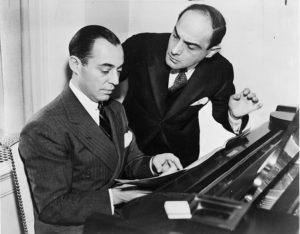
Richard Rogers (seated) and Lorenz Hart. New York World-Telegram, 1936. Public domain from Wikimedia Commons
MGM planned a movie to be called Hollywood Party in 1933 and hired Rodgers and Hart to provide songs. They wrote one called “Prayer (Oh Lord, Make Me a Movie Star)” for Jean Harlow to sing. MGM registered it for copyright as MGM Song #225 and then abandoned the project.
The following year, MGM hired Rodgers and Hart to provide songs for Manhattan Melodrama., Rodgers decided to reuse the tune from “Prayer.”
Since Hart wrote his lyrics only after Rodgers provided a tune, it was a simple matter to provide new ones. He called the new song “It’s Just That Kind of Play.” The lyric started, “Act One: you gulp your coffee and run.”
The studio cut it, but then decided to add a nightclub scene. Hart wrote lyrics again for the same tune. The third time was a charm for Hart. Shirley Ross sang “The Bad in Every Man.” It started
Oh, Lord, what is the matter with me
I’m just permitted to see
The bad in every man.
MGM made Manhattan Melodrama quickly on a low budget. It starred Clark Gable, William Powell, and Myrna Loy, but the studio had low expectations for it. To everyone’s surprise, the movie became a hit.
When Manhattan Melodrama played at the Biograph Theater in Chicago, gangster John Dillinger was in the audience. As he left the theater, FBI agents gunned him down. The movie gained great notoriety after that, but no one paid much attention to “The Bad in Every Man.”
Blue Moon—finally
Jack Robbins, the head of MGM’s publishing company, thought “The Bad in Every Man” could make a hit on its own, but he didn’t like the lyrics. He thought it could be a hit with simpler, more down-to-earth words.
Offended, Hart asked, “You mean some junk about “moon” and “June?” Basically, yes. But Robbins promised to promote the song heavily.
I have no idea if Hart even thought of the expression, “once in a blue moon.” All his other lyrics for the tune had a melancholy mood, though. So in any case, the expression “blue moon” fit both the character of the tune and Robbins’ request.
Robbins licensed the new version to Hollywood Hotel, a radio program that used the song as its theme song. After that, MGM featured “Blue Moon” in at least seven more movies.
For all that activity, “Blue Moon” didn’t hit the charts until Billy Eckstine’s recording of 1949. Mel Tormé’s recording hit the charts the same year. After that, it became a staple for singers and big bands. Frank Sinatra, Ella Fitzgerald, and Elvis Presley all covered it with notable success.
In 1961, The Marcels, known for turning pop standards to rock and roll, chose “Blue Moon” for their first recording. It turned the song on its ear by ignoring the somber sentiment of the words. The bass singer started rapidly singing, “bom dida bom di bom di bom bom,” and so on before the rest of the group ever got to the song. This slick, up-tempo version sold more than a million copies.
The following year, Art Blakey issued a bebop instrumental version. I normally think of bebop as insanely fast, but Blakey’s version retains the character of a mournful ballad.
From ballad to doo-wop to bop, only a great hit could inspire such a sheer variety of interpretations. People will love “Blue Moon” as long as they still like songs with real tunes and clever lyrics.
Who wrote Blue Moon, anyway?
The well-accepted story of “Blue Moon” was challenged in the 1990s by Liz Roman Gallese. She claimed it was really written by her father, Edward Roman. According to letters she produced, Roman wrote the song in 1930 or 1931 and sold it for $900 to buy a car. Or in another version of the story, he sued Rodgers and Hart in 1937 and got a $1,200 settlement.
She also recalled that when she was a young child, she told her father she had heard he wrote “Blue Moon.” He said he wrote it after a night of ice skating. “The moon reflected blue on the ice,” he had told her. Her documents include an unsigned contract and a 1936 newspaper article about a lawsuit Roman filed.
This isn’t the first time I have read about someone claiming to have written a song attributed to someone famous—or claiming that a relative did.
The New York Times published a story about it that includes pictures of some of the documents. It didn’t endorse Ms Gallese’s version but didn’t dismiss it, either. No part of it explains away the well-documented sequence of four sets of lyrics.
It appears that Rodgers’ and Hart’s reputations are safe from Edward Roman.
Sources:
America’s songs: the stories behind the songs of Broadway, Hollywood, and Tin Pan Alley / Philip Furia and Michael Lasser (Print: Routledge, 2006)
Blue Moon: Richard Rodgers & Lorenz Hart (Manhattan Melodrama); The Marcels; Rod Stewart / Tim Londergan, Tim’s Cover Story. March 12, 2018
The blue moon’s rich history in American music / Justin Joffe, Observer. July 31, 2015
Elvis and Ella Fitzgerald sang it. She says her father wrote it / James Barron, New York Times. September 16, 2018
Photo credits:
Full moon (a blue moon if it’s the second one in a month!) Some rights reserved by halfrain.
Rodgers and Hart. Wikimedia Commons
From the documentation found upon Edward W. Roman’s death in 1992, it is clear that he wrote the iconic song, “Blue Moon.” This documentation is available in its entirety on the website http://www.bluemoonsong.org. The “unsigned” contract is actually accompanied by a letter from New York song broker Jack Mahoney to the then Troy, NY, teenager that is signed, dated, and on official letterhead. It is also reasonable to “explain away” the four sets of lyrics given that the first three were written for MGM productions while Rodgers/Hart were contracted by MGM. The fourth set (for the song as we know it today), on the other hand, was a favor owed MGM music publisher Jack Robbins months after they’d had left MGM for Paramount. It’s entirely plausible that these were the lyrics written by Roman and brokered by Mahoney.